Budgeting in Pre-Production: How to Build a Film Budget


By Muhammad Wisal and Muhammad Ali / 5 min read
To build a film budget in pre-production, break down the script, make a schedule, then price every line from real quotes, grouped into above-the-line and below-the-line costs, with 10 to 15 percent held as contingency. The schedule comes before the numbers because shoot days drive most of the cost. Once the budget is locked, you track actual spending against each estimate until wrap.
Who owns the film budget?
On a small project the producer, or the director acting as producer, owns the budget. On larger indies the work is split:
- Line producer or UPM: builds the budget, gets bids, and protects the contingency.
- Production accountant: logs actuals, invoices, petty cash and payroll.
- Department heads: supply quotes and manage their own lines.
- 1st AD: makes the schedule, which sets how many days you pay for.
If you have none of these, name one person as budget owner and a second person to log actuals. Two people catch drift that one person misses.
What is above the line and below the line?
Above the line (ATL) covers the creative people hired before production: rights and story, writer, producers, director and principal cast. Below the line (BTL) covers everything that makes the shoot happen: crew, equipment, locations, art, wardrobe, transport, catering, insurance and post-production.
Other terms you will see:
- Top sheet: a one-page summary of totals by category, used by producers and investors.
- Fringes: payroll costs added on top of rates, such as taxes and benefits.
- Contingency: a buffer for surprises, commonly 5 to 15 percent.
- Estimate vs actual: what you planned to spend compared with what you paid.
How do you build a film budget step by step?
- Set the scope. Page count, number of shoot days, locations, night work, stunts, minors, animals and travel.
- Break down the script. List cast, extras, props, wardrobe, vehicles, effects and locations per scene. These become budget lines.
- Schedule it. A stripboard or one-line schedule tells you how many days each actor, crew member, location and gear package is needed.
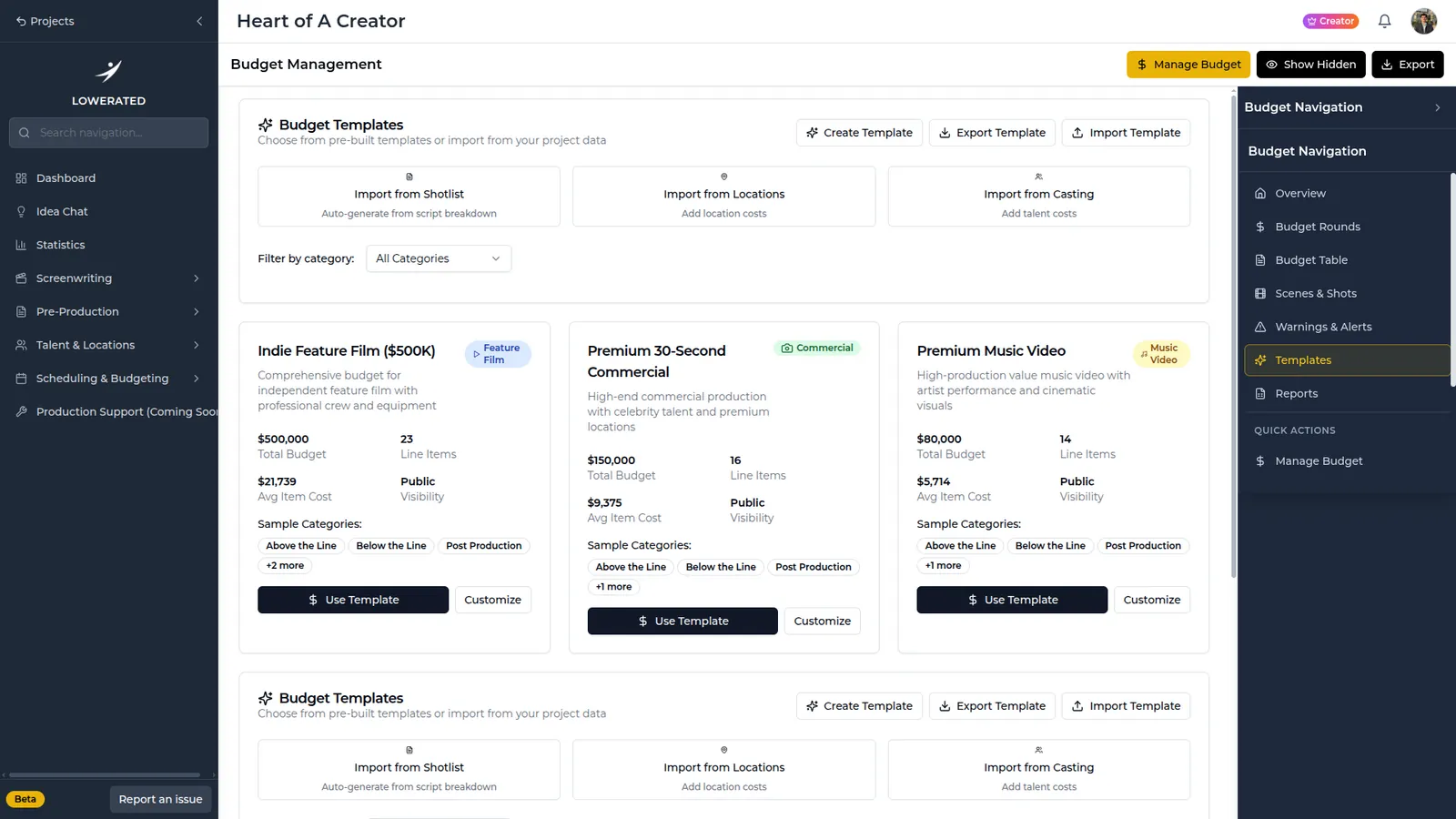
- Start from a template. Pick one that matches the project type (short, feature, commercial, music video) so you do not forget whole categories.
- Price every line. Use day rates times days. Get written quotes for gear, locations and insurance.
- Add the lines people forget (see the list below).
- Set contingency and write one sentence on when it can be spent and who approves it.
- Summarize on a top sheet and review it with whoever is funding the film.
What does a short film top sheet look like?
Here is an example top sheet for a two-day short with a 10,000 total. The figures are illustrative; your rates will differ by city and crew.
| Category | Estimate | Notes |
|---|---|---|
| Above the line: cast | 2,600 | Lead at 1,000 a day for 2 days, plus supporting roles |
| Crew | 1,800 | Sound mixer at 600 a day for 2 days, plus stipends |
| Camera, lighting, sound gear | 1,600 | Camera package at 800 a day for 2 days |
| Locations and permits | 1,250 | Coffee shop at 500 a day for 2 days, 250 permit |
| Catering and transport | 600 | Two shoot days |
| Insurance | 450 | Production liability and equipment |
| Post-production | 700 | Music license, mix, color |
| Contingency (10%) | 1,000 | Approved by producer only |
| Total | 10,000 |
If the coffee shop then asks for a site rep at 200 a day, you either spend contingency or trim another line, such as wardrobe, and note why.
Which costs do filmmakers forget?
The costs most often missed are the ones that are not in the script. Check for:
- Permits, site reps, security and police or traffic control
- Power: a generator, fuel and distro, or a tie-in electrician
- Restrooms, parking and crew shuttles at remote locations
- Cleaning fees and resets for delicate locations
- Fringes and payroll costs
- Hard drives, backups and data wrangling
- Rehearsals, table reads and ADR
- Music licensing, captions, deliverables and festival entry fees
Also budget for time risks. Overtime, company moves, weather on exteriors and resets for blood, food or breakaways all cost money. Night exteriors, stunts, vehicles and children usually justify a contingency toward 15 percent.
How do you track estimates vs actuals?
Log each invoice against the line it belongs to as soon as it arrives, and review the variance (the difference between estimate and actual) at the end of every prep and shoot day. Attach the quote or receipt to the line, and require approval for any change that moves the total.
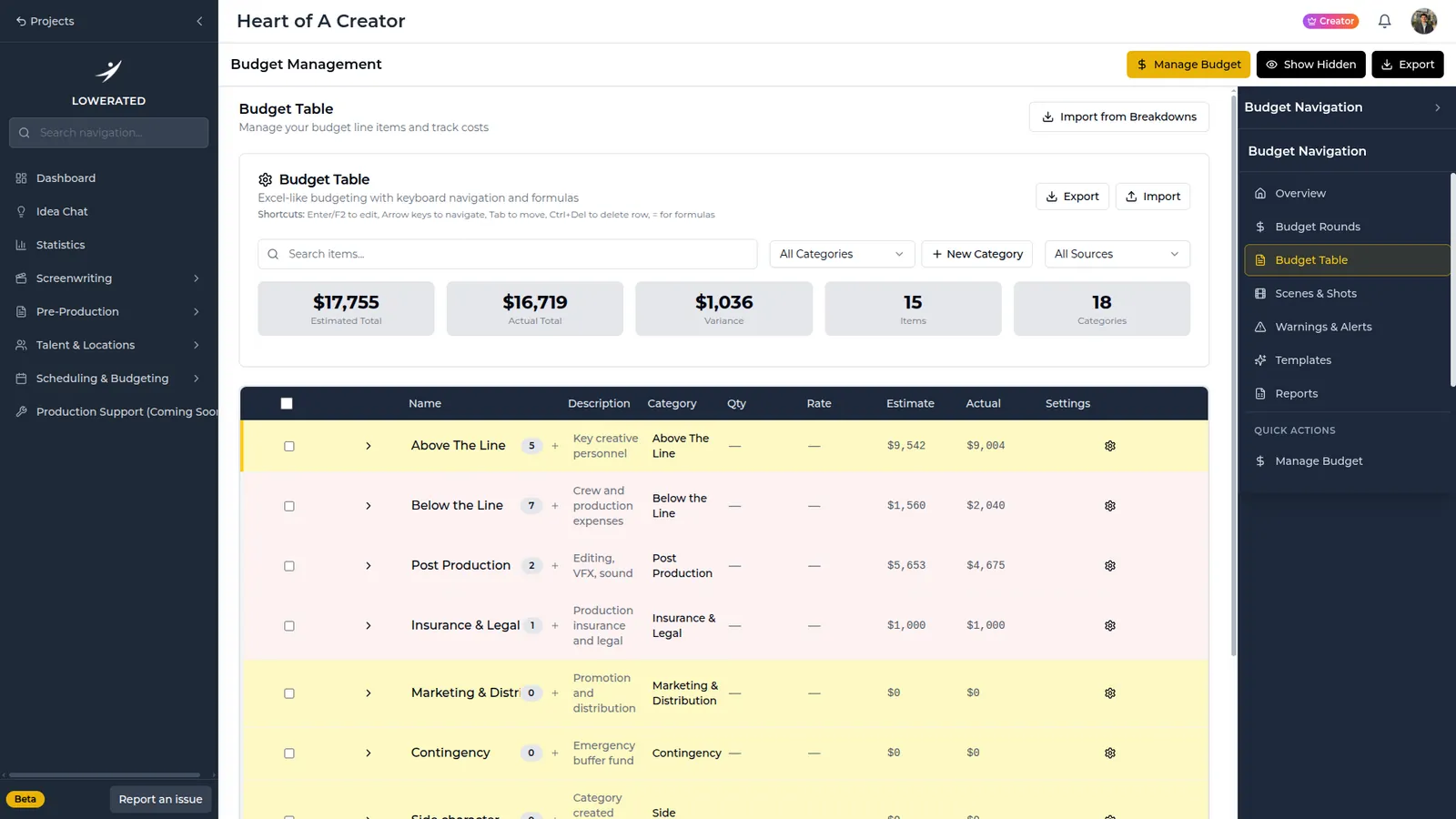
When money moves between lines, write a one-line note saying why. At wrap, those notes become your variance report, and the final budget becomes a reference for your next project.
Why should the budget sit next to the schedule?
Because every schedule change is a budget change. Adding a shoot day, moving a night scene or extending an actor's hold all change what you pay. Keeping the two side by side lets you see the cost of a scheduling decision before you make it.
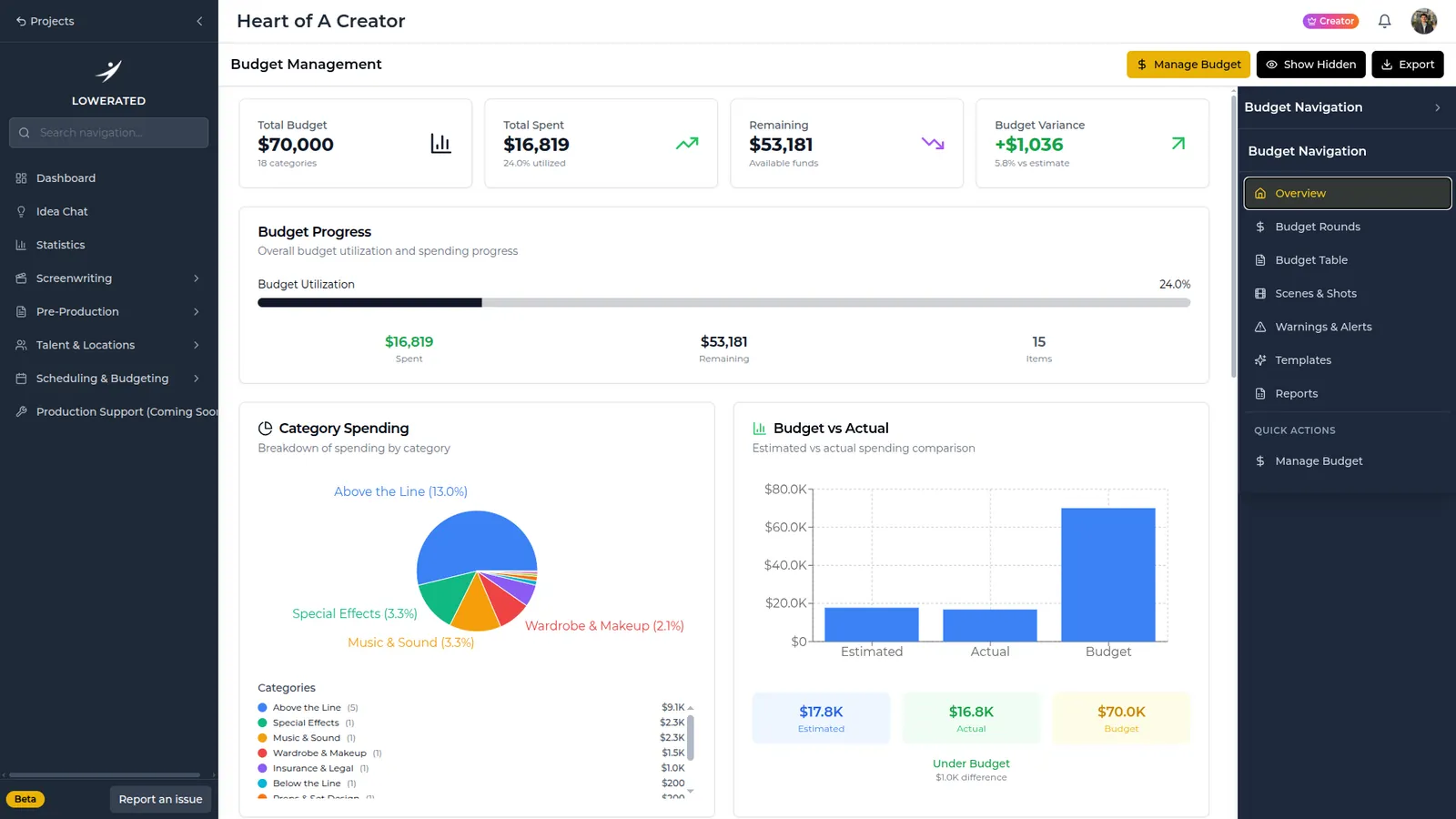
In Lowerated, budgets with line items, estimates and actuals live in the same project as the breakdown, stripboard and day out of days, so you work from one set of numbers.
The clip shows a production budget open alongside the shooting schedule in Lowerated.
Can AI make a film budget?
AI can help with the mechanical parts: drafting line items from a script breakdown, reminding you of categories you left out, and doing the arithmetic. It cannot know your local day rates, what a location owner will charge, or what your insurer will quote. Treat any AI-drafted budget as a checklist and replace every figure with a real quote before you rely on it.
FAQ
How much contingency should a film budget have?
A common range is 5 to 15 percent of the total. Simple interior shoots can sit near the low end; productions with nights, stunts, vehicles or weather risk should go higher.
Should I make the budget or the schedule first?
Draft the schedule first. The number of shoot days sets most cast, crew, gear and location costs, so a budget without a schedule is a guess.
What goes on a budget top sheet?
A top sheet lists the total for each major category (above the line, below the line, post, other costs and contingency) on one page, with the grand total at the bottom.
Is post-production part of the pre-production budget?
Yes. Post is planned and budgeted in pre-production, even though the money is spent later. Leaving it out is one of the most common reasons indie films stall after the shoot.
Key takeaways
- Break down the script and schedule it before you price anything.
- Split costs into above the line and below the line, and summarize them on a top sheet.
- Hold 5 to 15 percent contingency with a written rule for using it.
- Log actuals against estimates daily and note every change.
- Keep the budget next to the schedule so you see the cost of each decision. See our pre-production checklist and the planning tools directors use for the rest of prep.