Character Relationship Maps for Screenwriters


By Muhammad Wisal and Muhammad Ali / 6 min read
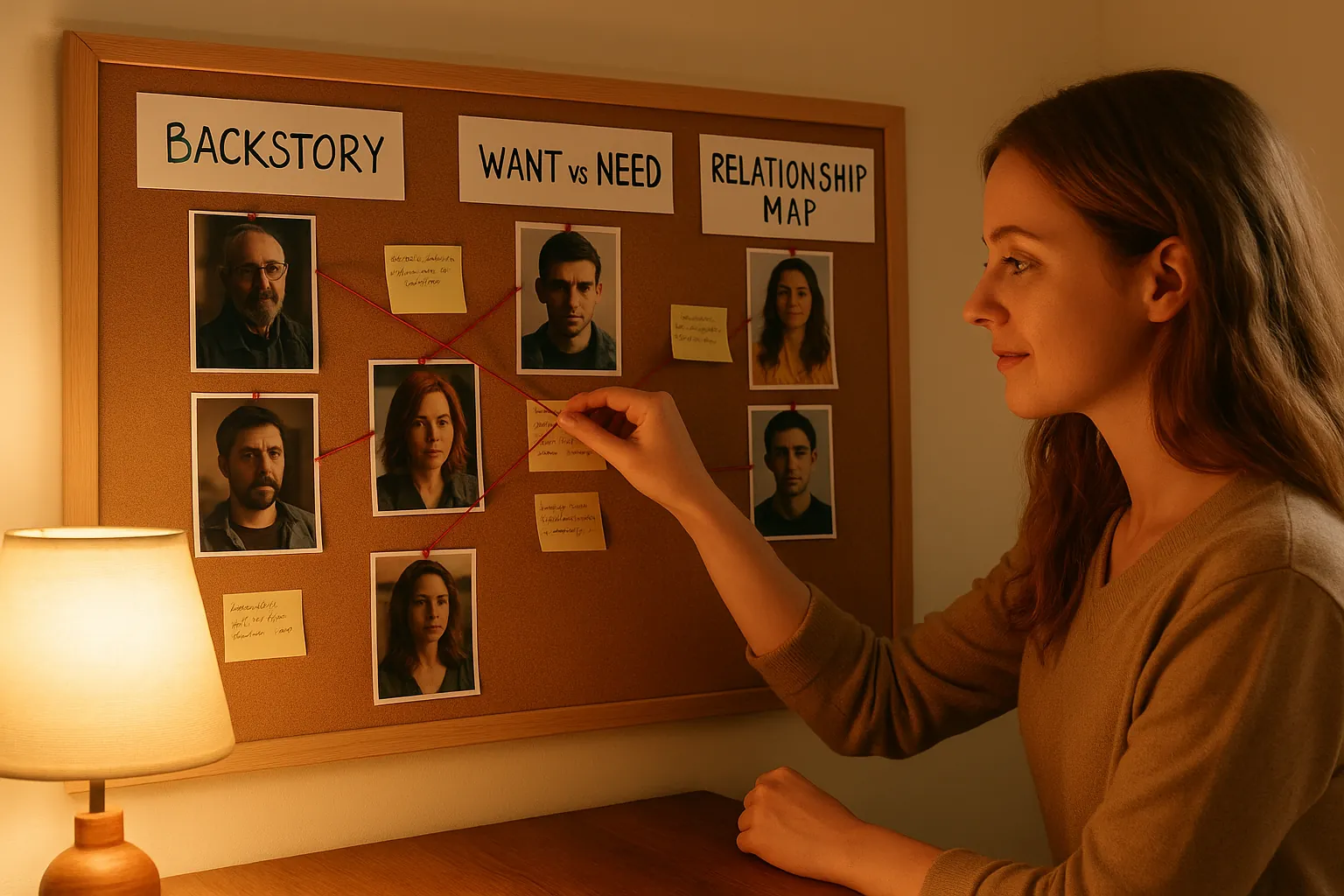
A character relationship map is a diagram of the people in your story and the connections between them, where each line says what one character wants from the other and where the tension sits. Screenwriters use it to spot missing conflict, characters who never meet, and relationships that do not change. Build it from your character list, label every line, then check it against your scenes.
What is a character relationship map?
A character relationship map shows your cast as points and their relationships as lines. A family tree shows who is related to whom. A relationship map for a screenplay goes further: each line carries a label for the relationship (sister, rival, ex, boss), what each side wants from the other, and how that changes by the end.
It is most useful in ensemble stories, family dramas, thrillers with shifting loyalties and TV series, where a reader can lose track of who owes what to whom. For a two-hander it can be as small as one line with good notes on it.
What should each connection on the map show?
Each line on the map should answer four questions. If you cannot answer them, the relationship is probably not doing any work in the story yet.
| On the line | Question | Example |
|---|---|---|
| Label | What are they to each other? | Mother and son, business partners |
| Want, both directions | What does A want from B, and B from A? | She wants his support for the sale. He wants her to admit she favors his brother. |
| Tension | Where do those wants collide? | Her plan needs him; his price is an apology she will not give. |
| Change | Is the relationship different at the end? | Starts as cold politeness, ends with a real argument and a truce. |
Many writers color or style the lines: a solid line for allies, a dashed line for hidden connections, a red line for open conflict. Pick a simple key and keep it.
What are the common types of relationship map?
There are three layouts most writers use, and the right one depends on the story's structure.
- Hub and spoke. The protagonist sits in the middle and every other character connects to them. Good for single-protagonist films. Its weakness is that it hides relationships between supporting characters.
- Web. Every character can connect to every other. Good for ensembles and family dramas, and the best way to see which pairs never interact.
- Factions. Characters grouped into sides (the crew, the police, the family) with lines inside and between groups. Good for heist films, political stories and anything with shifting loyalties.
What does a character relationship map look like in practice?
Here is a map for a family drama called "The Orchard Sale", written as a table so you can copy the structure. Greta, 68, wants to sell the family apple orchard to a developer. Her two sons disagree about it.
| Pair | Label | Wants | Tension | By the end |
|---|---|---|---|---|
| Greta and Bennett | Mother and elder son | Greta wants him to back the sale. Bennett wants to run the orchard himself. | She doesn't trust him with it. | She hands him the keys for one season. |
| Greta and Cal | Mother and younger son | Greta wants him home more. Cal wants his share of the money. | He supports the sale for the wrong reasons. | He admits he is in debt. |
| Bennett and Cal | Brothers | Each wants the other to give in. | An old fight about who stayed and who left. | They work one harvest day together. |
| Cal and Ruth | Partners | Ruth wants honesty about the debt. Cal wants her to wait. | She finds the letters. | She leaves, then returns for the vote. |
| Greta and Voss | Seller and developer | Voss wants a signature by Friday. Greta wants a promise to keep the old trees. | He will not put it in writing. | She refuses to sign. |
| Bennett and Teodoro | Co-workers, 20 years | Teodoro wants job security. Bennett wants an ally. | Teodoro has been offered work by Voss. | Teodoro stays, on his own terms. |
Drawn as a web, this map shows a problem straight away: Ruth and Greta have no line at all. Either that is deliberate (Ruth is an outsider to the family) or there is a missing scene where the two women meet and something passes between them.
How do you make a character relationship map step by step?
- List every character who matters. Leads, supporting roles and any minor character who changes the plot. Skip characters with no effect on a decision.
- Place the protagonist first. Put them in the middle, or in their faction, then add the others around them.
- Draw a line for every relationship that appears in the story. Include relationships that exist offscreen if they affect behavior, such as a dead parent or an absent ex.
- Label each line. Relationship type, what each wants, and where the tension is. Short phrases are enough.
- Mark the change. Note whether each relationship is the same at the end. Unchanged lines are fine for minor pairs and a warning sign for major ones.
- Check it against the scenes. For each important line, list the scenes where those two characters share the screen. A key relationship with only one shared scene is underwritten.
- Update after each draft. Rewrites move people around, and the map should match the current version.
The map works best alongside a character profile for each lead: the profile holds what a character wants overall, and the map shows what they want from each person.
What problems can a relationship map reveal?
- Isolated characters. Someone with only one line to the protagonist may be a plot device. Give them a stake in another relationship or cut them.
- Duplicate roles. Two characters with the same label and the same want (two loyal best friends, for example) can often be merged.
- Conflict only with the antagonist. If every tense line runs through the villain, the allies have nothing to fight about and the middle of the script sags.
- Static relationships. Major pairs that start and end in the same place usually mean a missing turn in the story.
- Too many lines for the length. A 12 page short with 15 active relationships cannot give any of them room. Cut down to the few that carry the story.
Shared-scene counts and dialogue balance make these problems easier to measure. See script analysis for dialogue balance and scene length.
How to map character relationships in Lowerated
Lowerated includes a character relationship map, plus a characters page built from your script.
- Write or import your screenplay. The characters page is built from the script, with an AI-drafted profile for each character.
- Open the relationship map. Review the connections between your characters.
- Compare it with your notes. Check the labels, wants and tension you planned against what the script actually shows.
- Rewrite where the map shows gaps. Add the missing scene, merge the duplicate role, or give a static relationship its turn.
The clip shows the character relationship map in Lowerated.
The characters page built from a screenplay, with a profile for each character.
Both are part of the scriptwriter. You can sign up and try them on your own script.
FAQ
When should I make a character relationship map?
Before you outline, as a planning tool, and again after the first draft as a check. The second version is usually more useful because it shows what is on the page.
Can I make a relationship map on paper?
Yes. Index cards and string on a wall, a whiteboard or a sheet of paper all work. A table like the one above is the easiest version to keep updated.
How many characters should be on the map?
Everyone who affects a decision in the story. For most features that is between five and fifteen. Background characters do not need a place.
Is a relationship map useful for TV?
Very. Series run long enough for relationships to shift many times, and writers' rooms often keep a map per season to track alliances and secrets. See how to write a TV series.
Key takeaways
- A relationship map shows characters as points and labels each line with wants, tension and change.
- Use hub and spoke for single-lead films, a web for ensembles, factions for stories about sides.
- Characters with no lines, duplicate roles and static major relationships are the main problems a map reveals.
- Check the map against your scenes: key pairs need scenes together.
- Update the map after every draft so it matches the script.