How to Become an Actor With No Experience (and Get Cast)


By Muhammad Wisal and Muhammad Ali / 6 min read
To become an actor with no experience, start training, get simple headshots, and audition for student films, indie shorts and local theater, where producers regularly cast newcomers. Each role gives you a credit for your resume and footage for a reel. Those two things are what get you into bigger auditions and, later, an agent's office.
Can you really become an actor with no experience?
Yes. Every working actor started with an empty resume. Student and independent filmmakers cast unknown actors all the time because they need people who are available, reliable and right for the part, and they rarely have the budget for established names. What you lack in credits you make up for with training, a good self-tape and being easy to work with.
What you cannot skip is the work. Casting directors can tell quickly whether someone has trained, and an untrained first audition rarely goes well.
How do you start acting with no experience, step by step?
- Take a class. Look for an ongoing scene study class, an on-camera class or an improv course near you. Classes build skill and connect you with other actors, who will tell you about auditions.
- Do theater if you can. Community and fringe theater give you stage time, discipline and an audience. Many screen actors started there.
- Get headshots. One clear, current photo that looks like you on a good day. A professional photographer is worth it once you are auditioning regularly; at the start, a well-lit photo by a friend with a good camera can work.
- Write a one-page resume. List training, any stage or screen work, and real special skills. See the sample below.
- Join casting sites. Use the casting sites that local productions in your area actually post on. Read each call carefully and apply only to roles you fit.
- Learn to self-tape. Many first-round auditions are self-tapes. Set up a plain background, front light, clear sound and a reader off camera. Our guide to self-tape specs covers the details.
- Book student and indie films. Film schools and local filmmakers constantly need actors. These jobs are often unpaid or low paid, so ask for copies of the footage in return; it becomes your reel.
- Cut a short reel. Once you have two or three good scenes, cut a reel of a minute or two, best scene first.
- Look for representation later. Agents and managers usually want to see training, some credits and a reel before they take a meeting.
What should an actor's resume look like with no experience?
An actor's resume is one page with your name, contact details, physical stats if relevant in your market, credits, training and special skills. With no credits yet, training and skills carry the page. Here is a sample for a newcomer, Lena Ortiz.
| Section | Entry |
|---|---|
| Name and contact | Lena Ortiz, email, phone, a link to an online profile |
| Film | "Low Tide" (student short), Lead, City College Film Program |
| Theater | "Our Town," Emily, Riverside Community Players |
| Training | Scene study, 12 weeks; on-camera audition technique workshop; Level 1 improv |
| Special skills | Fluent Spanish, competitive swimmer, drives manual, basic stage combat |
Only list skills you could do on camera tomorrow. "Horse riding" on a resume means you can ride a horse confidently in a scene.
Where do actors with no experience find auditions?
Most entry-level auditions come from four places: casting sites, film schools, local theater groups and the people you meet in class. In the US, actors commonly use sites such as Backstage, Actors Access and Casting Networks; in other countries the main platforms differ, and some, such as Spotlight in the UK, have their own eligibility rules. Film school notice boards and student film groups on social media are also good sources. Read our guide on how to stand out in auditions and casting calls once you start applying.
Background work is another way in. It will not build your resume much, but it shows you how a professional set works. Learn what a background actor does and what is expected on set.
How do you avoid acting scams?
Legitimate casting rarely asks you to pay to be considered for a role. Be cautious with anyone who asks for an upfront fee to audition, insists you buy their photo package or classes before you can be cast, or holds auditions in private homes or hotel rooms with no production details. Look up the production company and the people involved, and bring someone with you if anything feels off. If you are a minor, a parent or guardian should handle all contact.
What mistakes do new actors make?
- Using headshots that do not look like you now, so casting is surprised when you walk in.
- Padding the resume with credits or skills you do not have.
- Applying to every role regardless of age range or type.
- Sending a self-tape with poor sound or a loud reader in the frame.
- Being late or unprepared on a student set, which closes doors with the next generation of directors.
- Waiting for an agent before doing any work yourself.
Set behavior matters as much as talent at this stage. Read up on film set etiquette before your first shoot.
How to build an actor profile and apply to casting calls in Lowerated
Lowerated is for actors too. You can build an actor profile and apply to casting calls that independent filmmakers post on the platform.
- Create your actor profile. Add photos, your details, a reel and a CV. The profile has its own link and a QR code, so you can share it with a director or at a festival.
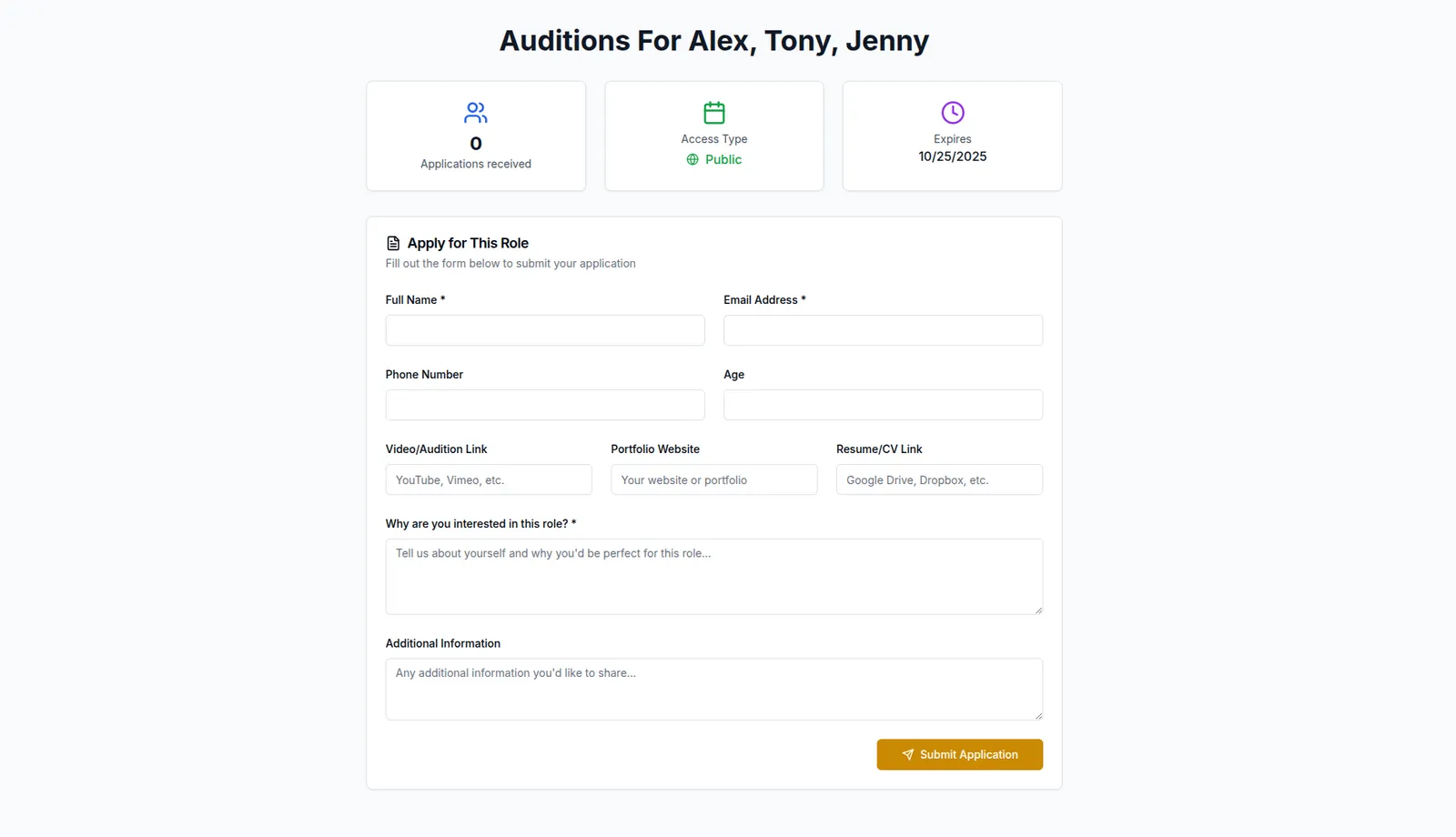
- Find a role. Filmmakers post casting calls, and actors can apply directly.
- Apply with your materials. Send your details, links and self-tapes. Each application lands in one place for the filmmaker to review.
The clip shows an actor profile with photos, details, a reel and a CV, shared with its own link and QR code.
The clip shows a casting call that actors find and apply to with their details, links and self-tapes.
For more on what to put in a profile, see how to build an actor profile that gets you cast.
FAQ
Do I need an agent to get my first acting job?
No. Most first roles in student and indie films come from casting sites, classes and local contacts. Agents usually come later, once you have credits and a reel.
Do I need to join a union to start acting?
No. Many first jobs are non-union. Union eligibility rules differ by country, so check with the actors' union where you live when you are ready.
Is it too late to start acting as an adult?
No. Films need actors of every age, and many people start in their thirties or later. Training and a steady stream of small roles matter more than when you began.
Should I do unpaid student films?
Early on, yes, if the project is organized and you will get the footage. Ask for a copy of your scenes in writing before the shoot.
Key takeaways
- Start with training, simple headshots and a one-page resume.
- Student films, indie shorts and local theater cast newcomers regularly.
- Every role should give you a credit and footage for your reel.
- Learn to self-tape well; it is often your first audition.
- Avoid anyone who asks you to pay to be considered for a role.