How to Build an Actor Profile That Gets You Cast


By Muhammad Wisal and Muhammad Ali / 6 min read

An actor profile is the page a casting director checks to decide whether to call you in: your headshots, credits, physical details, skills, reel and contact information in one place. A profile that gets you cast is current, specific and honest. It shows clearly what roles you are right for, so the person casting can say yes in a few seconds.
What is an actor profile?
An actor profile is your casting listing. It may live on a casting site, an agency's roster, a production's own casting system or your personal website, and most working actors keep several. It does the job a paper headshot and résumé used to do, plus video. Casting teams often look at dozens or hundreds of profiles for one role, so they scan. Your profile has to answer their first questions at a glance: does this person look right, are they available and local, and can they do the role.
What should an actor profile include?
A complete profile has these sections. Fill in every one that applies to you.
| Section | What to put in it | Example |
|---|---|---|
| Primary headshot | A recent, well-lit close-up that looks like you on a normal day | Natural light, plain background, eyes to camera |
| Additional photos | Two to four looks for different types of roles | Smart office look, casual look, full-length shot |
| Playing age | The age range you can believably play on screen | 28 to 35 |
| Physical details | Height, build, hair, eyes, and anything distinctive | 5'7", athletic build, dark curly hair, brown eyes |
| Location and travel | Where you are based and where you can work as a local | Based in Chicago, local hire in Milwaukee |
| Credits | Role, project, type and director or company | Lead, "Paper Kites" (short film), dir. Amara Obi |
| Training | Schools, classes, coaches | Two-year acting program, ongoing on-camera class |
| Skills | Only what you can do well on camera today | Turkish (native), stage combat, horse riding, manual driving license |
| Accents and languages | Accents you can hold through a scene, and fluency levels | Native: Turkish, English. Accents: Standard British, New York |
| Reel and clips | Short edited scenes and recent self-tapes | 90-second reel, plus a drama clip and a comedy clip |
| Union status | Membership or eligibility, if it applies where you work | Non-union |
| Representation and contact | Agent or manager, or your own contact details | Self-represented, email and phone |
What makes a good headshot for an actor profile?
A good headshot looks like you walking into the room today. Casting directors are frustrated when an actor arrives looking different from the photo, and it can cost you the next call. Keep it simple: eyes sharp, face clearly lit, little retouching, clothes that do not pull focus. Update it when your hair, weight or look changes. Use additional photos to show range in type (a lawyer, a parent, a mechanic) rather than range in costume.
What should go in an actor's reel?
A reel shows casting that you can act on camera. Keep it short, often one to two minutes, and open with your strongest moment, since many viewers decide in the first few seconds. Use scenes where you are clearly the focus and the sound is clean. If you have no produced work yet, shoot a few short self-taped scenes with a reader instead of padding a reel with weak footage. A good self-tape on your profile is better than a long reel of background work. Read more on self-tape specs.
How do you build an actor profile step by step?
- Define your type. Ask teachers and peers what roles they would cast you in. Write down three or four, such as "tired young nurse" or "warm small-town teacher". Your profile should support those first.
- Set a believable playing age. A range of five to eight years is usually more useful than a wide one.
- Get current photos. One main headshot plus a few looks that match your types.
- List credits honestly. Lead, supporting, featured or background, with project type. Student and short films count.
- List only real skills. If a role needs a skill and you list it, you may be asked to do it on the day.
- Add a reel or self-tapes. Put the best clip first.
- Proofread and test. Check every link, your email and your phone number.
- Update after every job. Add credits, new clips and new skills as they come.
What does a strong actor profile look like? A worked example
Elif Kaya is a 31-year-old actor in Chicago with five short film credits and stage work. Her first profile listed a playing age of 20 to 40, eleven skills, and a reel that opened with a wide shot of her in a crowd. She was not getting calls.
She made four changes:
- Playing age 27 to 34. Narrower and believable.
- Six skills she can do on camera now. She cut "basic piano" and "some Spanish", and kept Turkish, stage combat and riding.
- A new reel that opens on a close-up. Her best dramatic scene from a short now comes first.
- Two new self-tapes. One comic, one dramatic, both matching her types.
The profile now tells a casting director exactly where she fits: a woman in her late twenties or early thirties, bilingual in Turkish, physical, credible in drama and light comedy.
What are common actor profile mistakes?
- Old headshots that no longer look like you.
- A playing age range so wide it says nothing.
- Listing skills or accents you cannot perform under pressure.
- A reel that starts slow or shows you in the background.
- Missing location, so casting cannot tell if you are local.
- Broken links or an inbox you never check.
- Applying to every role, including ones your profile clearly does not fit.
For more on making the most of each audition, see how to stand out in auditions and casting calls. If you are just starting, read how to get cast with no experience.
How to build an actor profile in Lowerated
Lowerated includes actor profiles as part of its casting tools, alongside casting calls and self-tapes.
- Set up your actor profile. Use the checklist in the table above to decide what to put in it.
- Find a casting call. Filmmakers on Lowerated post casting calls with the roles they are casting.
- Apply with a self-tape. Submit your application and audition video for the role.
- Keep the profile current. Update it after each job so the next filmmaker sees your latest work.
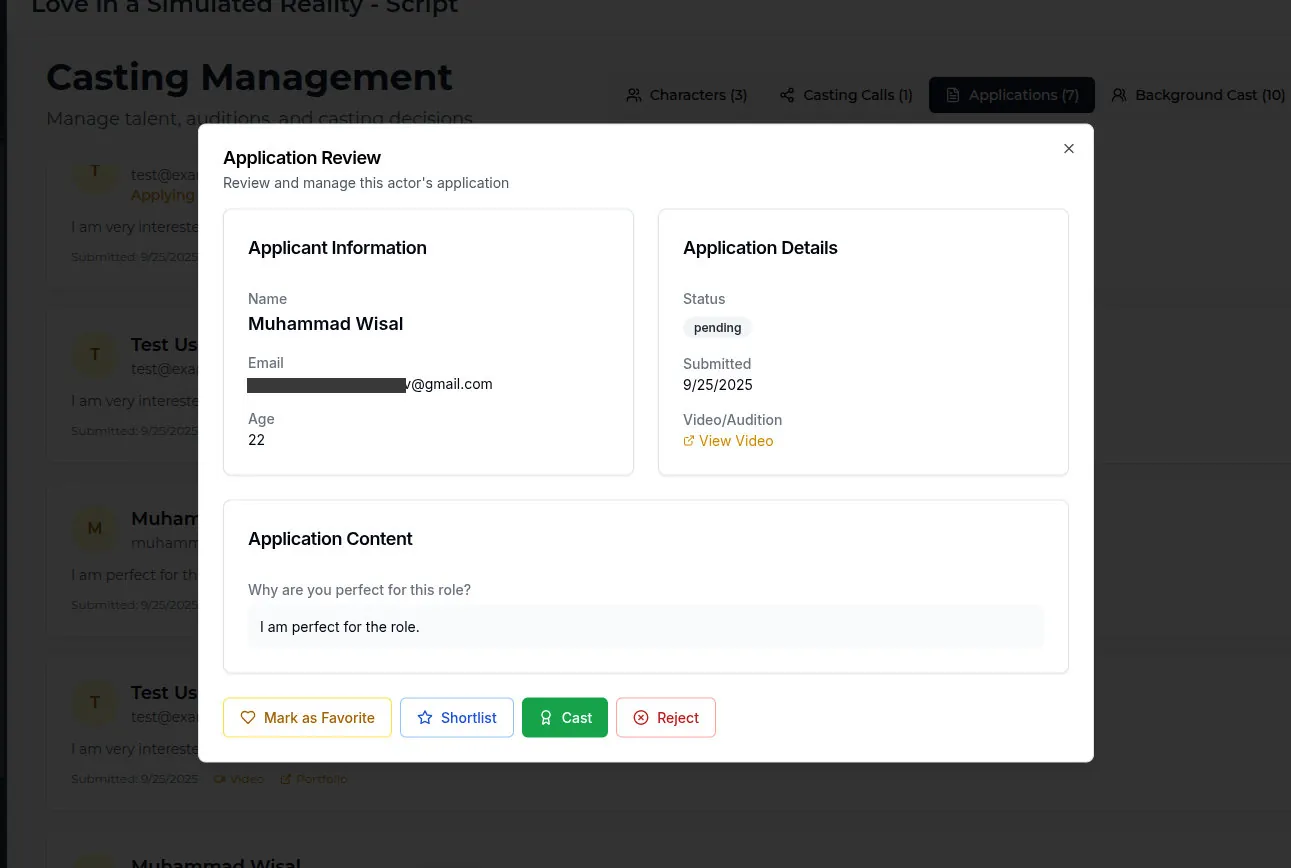
The clip shows an actor profile in Lowerated.
For the filmmaker's side of the process, read casting for a film.
FAQ
How many headshots should an actor profile have?
One strong primary headshot, plus two to four additional looks. More than that makes the profile harder to scan.
Should I list my real age or a playing age?
Most casting profiles ask for a playing age range. Choose a range you can believably play on screen, and keep it narrow.
Can I build a profile with no credits?
Yes. List training, skills and a couple of well-made self-tapes. Student and short films are real credits once you have them.
How often should I update my profile?
After every job, and whenever your look changes. Many actors also review it every few months.
Key takeaways
- An actor profile answers casting's first questions at a glance: look, location, availability and ability.
- Use a current headshot that looks like you today.
- Keep your playing age range narrow and your skills list honest.
- Open your reel with your strongest close-up moment, and keep it short.
- Update your profile after every job.