Above the Line vs Below the Line Costs


By Muhammad Wisal and Muhammad Ali / 6 min read
Above the line costs are the people and rights that shape the film creatively and are usually negotiated one by one: the story and screenplay, producers, director and principal cast. Below the line costs are everything it takes to physically make the film: crew, equipment, locations, art, wardrobe, transport, catering, and usually post-production. The "line" is a literal line on the budget form that separates the two groups.
Where does the term "above the line" come from?
Traditional film budget forms have a top sheet that lists every account. A horizontal line divides the creative and rights accounts at the top from the production accounts below. Over time the phrase stuck, and people now talk about "above the line talent", "below the line crew" and "the below the line budget" even when no paper form is involved.
You will see the split on any professional film budget template, in budgeting software, and in conversations with financiers, who often ask for the two totals separately.
What counts as above the line?
Above the line (ATL) usually covers four groups:
- Story and rights. Purchase or option of the underlying material (a book, an article, a life story), and the screenplay fee.
- Producers. Producer and executive producer fees, and often their assistants and development expenses.
- Director. The director's fee, and sometimes their assistant.
- Principal cast. The lead actors, plus related costs such as their travel, and casting director fees in some budgets.
Fringes (payroll taxes and benefit contributions) for these people sit above the line with them. Union rules for writers, directors and actors vary by country and agreement, so check current terms with the relevant guild or a production lawyer.
What counts as below the line?
Below the line (BTL) is the cost of making the film once the creative package is set. It usually breaks into three parts.
| Part | Typical accounts | Examples |
|---|---|---|
| Production | Production staff, camera, grip and electric, sound, art, set dressing, props, wardrobe, hair and makeup, locations, transport, catering, extras, stunts | 1st AD, gaffer, camera package rental, location fee, picture car, background actors |
| Post-production | Editing, sound design and mix, music, color, visual effects, titles, deliverables | Editor's weekly rate, mix stage, composer fee, color grade |
| Other | Insurance, legal, accounting, publicity, festival costs | Production insurance, clearances, festival entry fees |
Some budgets keep post-production and "other" as separate sections below the line. The grouping varies by company and software, but the idea is the same: if it pays for the physical work of shooting and finishing the film, it sits below the line.
What is the difference between above the line and below the line?
The most useful difference is how the two groups behave when the plan changes.
| Above the line | Below the line | |
|---|---|---|
| Who | Writer, producers, director, lead cast | Crew, extras, stunt performers, vendors |
| How it is priced | Negotiated deals, often a flat fee per person | Rates times units: days, weeks, items |
| What drives it | Who is attached to the film | Number of shoot days, locations and scenes |
| When it is fixed | Early, as people sign on | After the breakdown and schedule |
| Can it be deferred? | Often, on indie films | Harder, since vendors and crew need paying |
In practice, ATL tells you what the film is and who is in it. BTL tells you how hard it is to make. A two-hander set in one apartment has a small BTL even if the leads are expensive. A period war film with unknown actors has a modest ATL and a huge BTL.
Which costs are hard to place?
Some items move depending on the company, the chart of accounts or the deal:
- Casting director. Placed above the line in some budgets, below in others.
- Supporting cast and day players. Usually in the cast account above the line, but some budgets split smaller roles below.
- Line producer and unit production manager. The UPM is normally below the line in production staff. A line producer may sit either side.
- Stunt performers. Usually below the line, even when a lead does part of a stunt.
- Development costs. Research, early drafts and option payments usually sit above the line in story and rights.
Pick one approach, write it into the budget notes, and stick to it. Consistency matters more than which side you choose, because financiers and accountants compare totals over time.
Worked example: a small indie budget split
"Paper Lanterns" is a short drama about two sisters, Yusra and Delphine, running their late mother's print shop. Six shoot days, one main location, three cast. The figures are illustrative, not a guide to rates in your city.
| Account | Side | Estimate (USD) |
|---|---|---|
| Screenplay | Above | 1,000 |
| Producer | Above | 0 (deferred) |
| Director | Above | 1,500 |
| Cast (3 actors, 6 days, plus rehearsal) | Above | 4,200 |
| Above the line total | 6,700 | |
| Crew and production staff | Below | 7,800 |
| Camera, grip and electric | Below | 3,600 |
| Location, art and wardrobe | Below | 2,400 |
| Catering and transport | Below | 1,900 |
| Post-production | Below | 4,000 |
| Insurance and other | Below | 1,100 |
| Below the line total | 20,800 | |
| Contingency (10% of subtotal) | 2,750 | |
| Grand total | 30,250 |
If the producer adds a seventh shoot day, almost every BTL line grows. If a better known actor joins for the same six days, only the ATL cast line changes.
Why does the split matter to you?
- Financing. Investors look at the ATL total to judge the package and the BTL total to judge whether the film can be made for the money.
- Cutting costs. BTL shrinks when you cut shoot days, locations or company moves. ATL shrinks through deals and deferrals.
- Incentives. Some film incentive programs treat ATL and BTL spending differently. Rules vary by country and region, so read the program's guidelines or ask a production accountant.
- Talking to crew and vendors. Rental houses and crew quote BTL rates, and knowing the structure makes those conversations quicker.
Contingency usually sits after both totals. Our guide to contingency in a film budget explains how to size it.
Tracking ATL and BTL in Lowerated
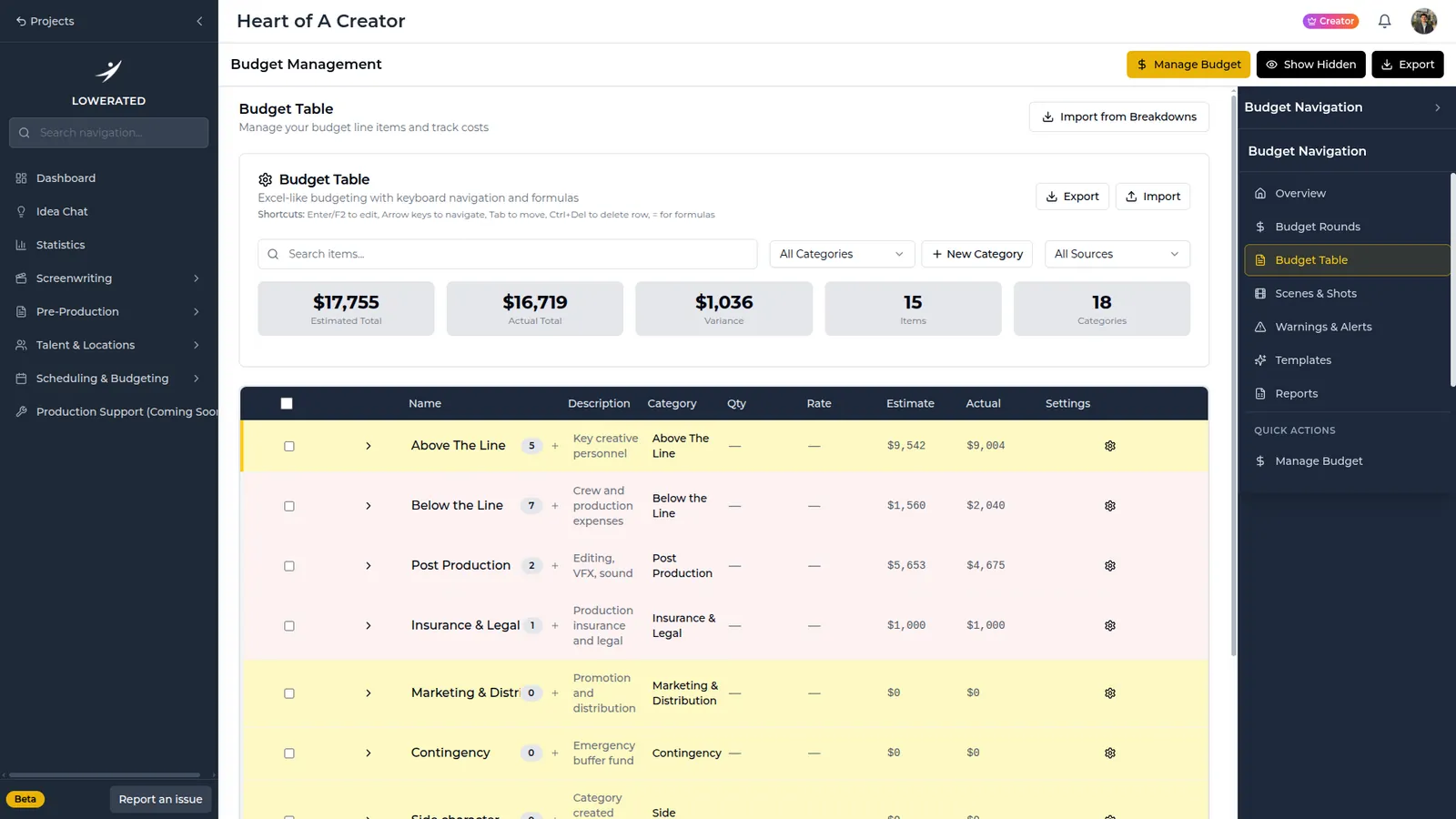
In Lowerated you plan the budget right next to your schedule. You add line items for each account, track estimates against what you actually spend, and can start from a budget template. The numbers stay next to the shoot days they pay for, so when you add a day on the schedule you can see which below the line costs need to grow.
The clip shows line items being added to a budget, with estimates tracked against actual spending next to the shooting schedule.
FAQ
Is the cinematographer above or below the line?
Below the line in standard budgets, in the camera account, even though the DP is a key creative. The same goes for the editor, production designer and composer.
Are actors always above the line?
Principal cast usually are. Extras and background actors are below the line, and some budgets place small roles below as well.
What does "below the line crew" mean?
It is shorthand for the technical and craft crew: camera, lighting, grip, sound, art, wardrobe, makeup, locations and production staff. Read more about these jobs in film crew roles.
Do short films need an ATL and BTL split?
It helps. Even on a small short, the split shows at a glance whether money is going to people or to shoot days.
Key takeaways
- Above the line covers story and rights, producers, director and principal cast.
- Below the line covers crew, equipment, locations, logistics, post-production and other costs.
- ATL is driven by deals. BTL is driven by shoot days, locations and scenes.
- Some items, such as casting and line producer fees, can sit on either side. Choose one approach and note it.
- Use the split to talk to investors and to decide where to cut.