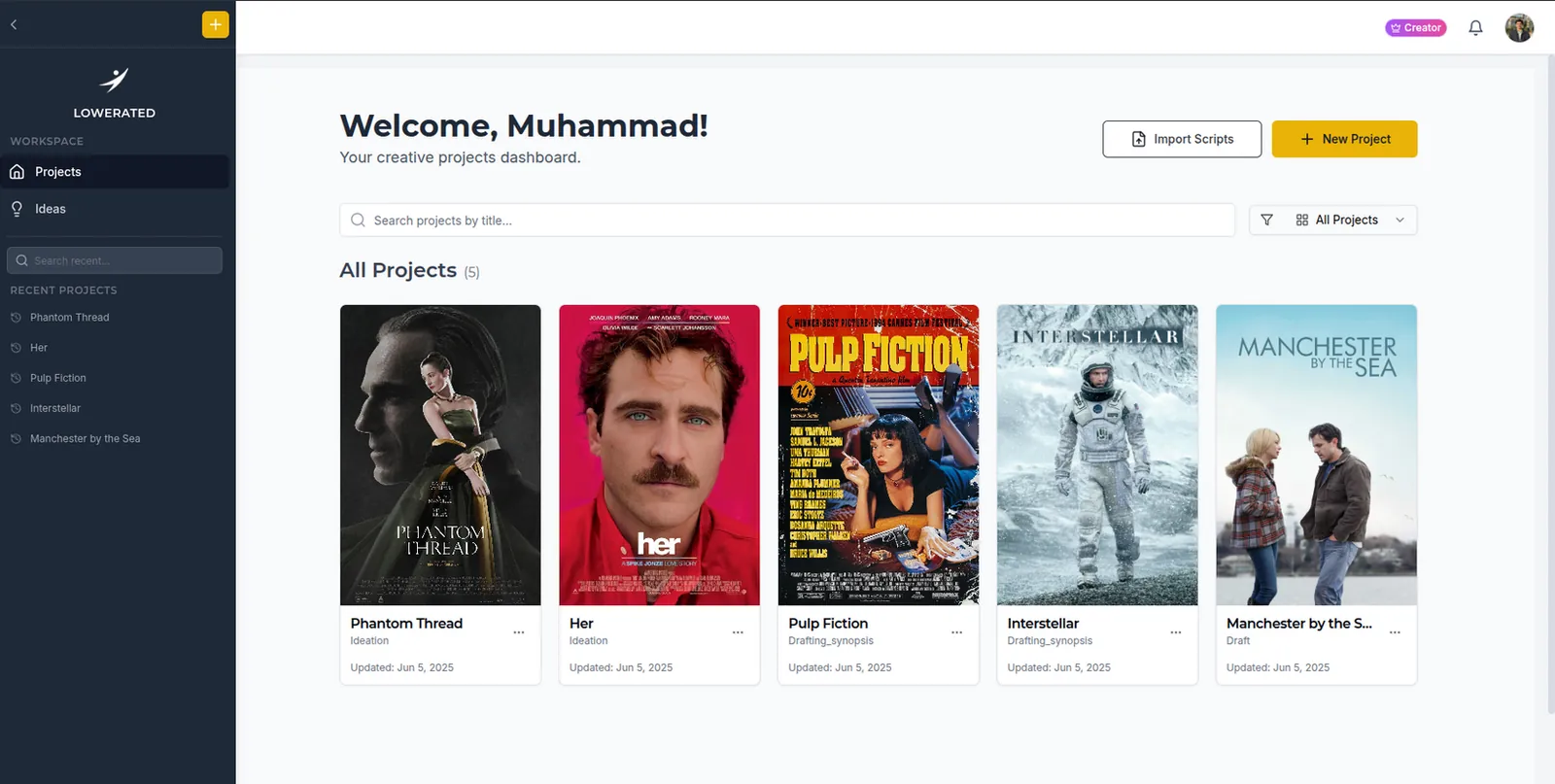
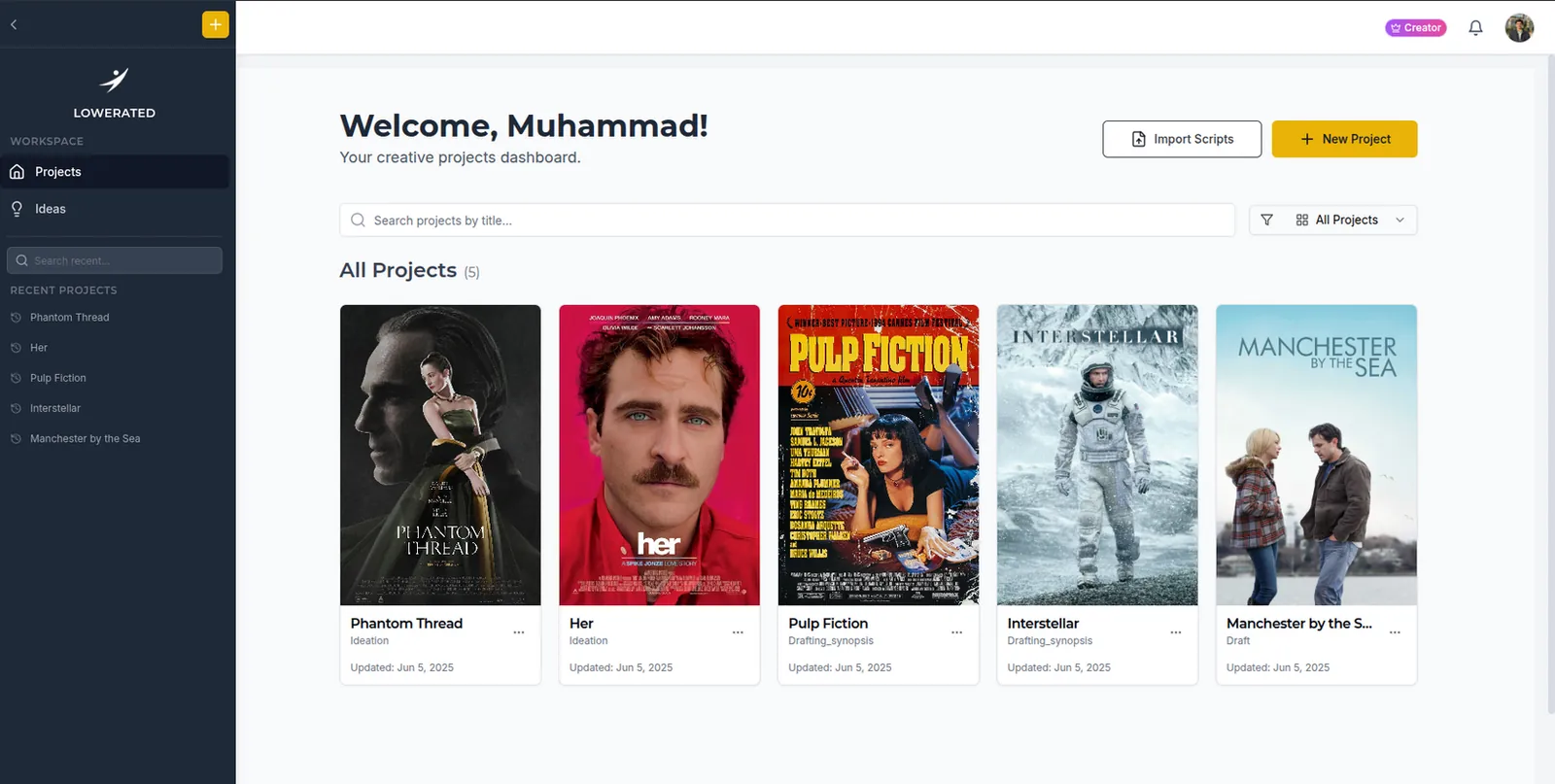
AI-Assisted Filmmaking Workspace for Independent Filmmakers: All-in-one filmmaking platform


By Muhammad Wisal and Muhammad Ali / 9 min read
Independent filmmakers usually do not struggle because they lack ideas. They struggle because turning one idea into a finished film requires dozens of connected decisions.
A screenplay may live in one place, casting notes in another, production schedules in a spreadsheet, creative discussions in messaging apps, and research in browser tabs. As the project becomes more complicated, the filmmaker can spend more time managing the process than developing the film itself.
That is the problem an AI-assisted filmmaking workspace should solve.
Lowerated is built around this idea: give filmmakers one environment where they can move from an initial concept toward a production-ready project with AI assistance across the creative and planning process. Its website currently describes the platform as an All-in-one filmmaking platform covering stages from idea generation to distribution, with tools for scriptwriting, pre-production, and community collaboration.
The important point is that AI should not take control of the film. It should remove unnecessary friction so the filmmaker can stay focused on the story, creative choices, and people who bring the project to life.
Why Independent Filmmakers Need a Better Workflow
Large productions often have separate departments for development, production management, casting, post-production, and distribution.
Independent filmmakers frequently have to wear several of those hats themselves.
A director might also be the writer. A producer may be responsible for casting and scheduling. A screenwriter may need to understand locations, characters, props, and production requirements before the project can move forward.
That creates a common problem: the creative work and the organizational work compete for the same limited time.
For an independent production, small inefficiencies can quickly become major obstacles.
Consider a simple change to a screenplay. Adding one scene could affect:
- Characters appearing in the scene
- Location requirements
- Props and costumes
- Shooting time
- Actor availability
- Scheduling
- Budget
- Shot planning
- Production logistics
When every part of the project is managed separately, the filmmaker has to repeatedly update the same information. A better workspace keeps these connected decisions closer together.
AI Script Writer for Filmmakers: Starting Without Losing the Human Story
The first major obstacle is often the blank page.
You may know what the movie is about but still struggle to build the opening scene, develop a character, structure the story, or turn an idea into properly formatted screenplay pages.
An AI Script Writer for Filmmakers can help with these early stages by accelerating brainstorming, scene development, dialogue exploration, and structural work.
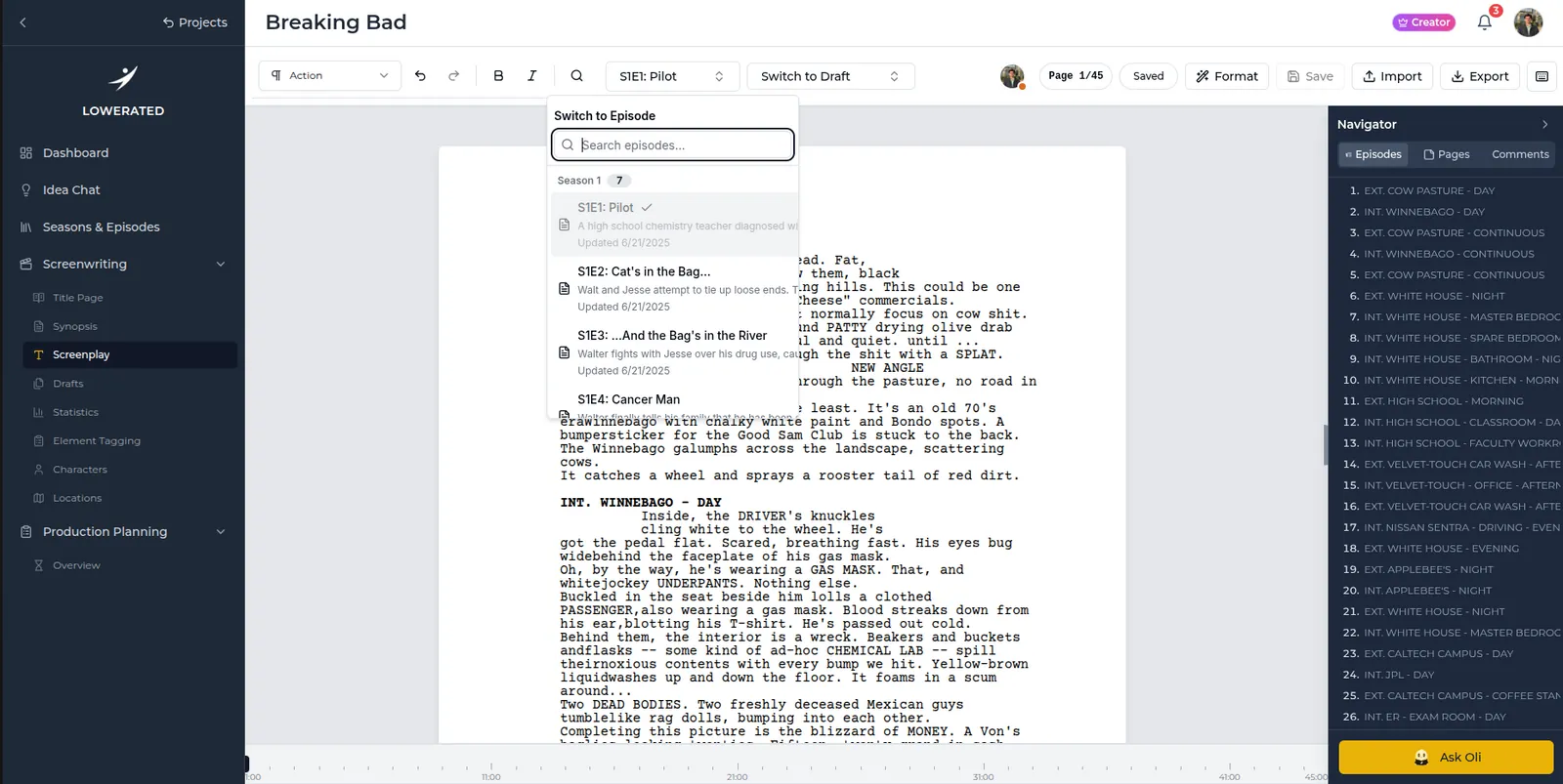
Lowerated's Script Writer is positioned as an AI-assisted tool that helps filmmakers and screenwriters write scenes, dialogue, and story structure faster while supporting industry-style screenplay formatting. The platform also highlights character profiling, element tagging, collaboration, analytics, and AI assistance.
The useful way to think about this is not: "AI writes my movie."
It is: "AI helps me get from a rough idea to something I can work with."
A filmmaker can still decide:
- What the story means
- Which characters matter
- What emotional tone the film should have
- What dialogue feels authentic
- What scenes should be removed
- What the audience should remember
AI can accelerate exploration, but the filmmaker remains the creative authority.
Pre-production Filmmaking Is Where Ideas Become Real
A script is not yet a production.
Before cameras roll, the filmmaker has to answer practical questions: Where will the film be shot? Who is in each scene? What equipment is required? How long will each setup take? Which scenes can be grouped together? What will the production cost?
This is where Pre-production Filmmaking becomes critical.

Lowerated's current pre-production offering is built around the transition from script to plan. Its website specifically highlights casting, location scouting, budgets, schedules, shot lists, and storyboards as parts of the workflow. That connection matters.
Why a Filmmaking Planner Tool Should Start With the Script
Many planning problems come from treating production planning as a completely separate activity.
The information needed for planning already exists inside the screenplay.
A practical Filmmaking Planner tool should help turn that information into production decisions rather than making filmmakers enter everything again manually.
For example, once a scene is identified, the planning process can revolve around questions such as:
Who is in the scene?Where does it happen?What is needed?How difficult is it to shoot?When can it be filmed?
That creates a more useful path:
Idea → Script → Breakdown → Plan → Shoot
Instead of:
Idea → Script → Spreadsheet → Separate casting file → Separate schedule → Separate notes
The difference may seem small, but on an independent production, reducing repeated work can make the workflow significantly easier to manage.
Film Casting Becomes Easier When It Is Connected to Production
Casting is another area where independent projects can become disorganized.
Film Casting is not simply about finding someone who looks appropriate for a character. Directors and producers need to consider performance, chemistry, availability, character requirements, schedule, and sometimes location.
The same information also matters later when the shooting plan is created.
That is why casting works better when it is connected to the wider project.
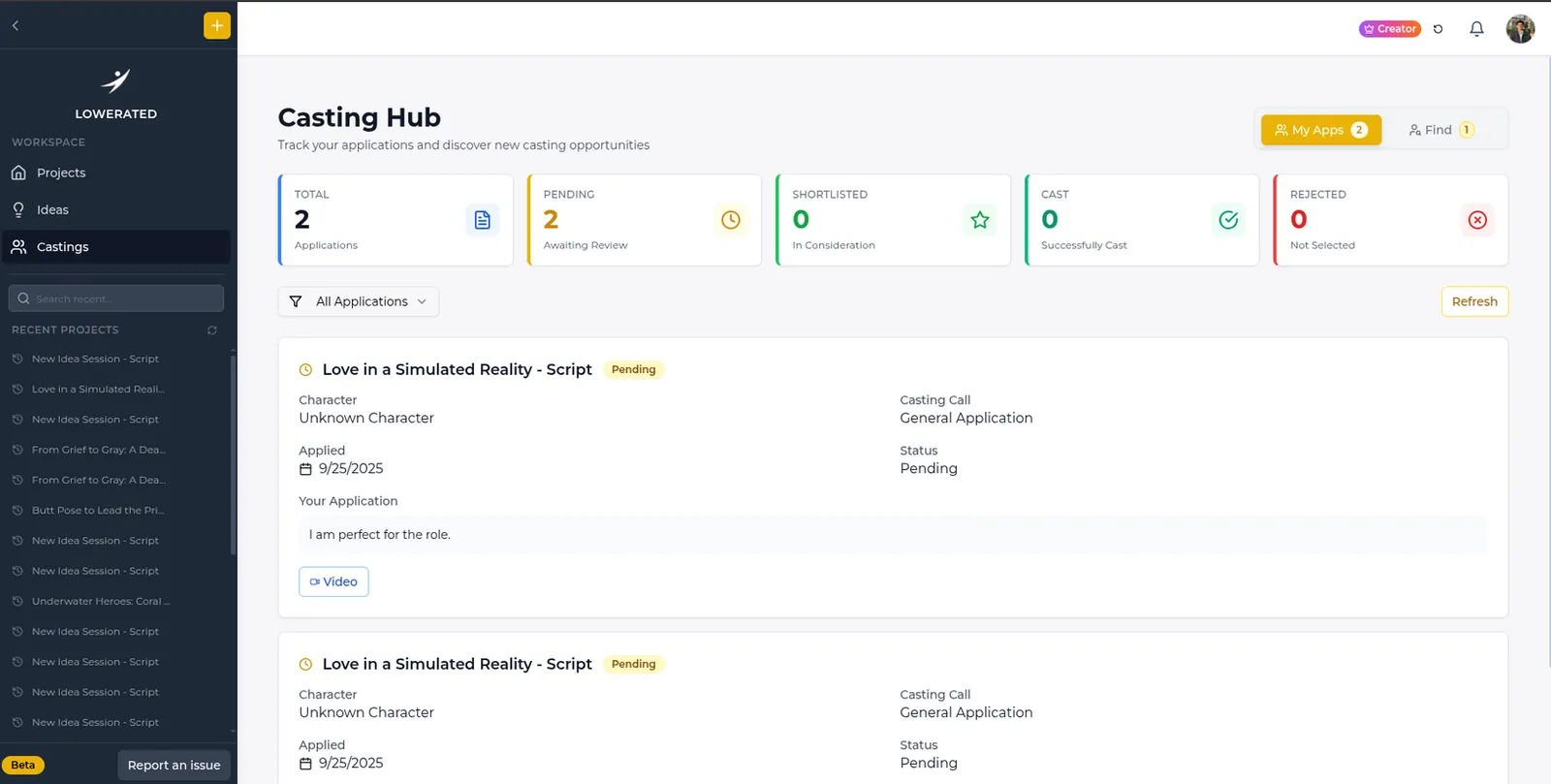
A more organized workflow can help filmmakers define:
- Character requirements
- Roles and descriptions
- Candidate information
- Audition materials
- Availability
- Callback notes
- Final casting decisions
Film Audition and Casting Calls Without Scattered Information
For filmmakers, creating Film audition and casting calls is only the beginning.
The difficult part can be managing the responses.
A project may receive dozens or hundreds of submissions. Without a structured process, important information can disappear across emails, messages, cloud folders, and spreadsheets.
A connected workflow makes it easier to move from:
Casting Call → Submission → Audition → Review → Callback → Final Cast
That is especially useful for independent filmmakers who may not have a dedicated casting department.
A Filmmaker Collaboration Platform Should Reduce Communication Problems
Filmmaking is a team sport.
Writers, directors, producers, actors, cinematographers, editors, designers, and other contributors all need to make decisions together.
The problem is not a lack of communication. Modern teams usually communicate too much.
The problem is where important information lives.
A creative decision buried inside a chat message can be difficult to find later. A revised script can become confused with an older version. A team member may be working from information that another member has already changed.
A Filmmaker Collaboration Platform can help solve this by bringing project communication and creative materials closer together.
Lowerated highlights collaborative script features including co-writing, comments, and version control, giving teams a more structured way to work on scripts together.
The goal should be simple: when someone joins the project, they should be able to understand what is happening without reading hundreds of old messages.
The Value of a Filmmakers Community Platform
Software solves only one part of filmmaking.
People solve another.
A new director may need a cinematographer. A screenwriter may need feedback. An actor may be looking for an independent production. A producer may be searching for collaborators.
That is where a Filmmakers Community Platform becomes valuable.
Lowerated presents its community as a place where filmmakers can "learn, collaborate, and grow together," with a focus on the next generation of filmmakers.
The value of that network is practical.
A filmmaker community can help creators:
- Meet potential collaborators
- Exchange ideas
- Learn from other creators
- Discover opportunities
- Share projects
- Find people with complementary skills
For an independent filmmaker, finding the right person can sometimes be more important than finding another piece of software.
Post-production Filmmaking Starts Before the Edit
It is easy to think of Post-production Filmmaking as something that begins only after shooting ends.
In reality, many post-production problems originate much earlier.
Missing footage, inconsistent shot planning, unclear creative decisions, poorly organized materials, and unnecessary reshoots can all create additional work once editing begins.
That means post-production benefits from good preparation.
A connected filmmaking workflow helps preserve information from earlier stages so the project does not become a completely different organizational problem after filming.
The objective is not to make every task automatic.
The objective is to avoid recreating the project from the beginning every time it enters a new stage.
What Should You Look for in the Best Filmmaking Platform?
There is no universal Best filmmaking platform for every creator.
A feature-heavy platform is not automatically useful. The better choice depends on whether it actually removes problems from your workflow.
For an independent filmmaker, useful questions include:
Does it connect creative and production work?
Writing, planning, casting, and collaboration should not feel like completely separate projects.
Does AI save time rather than create more work?
AI should help with repetitive or exploratory tasks while leaving important creative decisions in the filmmaker's hands.
Can the workflow grow with the project?
A short film, documentary, music video, or feature may begin as a simple idea and quickly become a complex production.
Can a team work together?
A solo workflow may be enough at the beginning, but successful projects often become collaborative.
Does it solve a real filmmaking problem?
This is the most important question.
The best workflow is not the one with the most features. It is the one that helps you make decisions faster and keeps the project understandable.
Why an All-in-one Filmmaking Platform Makes Sense for Indie Creators
Independent filmmakers have limited resources.
That includes money, time, people, and often technical expertise.
An All-in-one filmmaking platform can reduce the number of disconnected tools required to move a project forward.
Lowerated's website currently positions the platform around a workflow that runs from idea generation and AI-assisted scriptwriting through pre-production, community, and the broader filmmaking process.
The real benefit is not simply convenience.
It is continuity.
A filmmaker can think about the entire project as one connected journey rather than a collection of separate tasks.
That can help answer a question many independent filmmakers face:
"What do I do after I finish this part?"
After the idea comes the script.
After the script comes planning.
After planning comes casting and production.
After production comes post-production.
And after the film is ready, there is distribution.
A good workspace should make that path easier to understand.
AI Should Assist the Filmmaker, Not Replace the Filmmaker
There is still a lot of debate about AI in creative industries.
Some filmmakers worry that AI will make creative work less human. Others see it as a productivity tool.
The useful middle ground is to focus on what AI is actually good at.
AI can be valuable for:
- Exploring possibilities
- Organizing information
- Accelerating repetitive tasks
- Supporting brainstorming
- Developing early drafts
- Helping structure complex workflows
But the parts of filmmaking that require taste, judgment, experience, emotion, and human connection remain deeply important.
The purpose of an AI-assisted workspace should therefore be augmentation, not replacement.
That is particularly important for independent creators. They do not need a machine to decide what their film should be. They need technology that gives them more room to make those decisions.
The Independent Filmmaker's Real Advantage
Big productions may have larger budgets and larger teams.
Independent filmmakers have something different: flexibility.
They can experiment. They can move faster. They can tell unusual stories. They can build projects around personal perspectives that larger productions might overlook.
The challenge is turning that creative freedom into an organized production process.
That is where a modern filmmaking workspace can make a meaningful difference.
Lowerated's stated vision is "Zero barriers during film creation," with a mission focused on making filmmaking easier.
That idea is particularly relevant to independent creators.
The goal is not to make filmmaking effortless in the sense that no hard work is required. Making a film will always require difficult creative and practical decisions.
The goal is to make the unnecessary parts easier.
From a Film Idea to a Production-Ready Project
An independent filmmaker may start with nothing more than a concept.
The real challenge is turning that concept into something that can survive the production process.
A useful AI-assisted workspace should help create that progression:
Idea → Story → Script → Pre-production → Casting → Collaboration → Production → Post-production → Distribution
That is the real opportunity behind platforms like Lowerated.
Not replacing the craft of filmmaking.
Not generating a film with one click.
But helping independent creators spend less time fighting disconnected workflows and more time actually making films.
If you are looking for an All-in-one filmmaking platform that brings AI-assisted scriptwriting, planning, collaboration, and filmmaking workflows into one environment, explore Lowerated and see how it fits your process.
Your film still needs your vision. The workspace should simply make it easier to bring that vision to life.