Company Moves in Film: How to Plan Them


By Muhammad Wisal and Muhammad Ali / 7 min read
A company move in film is when the whole unit (cast, crew, equipment and vehicles) packs up at one location and relocates to another during the same shoot day. To plan one, schedule it only when the scenes justify it, put it at a natural break such as lunch, send an advance team ahead, and give the move its own time on the schedule and call sheet. A move almost always costs more time than the drive itself, so plan it like a scene.
What counts as a company move?
A company move means the base of operations changes: trucks, unit base, catering and parking all have to go somewhere new. Moving from the kitchen to the bedroom of the same house is usually called a set move or a move within the location, because the trucks and base stay put. Moving from that house to a gas station across town is a company move. The difference matters because a set move costs minutes and a company move often costs an hour or more, depending on crew size, distance and how much gear has to be wrapped and unpacked.
Why do company moves take so long?
The drive is the smallest part. A move has several stages, and each one eats time:
- Wrap out: lights come down, cables are coiled, set dressing is packed, and the location is left the way you found it.
- Load: every department loads its vehicle, and nobody leaves until the last case is on.
- Travel: the drive, plus finding parking for every vehicle at the other end.
- Unload and set up: unit base, power, video village, hair and makeup and wardrobe all set up again.
- Light and rehearse: the first setup at the new location needs to be lit and blocked before the camera rolls.
A crew of eight with one van moves faster than a crew of forty with grip and electric trucks, but every crew loses shooting time. That is why ADs try to keep moves to one per day at most, and avoid them entirely when the page count is heavy. See how many pages you can shoot a day for how moves fit into a workable day.
How do you plan a company move step by step?
- Check if you really need it. Group scenes by location on the schedule first. If a move exists only because two short scenes sit on the same day, see if one can join another day at that location.
- Pick the right moment. Moving over lunch is a common choice: the crew wraps out, travels, eats at the new location and starts the afternoon there. Moving at the start of the day (by calling the crew straight to the second location) avoids a mid-day move altogether.
- Measure the real travel time. Drive the route at the same time of day during the tech scout. A 15 minute trip at noon can be 45 minutes at rush hour.
- Lock parking and unit base at the new location. Know where each truck, trailer and crew car will park before the day. See the guide to transport and parking plans.
- Send an advance team. A small pre-rig crew (grips, electric, art) can go ahead to rig power and light the first setup while the main unit finishes the first location.
- Plan the last shot at location one. Make it a setup that can wrap fast, so most departments can start packing during the final takes.
- Put the move on the schedule and call sheet. On a stripboard, a move is often shown as a banner or note between strips. On the call sheet, list both addresses, the move time, the route and parking at the second location.
- Brief the crew. At the start of the day, the 1st AD says when the move is and what the first shot at the new location will be, so departments can plan their wrap.
A worked example: a shoot day with one move
Here is part of a schedule for day 3 of "Low Tide", a short about two sisters selling their late father's boat. The morning is at the marina, the afternoon at a diner 20 minutes away.
| Time | Item | Notes |
|---|---|---|
| 7:00 AM | Crew call, Pier 4 Marina | Unit base in north lot |
| 8:00 AM | Sc. 5, EXT. MARINA DOCK - DAY | 1 4/8 pages, cast 1, 2 |
| 10:15 AM | Sc. 6, INT. BOAT CABIN - DAY | 6/8 page, cast 1, 2 |
| 11:15 AM | Pre-rig team leaves for diner | Key grip, 1 electric, set dresser |
| 11:30 AM | Sc. 7, EXT. MARINA PARKING LOT - DAY | 2/8 page, simple two-shot, quick wrap |
| 12:00 PM | Company move to Harbor Diner | Wrap out and load 30 min, drive 20 min |
| 1:00 PM | Lunch at Harbor Diner | Catering set up by 12:45 |
| 1:30 PM | Sc. 12, INT. DINER - DAY | 2 2/8 pages, cast 1, 2, 4. First setup prelit |
| 5:30 PM | Camera wrap |
Two choices make this move work. The last scene at the marina is short and simple, so packing can start during it. And the pre-rig team has the diner lit by the time lunch ends, so shooting starts as soon as lunch ends instead of an hour or more later.
What are common company move mistakes?
- Scheduling two or more moves in a day "because the locations are close." Every move has fixed wrap and setup time, whatever the distance.
- Using map travel times from the middle of the night instead of the real time of day.
- Forgetting parking at the second location, so trucks circle while the crew waits.
- Not giving the location permit or the location owner the right times for both places. See the guide to film permits for what usually needs to be stated.
- Leaving a heavy, slow-to-wrap setup as the last shot before the move.
- Forgetting cast transport: actors in costume and makeup need a ride and someone to keep continuity intact.
- Leaving the first location messy. Do a walkthrough before the last vehicle leaves.
How do company moves affect the schedule?
Company moves are one of the main reasons schedules are built by location. When the 1st AD orders scenes on the stripboard, the first pass groups everything at the same location together, then day and night, then cast. Each time two locations share a day, the schedule pays for a move. Count your moves after each version of the schedule: fewer moves usually means more pages per day. The cost shows up later too: a move day may need extra drivers, a second parking permit, and catering at a different address, all of which go on the call sheet.
How to plan company moves in Lowerated
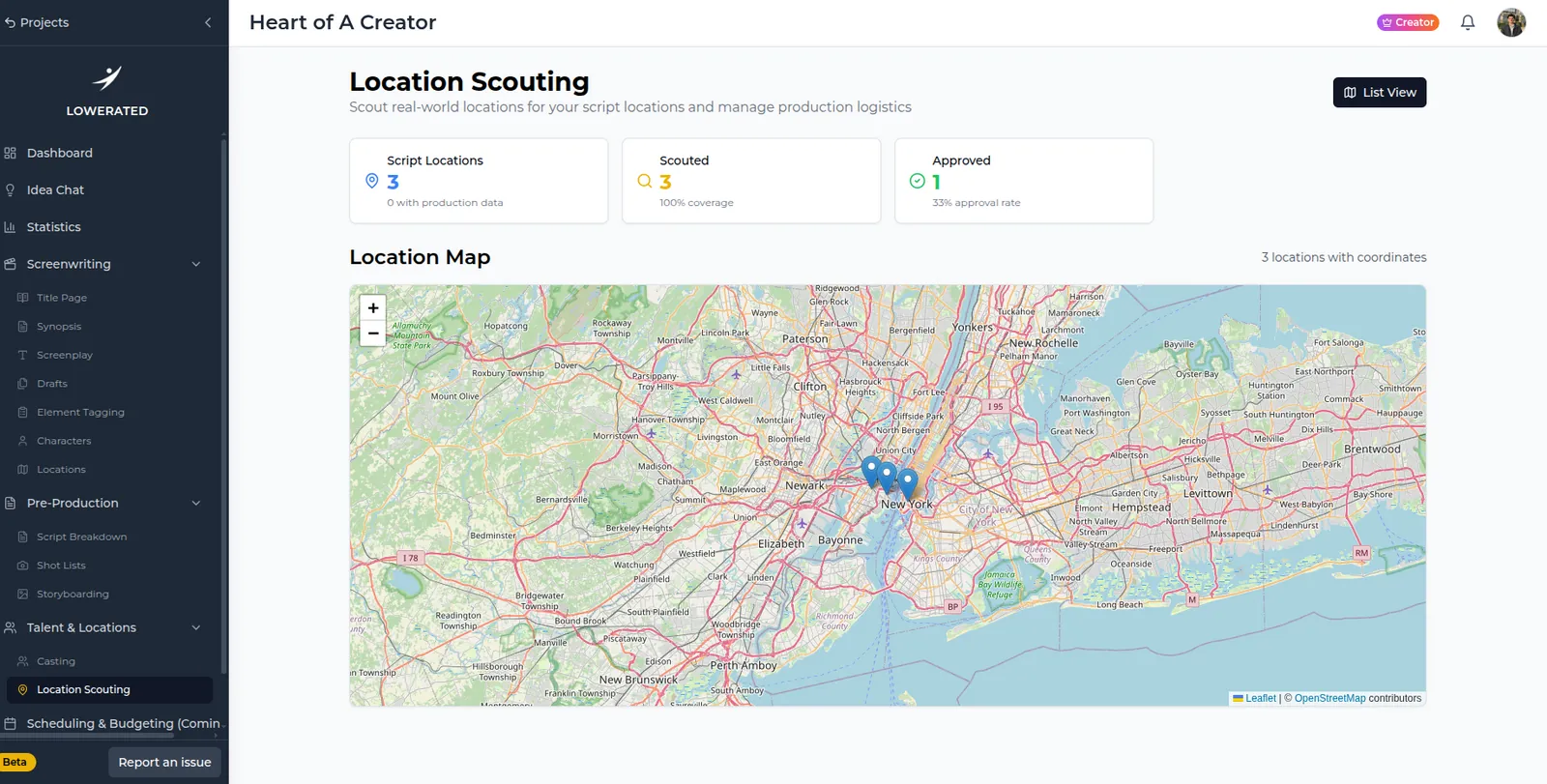
Lowerated does not plan the logistics of a move for you, but its stripboard helps you see where moves will fall. On the stripboard, every scene is a strip and you plan shoot days by dragging strips between them. Drag strips so scenes at the same location sit together, and you can see how many moves each day holds. The Locations page puts every location in your script on one map, so you can see which places are close enough to share a day.
The clip shows scenes as strips, filtered to night scenes, with one dragged onto day one of the schedule.
Once the days are set, the call sheet for each day is built from the schedule, and you add the move time, the second address and parking notes when you review it.
FAQ
How long does a company move take?
It depends on crew size, gear and distance, but plan for an hour or more of lost shooting time on most crews, including wrap out and setup. Small crews with little gear can move faster.
Is a company move the same as a set move?
No. A set move is a change of set within the same location, with trucks and base staying put. A company move relocates the whole unit.
When is the best time for a company move?
Many ADs move over lunch, or call the crew directly to the second location the next day instead. Avoid moving late in the day when the crew is tired and light is running out.
Who organizes a company move?
The 1st AD decides when it happens on the schedule. The locations department and transport coordinator handle routes, parking and vehicles, and the 2nd AD puts the details on the call sheet.
Key takeaways
- A company move relocates the whole unit and usually costs an hour or more of shooting time.
- Keep moves to one per day at most, and remove them by grouping scenes by location.
- Move over lunch or at the start of the day, and send a pre-rig team ahead.
- Make the last shot before a move quick to wrap.
- Put both addresses, the move time, route and parking on the call sheet.