How to Rewrite a Screenplay


By Muhammad Wisal and Muhammad Ali / 7 min read
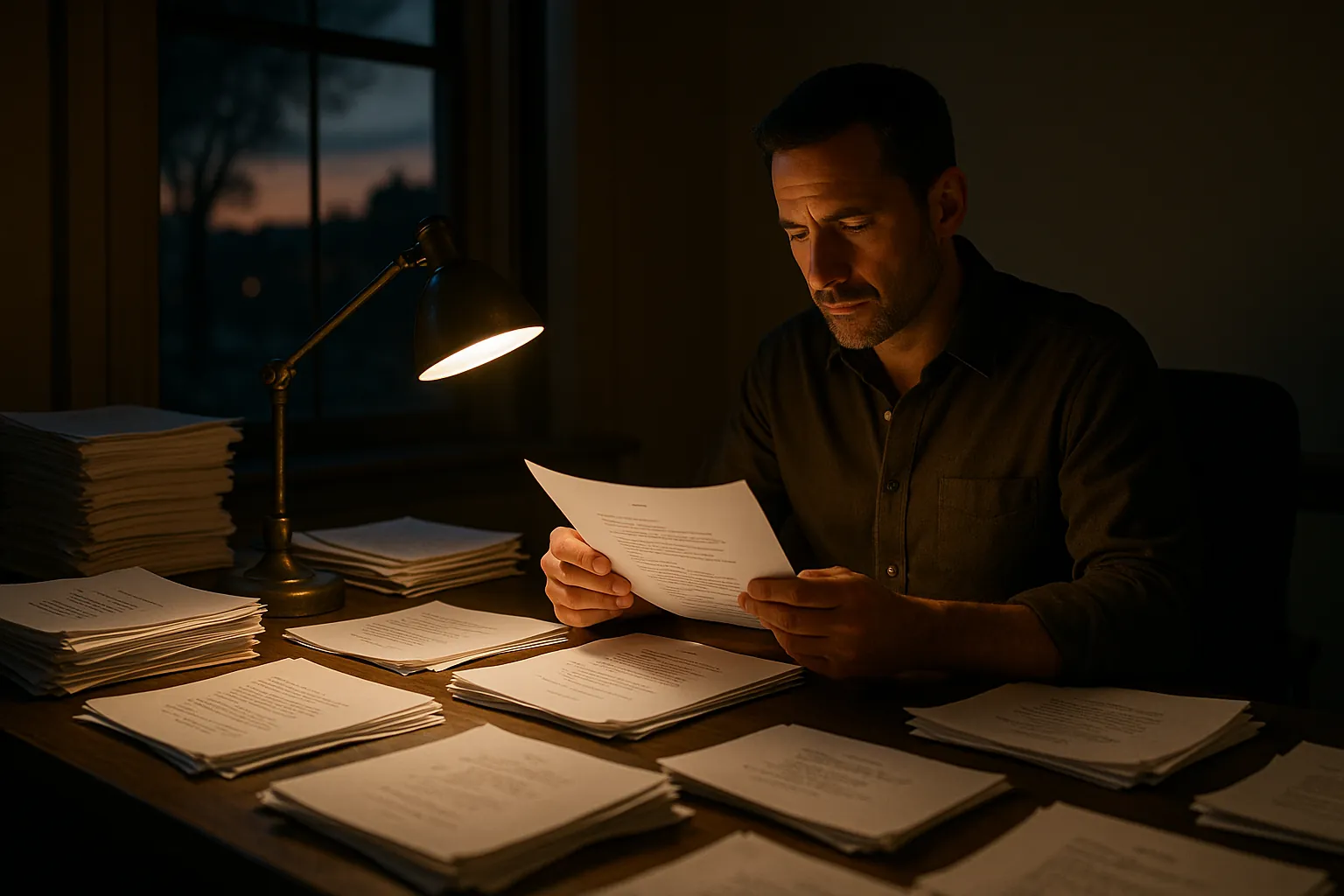
To rewrite a screenplay, put the draft away for a while, read it in one sitting, and write down problems before you fix anything. Then work in passes from big to small: story and structure first, then characters, then scenes, then dialogue and polish. Save each draft as its own version so you can always go back.
What is the difference between a rewrite, a revision and a polish?
A rewrite changes the story or its structure; a revision changes parts of a draft that already works; a polish adjusts lines and small details. Writers and producers use these words loosely, but the distinction helps you decide how much to change.
| Type | What changes | Example |
|---|---|---|
| Rewrite | Plot, structure, characters, point of view, the ending | The brother becomes the main character; the second act is rebuilt |
| Revision | Specific scenes or sequences, based on notes | Two scenes merged, a new scene added to set up the ending |
| Polish | Dialogue, action lines, typos, length | Cutting a page, sharpening three lines, fixing format |
Most screenplays go through several rounds of all three. A first draft almost always needs a rewrite, even when the writer hopes it only needs a polish.
How do you rewrite a screenplay step by step?
- Let it rest. Leave the draft alone long enough to read it as a stranger would. A couple of weeks is common; even a few days helps.
- Read it in one sitting. Print it or read it on a different screen. Do not stop to fix anything. Mark where you got bored, confused or moved.
- Write a list of problems, not solutions. "I don't believe Calla would stay" is a better note than "add a scene where she packs a bag." Solutions come later.
- Make a reverse outline. List every scene in one line: what happens and what changes. This shows structure problems that are hard to see on the page.
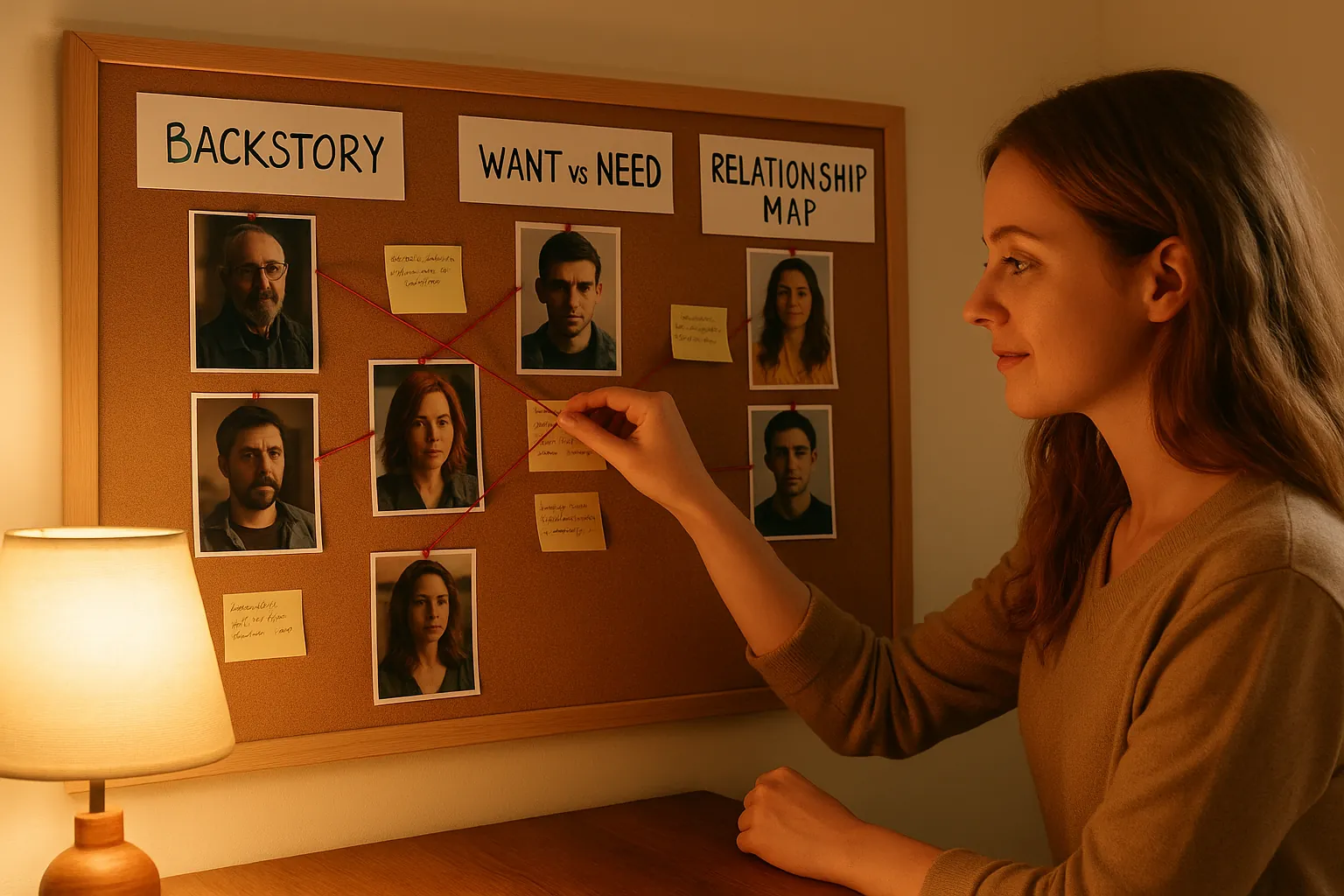
- Fix the biggest problem first. Story, structure and the main character's want and arc. If these change, many smaller fixes become unnecessary.
- Work in focused passes. One pass per problem: a character pass, a scene pass, a dialogue pass. Trying to fix everything at once leads to a draft that is different but not better.
- Get outside reads. Once the draft is the best you can make it alone, share it with a few readers or hold a reading. See how to get feedback on your screenplay.
- Save the draft as a new version and repeat. Name it clearly (second draft, a date) and keep every earlier draft.
What is a reverse outline, and what does one look like?
A reverse outline is a list of the scenes you actually wrote, made after the draft, with one line for what happens and one for what changes. It shows dead scenes, repeated beats and a missing turn far more clearly than rereading does.
Here is part of one for "Salt Road", a short film about Calla, the night manager of a desert motel, and her brother Ruben, who turns up owing money to the wrong people.
| Scene | What happens | What changes | Decision |
|---|---|---|---|
| 1 | Calla closes the office for the night | Nothing; we learn she is alone and tired | Merge with 2 |
| 2 | Ruben's car pulls in; he asks for a room | Her quiet night is over | Keep, open the film here |
| 3 | They argue about money in the office | She refuses to help | Keep |
| 4 | Calla calls their mother | Nothing new; repeats scene 3's argument | Cut |
| 5 | Two men check in asking about a silver car | The danger is real and close | Keep, move earlier |
| 6 | Calla hides Ruben's car keys | She chooses to protect him | Keep; needs a reason we believe |
Two problems jump out. The film starts a scene too early (scene 1 adds nothing), and scene 4 repeats an argument we have already seen. Moving the men's arrival earlier also raises the pressure on everything that follows. None of this needed a single line of dialogue to change yet.
What should each rewrite pass focus on?
Each pass asks one question of the whole script. The usual order runs from the decisions that change the most pages to the ones that change the fewest.
| Pass | Question to ask | Typical fixes |
|---|---|---|
| Story and structure | Does the story turn at the right moments and end where it should? | Move, cut or add scenes; change the ending; start later |
| Main character | Is it clear what they want, what stops them and how they change? | Sharpen the goal, raise the stakes, add a choice that costs them |
| Supporting characters | Does every character have a reason to be in the story? | Merge or cut roles; give each a want of their own |
| Scenes | Does each scene change something? | Enter later, leave earlier, cut scenes that repeat a beat |
| Dialogue | Does each line sound like that character and carry subtext? | Cut on-the-nose lines, trim speeches, separate voices |
| Polish | Does it read fast and clean? | Tighten action lines, fix format and typos, check length |
How do you handle notes from readers?
Treat notes as symptoms, not prescriptions. When a reader says "cut the mother," what they often mean is "I was bored in the middle." Ask what they felt at that point and look for the cause yourself.
- Look for patterns. One reader confused by the ending is an opinion. Three readers confused by it is a problem.
- Separate taste from craft. "I don't like thrillers" is taste. "I didn't know why she stayed" is craft.
- Hear it aloud. A reading shows dialogue problems and slow scenes fast. See how to run a table read.
- Decide, then commit. You do not have to take every note. Take the ones that serve the story you are trying to tell.
How do you keep track of drafts and revisions?
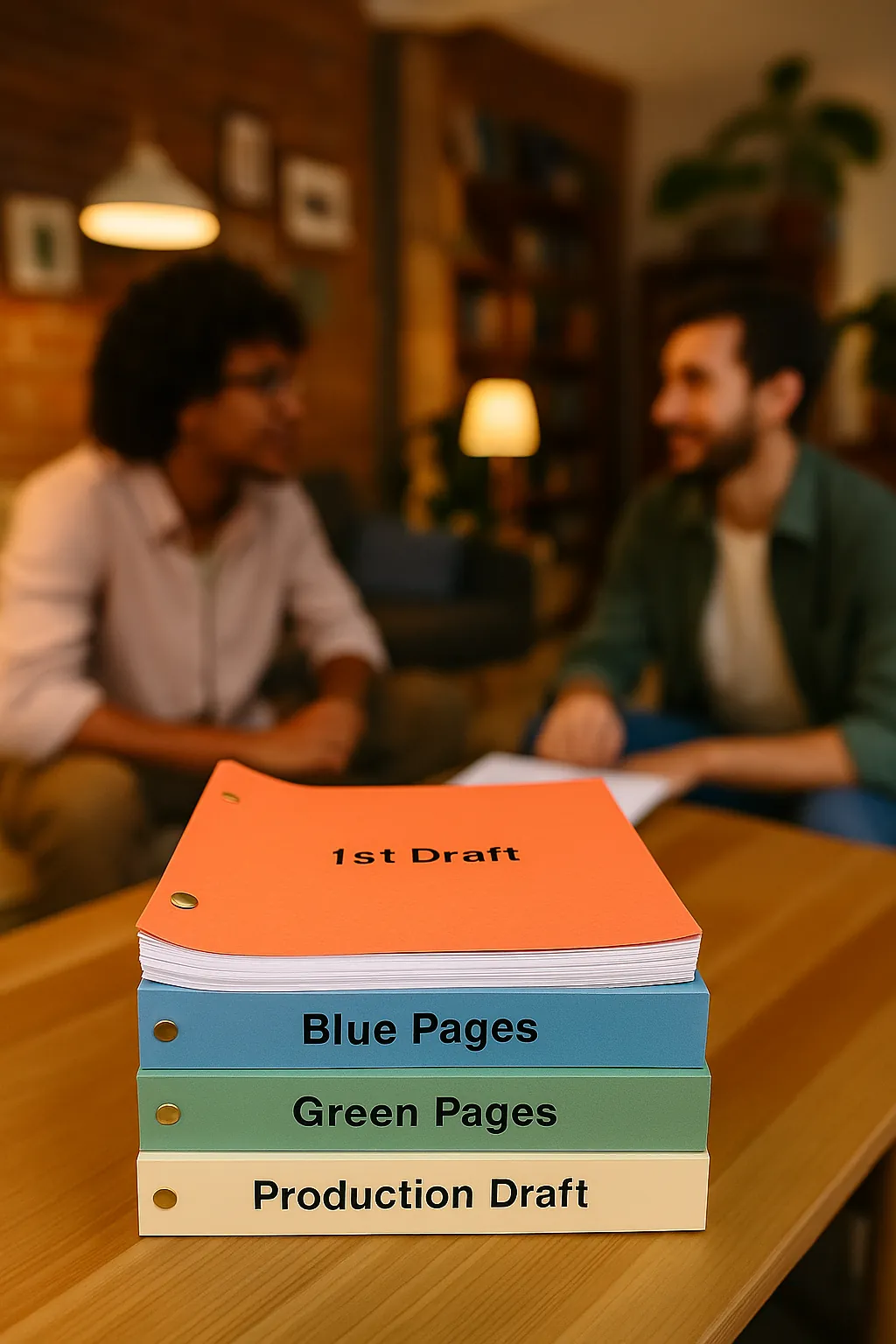
Save every draft as a separate version and never overwrite your only copy. Label drafts clearly with a number and date. Keep a file of cut scenes and lines; good material often finds a new home later.
Once a script goes into production, changes follow a stricter system. Revised pages are marked with an asterisk in the right margin and issued on colored paper in a standard order, usually starting with blue, then pink, yellow and green, so everyone can see which version they hold. The details are in screenplay revision colors explained.
What are common rewriting mistakes?
- Polishing first. Perfecting dialogue in a scene you later cut wastes days.
- Restarting from page one every session. The first act gets rewritten ten times and the ending never gets a pass.
- Changing too much at once. If you fix the structure, the voice and the theme in one go, you cannot tell what helped.
- Taking every note literally. Each reader fixes the script for themselves, and the result belongs to no one.
- Losing earlier drafts. Overwriting means you cannot go back when a change turns out worse.
- Never stopping. When new passes only move problems around, it is time to send it out or start the next script.
How to rewrite a screenplay in Lowerated
In Lowerated's Scriptwriter, you save drafts as you go, mark revisions with the standard colors, and go back to any version of the script when you need it. For line-level work in the polish pass, select a line that is not working and ask Oli, the AI writing partner, for another take. Oli rewrites only the line you select, and nothing changes in your script until you accept it.
The clip shows drafts saved as you go, revisions marked in the standard colors, and an earlier version opened again.
The recording shows Oli suggesting a new version of one selected line, which only changes the script once accepted.
FAQ
How many drafts does a screenplay need?
There is no set number. Many scripts go through several drafts before they are ready to send out, and more once a producer is involved.
How long should I wait before rewriting?
Long enough to read the draft with fresh eyes. A couple of weeks is common, but even a few days away helps.
Should I rewrite from scratch or edit the existing draft?
If the story or main character changes, a page-one rewrite from a new outline is often faster. If the structure works, edit the existing draft pass by pass.
When is a screenplay ready to send out?
When readers no longer flag the same big problems, and your own passes only change small things. At that point, more rewriting rarely helps.
Key takeaways
- Rest the draft, read it in one go, and list problems before fixing anything.
- Use a reverse outline to find dead scenes, repeated beats and slow starts.
- Rewrite in passes from story and structure down to dialogue and polish.
- Read notes as symptoms and look for patterns across readers.
- Save every draft as its own version, and use revision colors once in production.