How to Write a Scene That Works


By Muhammad Wisal and Muhammad Ali / 6 min read
To write a scene that works, know what the main character wants in it, put something in the way, and make sure the situation has changed by the end. Start the scene as late as you can, leave as soon as the change lands, and let the conflict play out through action and dialogue rather than explanation.
What is a scene in a screenplay?
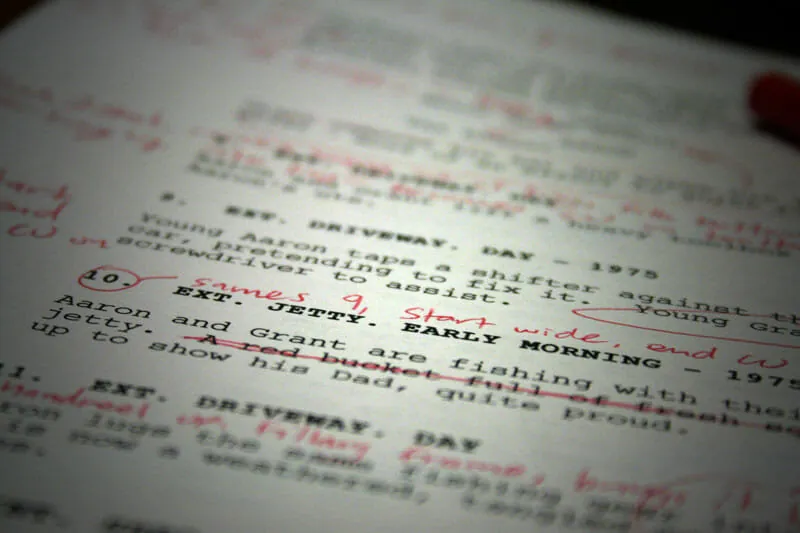
A scene is a unit of story that happens in one place and one continuous stretch of time. In a script, a new scene starts with a new scene heading, such as INT. GARAGE - NIGHT, whenever the location or time changes. For how those headings are built, see scene headings explained.
Dramatically, a scene is a small story with its own beginning, middle and end. Someone wants something, meets resistance, and comes out the other side in a different position. A group of scenes that work toward one goal is a sequence.
What makes a scene work?
A scene works when something changes. Story teacher Robert McKee calls this the scene's turn: a value shifts from positive to negative or the reverse. Trust becomes suspicion. Hope becomes fear. A plan becomes a problem. If a character walks in and out in the same state, the scene is probably doing exposition only and can be cut or merged.
Use this checklist on any scene:
| Question | What to look for |
|---|---|
| Whose scene is it? | One character drives it, even in a group scene |
| What do they want right now? | A specific, playable goal: get the keys, get a yes, get out |
| What is in the way? | Another person, the situation, or their own fear |
| What are the tactics? | How they try to get it: charm, threats, guilt, bargaining |
| What changes? | The value or situation at the end differs from the start |
| Why here? | The location adds pressure or meaning |
| What does it set up? | The scene leaves a question that pulls us into the next one |
How do you write a scene step by step?
- Find the scene's job. Look at your outline. What does the story need from this scene: a decision, a reveal, a loss? Write it in one line.
- Pick the point-of-view character and their goal. Make the goal something an actor could play in the moment.
- Choose the opposition. The other character should want something that conflicts. Two people who agree make a flat scene.
- Choose a location that adds pressure. A breakup in a crowded elevator plays differently from one in a quiet kitchen.
- Enter late. Skip arrivals, greetings and small talk. Start at the moment the pressure is already on.
- Escalate in beats. Each exchange should push harder, or switch tactic when the last one fails.
- Land the turn. Write the moment the value flips. It can be a line, a look, or an action.
- Leave early. End once the turn has landed. Goodbyes and wrap-up lines can usually go.
- Cut what the audience already knows. If a fact was established earlier, trust the reader to remember it.
What does a rewritten scene look like?
Here is a first draft of a scene from an invented drama. Corinne and her brother Mateo are clearing out their late father's garage. The story needs this scene to show that Mateo has already sold the house.
INT. GARAGE - DAY
Corinne pulls into the driveway. Mateo waves from the garage.
MATEO: Hey. How was the drive?
CORINNE: Fine. Long. How are you?
MATEO: Okay. Listen, I need to tell you something. I sold the house. The buyers sign on Friday. I know you wanted to keep it, but I couldn't afford it.
CORINNE: I'm so angry that you did that without me.
It covers the information, but nothing turns on screen. We arrive too early, Mateo explains everything, and Corinne names her feeling. Here is the rewrite:
INT. GARAGE - DAY
Boxes everywhere. Corinne wraps their father's chisels one by one in newspaper. Mateo tosses paint cans into a dumpster bag.
CORINNE: Keep the workbench. I'll get a truck in the spring.
MATEO: Spring.
CORINNE: The roads are bad till March.
Mateo keeps bagging cans. She notices a realtor's tag tied to the workbench vise. It reads: INCLUDED IN SALE.
CORINNE (CONT'D): When were you going to tell me?
MATEO: Friday.
She sets the chisel down and starts unwrapping the others.
Now the scene starts in the middle of work, the conflict hides inside a plan for spring, and the reveal comes from an object she finds. The turn is clear: she came to pack, and she ends up undoing it. Her action carries the anger, so no one has to name it. Read more in subtext in screenwriting and how to write action lines.
(In a real script the character name sits centered above the dialogue. It is shown inline here to save space.)
How long should a scene be?
As long as the turn needs, and usually shorter than your first draft. Many feature scenes run one to three pages, and one page is often treated as about a minute of screen time. Long scenes are fine when the conflict keeps escalating. A long scene with one beat repeated is a problem at any length.
What are common scene-writing mistakes?
- No turn. The scene delivers information and nothing changes. Ask what the characters lose or gain.
- Characters who agree. Even allies should want slightly different things.
- Starting at the door. Arrivals, hellos and coffee orders delay the scene.
- Explaining feelings. Characters say exactly what they feel. Let behavior show it.
- Same scene twice. Two scenes with the same turn. Merge them or change one.
- Ending on a summary line. A line that repeats what we just saw. Cut to the next scene instead.
Writing scenes in Lowerated
Lowerated's Scriptwriter formats scene headings, action and dialogue to industry standard as you type, so you can draft a scene without stopping for layout. When a line is not working, select it and ask Oli, the AI writing partner, to rewrite it. Oli rewrites only the line you select, and nothing changes until you accept.
The recording shows a scene written in the editor, formatted as it is typed.
The clip shows Oli working inside the script editor alongside your draft.
FAQ
What is the difference between a scene and a sequence?
A scene happens in one place and time. A sequence is a group of scenes that work toward one goal, such as a heist or a first date.
Does every scene need conflict?
Every scene needs something in the way, even if it is small. Conflict can be internal, polite or quiet. It does not have to be an argument.
How do I know where to start a scene?
Write it, then cut lines from the top until the scene stops making sense. Restore the last line you cut. That is often your opening.
Can a scene have no dialogue?
Yes. Many strong scenes are pure action. The same rules apply: a goal, an obstacle and a change.
Key takeaways
- A scene works when the situation or value changes by the end.
- Give the point-of-view character a playable goal and someone who wants something else.
- Enter late, escalate, land the turn, and leave early.
- Let actions and objects carry feeling instead of explaining it.
- Cut scenes that repeat a turn you have already shown.