Scene Headings (Sluglines) Explained


By Muhammad Wisal and Muhammad Ali / 7 min read
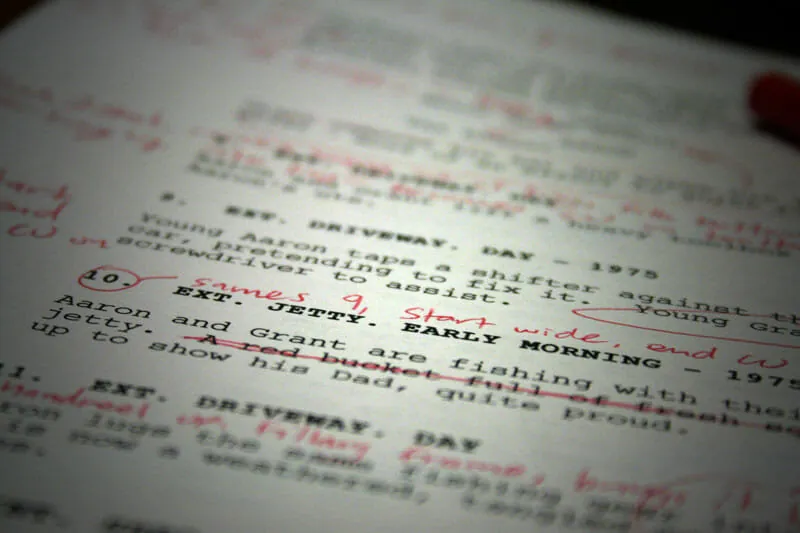
A scene heading, or slugline, is the all-caps line that opens every scene in a screenplay and tells the reader where and when it takes place. It has three parts: INT. or EXT., the location, and the time of day, as in INT. LIGHTHOUSE - LAMP ROOM - NIGHT. You write a new one every time the location or the time changes.
What is a scene heading in a screenplay?
A scene heading is the first line of a scene. It sits at the left margin, in capital letters, with one blank line before and after it. Screenwriters call it a slugline or a slug; production teams sometimes call it the scene header. Everything below it, up to the next heading, belongs to that scene.
Scene headings do two jobs. For the reader, they set the picture: inside or outside, which place, day or night. For the production, they are data. The assistant director uses them to build the breakdown and the schedule, so the same location written two different ways can turn into two different sets on the stripboard.
What are the parts of a scene heading?
A standard scene heading has three parts, separated by spaces and a hyphen before the time of day.
| Part | What it says | Options and examples |
|---|---|---|
| Interior or exterior | Whether the camera is inside or outside | INT., EXT., INT./EXT. (also written I/E) for scenes that move between both, such as inside a moving car |
| Location | The set, from general to specific | LIGHTHOUSE, LIGHTHOUSE - LAMP ROOM, TEODORA'S TRUCK |
| Time of day | When the scene happens, mainly for lighting | DAY, NIGHT, or more specific: DAWN, DUSK, MORNING, EVENING. Also CONTINUOUS, LATER, MOMENTS LATER |
Most writers keep the time of day to DAY or NIGHT unless the exact light matters to the story. DAWN or DUSK tells the production they have a short window to shoot, so use those only when you mean it.
How do you write a scene heading step by step?
- Decide inside or outside. Write where the camera is. A character looking out a window from a kitchen is INT.; the same character seen through the window from the yard is EXT.
- Name the location in a fixed form. Pick a name and use exactly that name every time: LIGHTHOUSE - LAMP ROOM, never LAMP ROOM on one page and LIGHTHOUSE TOP on another.
- Go from general to specific. Main location first, then the room: INT. HARBOR OFFICE - BACK ROOM. Some writers use a comma instead of the second hyphen. Either works if you stay consistent.
- Add the time of day. DAY or NIGHT in most cases. Use CONTINUOUS when the action follows straight on from the previous scene into a new place.
- Follow it with action. Put at least one line of action under the heading to set the picture before anyone speaks.
What does a sequence of scene headings look like?
Here is a run of scene headings from a short film about a lighthouse keeper, Teodora, and her nephew Caspian, who arrives during a storm. Notice how each heading changes only when the place or time changes.
EXT. LIGHTHOUSE - DUSK
INT. LIGHTHOUSE - KITCHEN - NIGHT
INT. LIGHTHOUSE - STAIRWELL - CONTINUOUS
INT. LIGHTHOUSE - LAMP ROOM - CONTINUOUS
EXT. COAST ROAD - NIGHT
INT./EXT. CASPIAN'S CAR - NIGHT
INT. LIGHTHOUSE - KITCHEN - LATER
Teodora climbs from the kitchen to the lamp room in one unbroken movement, so the second and third headings use CONTINUOUS. The car scene uses INT./EXT. because we see Caspian both inside the car and from the road. The last heading returns to the kitchen later the same night, so LATER is enough.
This is how the same headings look once an assistant director turns them into schedule information:
| Scene | I/E | Set | Day/Night |
|---|---|---|---|
| 1 | EXT | Lighthouse | Dusk |
| 2 | INT | Lighthouse, kitchen | Night |
| 3 | INT | Lighthouse, stairwell | Night |
| 4 | INT | Lighthouse, lamp room | Night |
| 5 | EXT | Coast road | Night |
| 6 | INT/EXT | Caspian's car | Night |
| 7 | INT | Lighthouse, kitchen | Night |
CONTINUOUS and LATER both become Night on the schedule, because the AD needs to know the lighting, not the timing. Scenes 2 and 7 share a set, so they will likely be shot on the same day. That grouping only works because both headings name the kitchen the same way. The guide to scheduling a film shoot shows how these strips are ordered into shoot days.
When do you use a secondary heading?
Use a secondary heading (a mini slug) when the action moves to a new spot inside a location you have already established, and the time has not changed. Instead of a full heading, write just the new area in caps on its own line:
INT. HARBOR OFFICE - NIGHT
Teodora shakes rain from her coat and crosses to the counter.
BACK ROOM
The radio set hisses. Nobody is here.
Secondary headings keep a busy sequence readable. Use them only when the move is clear from context, and switch back to a full heading if the time jumps or the location changes.
How do you handle flashbacks, dreams and phone calls?
- Flashbacks. Add the label to the heading: INT. LIGHTHOUSE - KITCHEN - DAY (FLASHBACK). Some writers prefer FLASHBACK - INT. LIGHTHOUSE - KITCHEN - DAY. Close the flashback with a new heading for the present, or BACK TO PRESENT DAY in action.
- Dreams. Same approach: (DREAM) at the end of the heading, then a new heading when the character wakes.
- Phone calls between two locations. Give each location its own heading, then write INTERCUT as a transition so you do not need a new slug for every line. See how to format phone calls and texts.
- Montages. A montage usually gets one heading, MONTAGE or SERIES OF SHOTS, with short lettered or bulleted beats under it. The guide to writing a montage covers the options.
Do scene headings have scene numbers?
Not in a spec script. Scene numbers are added when a script becomes a shooting script, and they appear on both sides of the heading. After numbers are locked, a new scene inserted between 12 and 13 becomes 12A, and a cut scene stays in the script as "12 OMITTED" so the numbering does not shift. This keeps every department's paperwork pointing at the same scene. Formatting rules for spec scripts in general are in how to format a screenplay.
What are common scene heading mistakes?
- Inconsistent location names. MARINA, THE MARINA and HARBOR DOCKS for one place. The breakdown treats them as three sets.
- Missing time of day. Every full heading needs DAY, NIGHT or a continuity word.
- Too much in the heading. Action or description inside the slug, such as INT. KITCHEN - NIGHT - TEODORA IS COOKING. Put the action below.
- Overusing CONTINUOUS. Use it only when the action follows straight on into a new place, not for every new scene.
- Vague times when they matter. If a scene needs sunset light, write DUSK, so the schedule plans for it.
- No new heading after a time jump. If an hour passes in the same room, write a new heading with LATER.
Writing scene headings in Lowerated
In Lowerated's Scriptwriter, scene headings, action, character names and dialogue fall into industry standard format as you write, so you type the slug and keep going. Once the script has some shape, script statistics show your day and night scenes and your locations, which is a quick way to catch a location spelled two ways or a script heavier on night shoots than you meant.
The recording shows a scene typed into the editor, with the scene heading and other elements formatted as they are written.
The clip shows script statistics, including dialogue share, day and night scenes and locations.
FAQ
Why is it called a slugline?
The term is usually traced to newspaper and typesetting slang for a short label line. In screenwriting it simply means the scene heading.
Is it INT./EXT. or I/E?
Both are accepted. INT./EXT. is more common in spec scripts. Pick one and use it throughout.
Should I use a hyphen or a comma between location and room?
Either is fine. INT. HARBOR OFFICE - BACK ROOM - NIGHT and INT. HARBOR OFFICE, BACK ROOM - NIGHT are both standard. Consistency matters more than the choice.
Do I need a new scene heading for every room?
You need a new heading when the location or time changes. Moving between rooms of an established location can use a secondary heading instead.
Key takeaways
- A scene heading has three parts: INT. or EXT., the location, and the time of day.
- Write a new heading whenever the location or time changes, and follow it with action.
- Name each location the same way every time, because the breakdown and schedule depend on it.
- Use secondary headings for moves inside an established location.
- Leave scene numbers off a spec script; they belong to the shooting script.