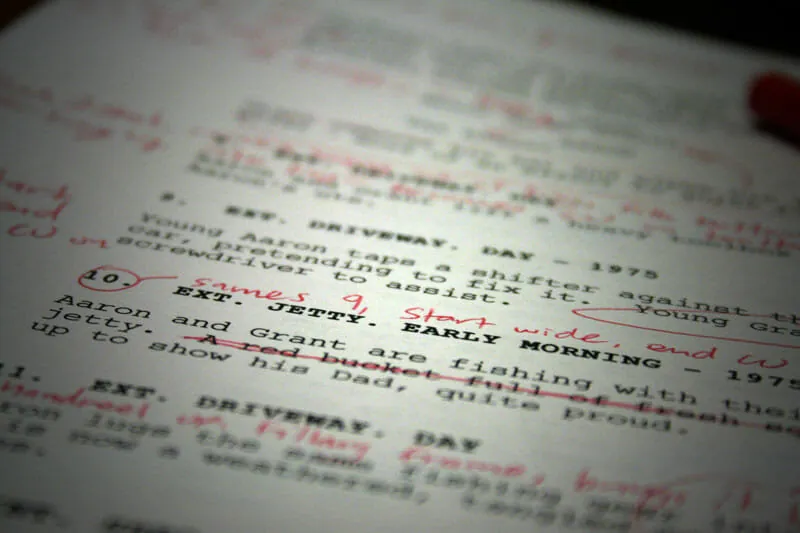
How to Write Action Lines


By Muhammad Wisal and Muhammad Ali / 7 min read
To write action lines, describe only what the audience will see and hear, in present tense, in short paragraphs of one to four lines. Lead with the most important image, use specific verbs instead of adverbs, put a character's name in caps the first time they appear, and cut anything a camera cannot film.
What are action lines in a screenplay?
Action lines (also called action, description or scene description) are every line in a screenplay that is not a scene heading, a character cue, dialogue, a parenthetical or a transition. They tell the reader what is on screen: who is there, what they do, what the place looks like and what we hear. They run the full width of the text block, from the 1.5 inch left margin to the right margin, in plain 12 point Courier like the rest of the script.
Action is where a reader decides whether you can write. Dialogue gets the attention, but action carries the pace. A script with tight action reads fast; a script with dense blocks of description reads slow, even when the story moves quickly.
What are the basic rules for writing action?
The basic rule is simple: write what can be filmed, in the order the audience will see it, as briefly as you can. The rest of the rules follow from that.
| Rule | Why it matters | Example |
|---|---|---|
| Present tense | The film happens now, as the reader watches it | Odile wipes grease from her hands. |
| Only what is visible or audible | The camera cannot film a thought or a backstory | She checks the clock twice. (Not: She worries she is late.) |
| Short paragraphs | White space keeps the read fast; three or four lines is a common ceiling | One image or one beat per paragraph |
| Character intro in caps | Signals a new speaking or key role for casting and breakdown | ODILE (50s, ferry mechanic, burn scar on one wrist) |
| Specific verbs | One strong verb does the work of a verb plus adverb | He shoulders the door. (Not: He pushes the door hard.) |
| Order of perception | The reader builds the shot in the order you give it | A wrench clatters. Odile looks up. BRAM stands in the hatch. |
After the first appearance, the character's name goes in normal case. Some writers also put key sounds or props in caps. That is a style choice in a spec script, not a rule, and using it on every noun makes the page harder to read. See how to format a screenplay for the full margin and indent settings.
How do you write action lines step by step?
- Picture the shot first. Before you type, decide what the audience sees when the scene opens. Write that image, nothing else.
- Write one beat per paragraph. A beat is one action or one change. A new beat gets a new paragraph. This also suggests shots to the director without naming them.
- Lead with the strongest word. Put the subject and the verb early. "Smoke pours from the engine hatch" lands harder than "From the engine hatch, there is smoke that is pouring."
- Introduce characters in a single line. Name in caps, a rough age, and one detail that tells us who they are. Skip full physical descriptions unless the story needs them.
- Cut the camera directions. Remove "we see", "we hear", "the camera pans". Write the thing itself.
- Read it for time. A page of action should take about as long to read as it takes to play. If a two second moment takes six lines, cut.
- Cut again on the next pass. Remove "begins to", "starts to", "suddenly", "very" and repeated information that the dialogue already covers.
What does good action look like? A before and after
Here is a first draft of a short scene opening in a ferry engine room, then the same moment rewritten.
Before:
We see the engine room of the old ferry. It is very hot and there is a lot of noise. Odile, who is a mechanic in her fifties and has worked on this boat for most of her life, is starting to work on the engine, and she is feeling tired because she has been awake since four in the morning. Suddenly there is a loud bang and she quickly turns around to look at what has happened.
After:
The ferry's engine room. Heat haze over the pistons. Noise like a held scream.ODILE (50s, oil to the elbows, burn scar on one wrist) works a seized bolt with both hands.
BANG. Behind her, a pressure gauge cracks.
She spins, wrench up.
The rewrite drops from 78 words to 43. It removes "we see", the backstory and the tiredness nobody can film. It gives the reader three paragraphs, three beats and three likely shots. The scar is a visible detail that hints at history, so it stays.
How much detail should action lines include?
Include the detail that changes how a scene plays or what a department needs, and leave out the rest. A useful test: if the production designer, an actor or the director would have to know it, write it. If it only decorates, cut it.
- Keep: a prop that matters later, a wound, the weather if it affects the action, a sound that someone reacts to.
- Cut: paint colors, brand names with no story purpose, the full contents of a room, an actor's exact hair and height.
Details you write also flow into the script breakdown. Every prop, vehicle and piece of wardrobe named in action becomes something someone has to source. That is one more reason to name only what the scene needs.
How do you show emotion and thoughts in action?
You show emotion through behavior the camera can catch: what a character does, avoids, or does too carefully. "Bram is furious" tells; "Bram sets the coffee down so gently it doesn't make a sound" shows, and gives the actor something to play.
A little voice is fine. Many working writers use short asides ("This is a man who has never lost an argument") when they add tone a reader needs. Use them sparingly. If you need a paragraph of inner life, the scene probably needs a visible action or a line of subtext instead.
What are common action line mistakes?
- Walls of text. Five line paragraphs or longer slow the read. Break them at each new beat.
- Directing the camera. "CLOSE ON", "PAN TO" and "we see" belong in a shooting script, not a spec. Write the image and let the shot follow.
- Unfilmable information. Backstory, thoughts and history in action lines. If it matters, find a way to show it or let a character say it.
- Weak verbs plus adverbs. "Walks slowly" becomes "shuffles", "drifts" or "trudges", each with a different feel.
- Repeating the dialogue. "She tells him she is leaving" followed by the line where she says it.
- Passive and continuous tenses. "The door is being opened by Bram" or "Bram is opening the door" instead of "Bram opens the door."
- Too many caps. Capitalizing every prop and sound until nothing stands out.
How do action lines fit with the other screenplay elements?
Action sits between the scene heading, which says where and when, and the dialogue, which says what people say. Each scene usually opens with a scene heading followed by at least one line of action to set the picture before anyone speaks. Parentheticals and transitions do small, specific jobs around them, covered in the guide to transitions, parentheticals and other screenplay elements. If you find yourself putting physical action inside a parenthetical, move it to an action line.
Writing action lines in Lowerated
Lowerated's Scriptwriter formats scene headings, action, character names and dialogue to industry standard as you type, so an action paragraph lands at the right margins without setting anything up. When a line of action runs long, select it and ask Oli, the AI writing partner, for a shorter take. Oli rewrites only the line you select, and nothing changes in your script until you accept it.
The recording shows a scene typed into the editor, with each element falling into standard format as it is written.
The clip shows a selected line rewritten shorter, with the suggestion shown on the page until it is accepted.
The editor is part of the Scriptwriter.
FAQ
How long should an action line be?
Most action paragraphs run one to three lines, and four is a common ceiling. Big set pieces can run longer in total, but break them into short paragraphs, one beat each.
Should action lines be in present tense?
Yes. Screenplays describe what happens on screen as it happens, so action is always written in present tense.
Can I use "we see" in a screenplay?
You can, and some produced scripts do, but most readers prefer that you cut it. "We see a car" is almost always stronger as "A car skids into the lot."
Do I capitalize sounds in action lines?
It is optional in a spec script. Some writers cap important sounds so they stand out; others never do. If you use caps, save them for sounds that matter to the scene.
Key takeaways
- Action lines describe only what the audience sees and hears, in present tense.
- Write one beat per paragraph and keep paragraphs to about one to four lines.
- Introduce characters in caps with an age and one telling detail.
- Use specific verbs, cut adverbs, and remove camera directions from spec scripts.
- Name only the props and details the scene needs; each one becomes a breakdown item.