How to Write a Short Film Script


By Muhammad Wisal and Muhammad Ali / 6 min read
To write a short film, build the story around one character, one want and one turning point, keep it to a few locations and a small cast, outline the beats, then write it in standard screenplay format and cut it until every page earns its place. Most shorts that get made and screened at festivals run 5 to 15 pages, which is about 5 to 15 minutes on screen.
What makes a short film script different from a feature?
A short film is a single, focused dramatic idea, while a feature has room for subplots and a long character arc. In a short you usually get one situation, one central relationship and one change. There is no time to set up a world slowly, so the story starts close to the moment of conflict.
Shorts are also written with production in mind. Many short film writers are the director or producer too, and every extra location, night exterior or cast member adds a shoot day or a cost. A good short script is a strong story that a small team can actually shoot.
How long should a short film script be?
Aim for 5 to 15 pages for a first short. One page is roughly one minute of screen time, so a 10 page script runs about 10 minutes. Shorter films are easier to finish, and festivals often find them easier to fit into a program. For the full breakdown by format, see how long a screenplay is.
How do you write a short film step by step?
- Find a contained idea. Look for a single moment of pressure: a decision, a confession, a goodbye, a small crime. Ask whether the whole story can happen in an afternoon or an evening.
- Define the character and the want. Write one sentence: who is this person, what do they want right now, and what stands in the way.
- Find the turn. Decide the moment where things change: a reveal, a choice, a reversal. Many good shorts are built backward from this moment.
- Set your limits. Pick two or three locations you can get, two to four speaking roles, and mostly day scenes unless night is essential. Write to those limits from the start.
- Outline the beats. Five to eight beats is plenty: opening image, setup of the want, complication, escalation, turn, final image.
- Write a fast first draft. Get to the end in one or two sittings. Do not polish the opening while the ending is unwritten.
- Format it correctly. Use scene headings, action, character names and dialogue in standard layout so the page count means something.
- Rewrite and cut. Remove every scene that does not move the character toward the turn, then trim inside the scenes that remain.
- Hold a table read. Hear it out loud, time it, and note where attention drops.
Worked example: from idea to outline
Here is a short called "Exact Change", planned for a two day shoot.
Premise: On the last night before her toll booth is replaced by cameras, a tired attendant, Corinne, finds out the regular driver she has chatted with for years has been paying in coins he cannot spare.
| Beat | What happens | Pages |
|---|---|---|
| Opening image | Corinne alone in the booth at 2 AM, packing a box of her things | 1 |
| Setup | Mr. Abiodun pulls up as usual, pays in coins, they trade the same joke | 2 |
| Complication | He tells her his car is being sold. This is his last drive too | 2 |
| Escalation | She counts his coins and finds a pawn ticket wrapped among them | 1 |
| Turn | She chases him down the empty lane to return it, and he admits why he kept coming | 3 |
| Final image | Corinne leaves the booth light on as the camera gantry blinks above | 1 |
That is 10 pages, two locations (booth interior and the toll lane), two speaking roles and one car. Night is essential here, so the writer keeps everything else simple to pay for it.
What does a short film script page look like?
A short uses the same format as any screenplay. Here is the opening of "Exact Change":
INT. TOLL BOOTH - NIGHT
A cramped glass box. A space heater ticks. CORINNE (50s, reading glasses on a cord) wraps a chipped mug in newspaper and sets it in a cardboard box.
Headlights sweep the glass. She checks the clock: 2:04.
CORINNE
(to herself)
Right on time.EXT. TOLL LANE - CONTINUOUS
An old sedan rolls up. MR. ABIODUN (70s, cardigan, careful hands) lowers the window and holds out a fistful of coins.
Notice what the page does: it shows the situation (packing up), the routine (right on time) and both characters within a minute. For more on how each element works, see our guide on how to write a scene and screenplay format.
How do you keep a short film script affordable to shoot?
Write the budget into the script before you write the first scene. The biggest cost drivers in a short are usually the number of locations, the number of shoot days, night work, cast size, moving vehicles, children, animals, crowds and period settings.
- Use locations you or your team can access for free or cheaply.
- Keep company moves to a minimum. Two scenes in one house beat two scenes in two houses.
- Write day interiors when the story allows. They are the easiest to light and control.
- Give background characters a reason to be absent, such as an empty office after hours.
- Check props and effects. A broken window is one line of action and a real cost on the day.
Our guide to writing a low-budget screenplay goes deeper on this.
Common short film writing mistakes
- Squeezing a feature into 12 pages. Too many characters, a long backstory and three subplots. Pick one thread.
- Starting too early. Scenes of someone waking up, making coffee and driving to work before anything happens.
- Ending on a twist that undoes the story. "It was all a dream" endings usually feel like a cheat. A turn should change the meaning of what came before, not erase it.
- Explaining everything in dialogue. Short films reward showing. Let an object, a look or an action carry the information.
- Writing what you cannot shoot. A car chase or a stadium crowd on a micro budget usually ends up cut or done badly.
- Skipping the rewrite. First drafts of shorts are almost always too long.
What happens after the script is done?
A locked short script goes into pre-production: a breakdown of cast, props, wardrobe and locations, then a schedule, casting and call sheets. If you wrote with limits in mind, this stage is much easier. Our pre-production guide for short films walks through it.
Writing a short film script in Lowerated
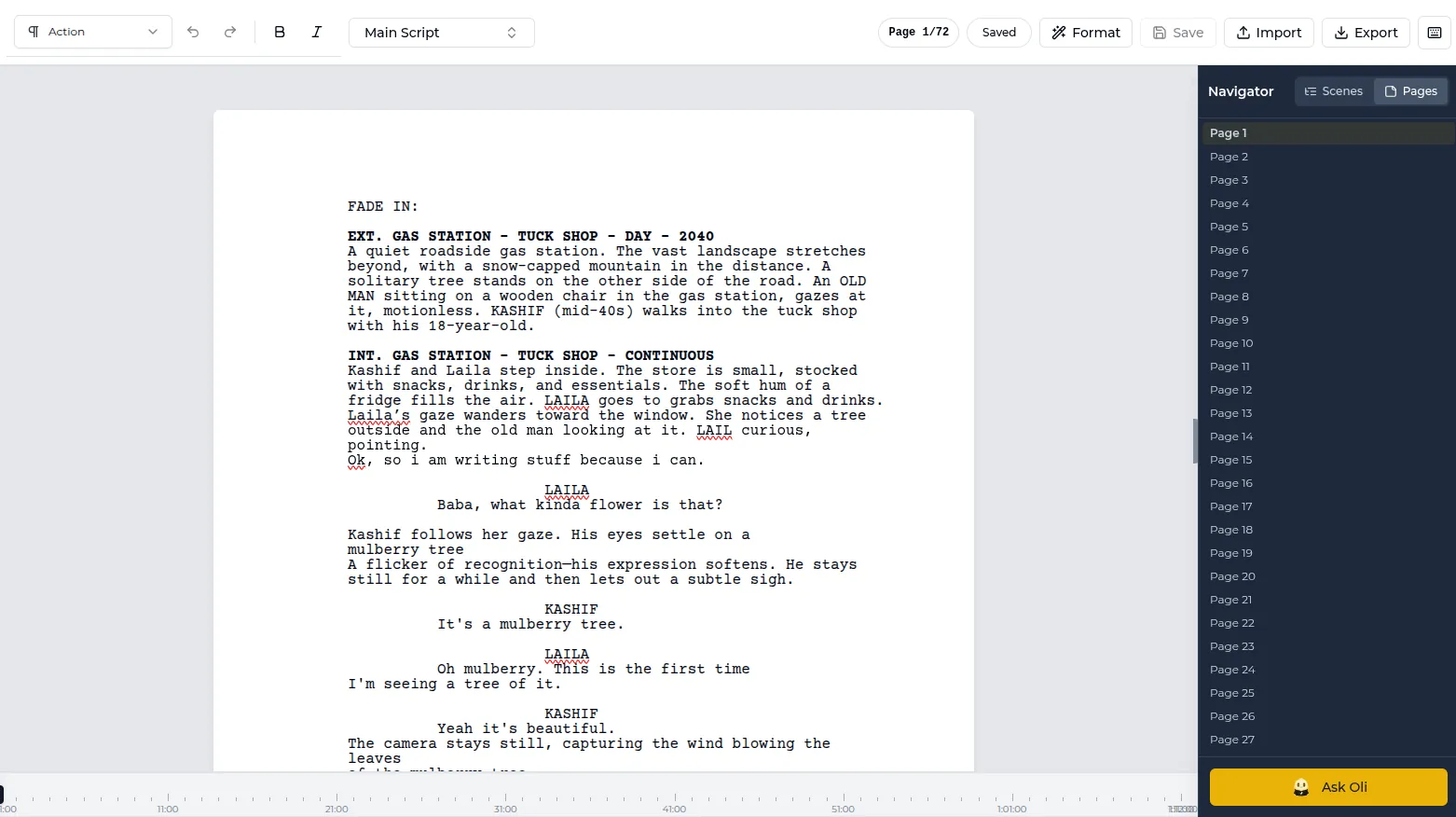
Lowerated's Scriptwriter applies industry-standard screenplay formatting as you type, so scene headings, action, character names and dialogue land in the right place and your page count stays honest. When a line feels flat, you can ask Oli, the AI writing partner, to rewrite only the line you select. Nothing changes until you accept it. When the draft is ready, you export a clean PDF for readers and the team.
The clip shows Oli suggesting rewrites for a selected line of a script, which the writer can accept or ignore.
FAQ
How many pages should a 5 minute short film be?
About 5 pages in standard format. Time a table read to confirm, since action and pauses can stretch it.
Do short films need three acts?
They need a beginning, middle and end, but not a formal three-act structure. Many shorts work as setup, complication and turn.
Can a short film have no dialogue?
Yes. Many strong shorts tell the story through action and image. Write the action lines clearly so the reader can see the film.
Should I write a short as a proof of concept for a feature?
It can work if the short stands on its own as a complete story. A short that only feels like a trailer for a feature is harder to program.
Key takeaways
- Build a short around one character, one want and one turning point.
- Aim for 5 to 15 pages, which is about 5 to 15 minutes on screen.
- Set limits on locations, cast and night work before you start writing.
- Outline five to eight beats, write a fast draft, then cut hard.
- Use standard screenplay format so the page count and schedule are reliable.