Writing a Low-Budget Screenplay


By Muhammad Wisal and Muhammad Ali / 7 min read
A low-budget screenplay is a script written so it can be shot with little money: few locations you can actually get, a small cast, mostly day scenes, and no stunts, crowds or effects unless the story depends on them. The best way to write one is to start from what you have access to, design the story around it, then check every scene against a script breakdown before you call the draft done.
What makes a screenplay expensive to shoot?
A screenplay gets expensive through what it asks the production to supply, not through its length alone. Every location, actor, night, vehicle and special effect on the page turns into people, time and gear. Here are the usual cost drivers and the cheaper choices writers use instead.
| Cost driver | Why it costs money | Lower-cost choice |
|---|---|---|
| Many locations | Each one needs finding, permission, travel and setup time, and moving the unit between them eats shooting hours | Fewer locations, with several scenes in each |
| Night exteriors | Lighting large outdoor areas needs more gear and crew, and night shoots tire everyone out | Move scenes inside, or to day, where the story allows |
| Speaking roles | Every actor needs casting, scheduling, feeding and, often, paying | Merge minor characters; give lines to characters already in the scene |
| Crowds and extras | People to recruit, dress, feed and direct, plus control of a public space | Imply the crowd through sound, an off-screen voice or a tight frame |
| Moving vehicles | Picture cars, safe rigging or towing, road permissions and extra crew | Parked car scenes, or the drive happens between scenes |
| Stunts, weapons, fire, water | Specialists, safety planning and often insurance requirements | Keep the danger off screen and show the aftermath |
| Children and animals | Limited working hours, supervision and handlers; rules vary by country and state | Write them out unless the story needs them |
| Period or unusual settings | Wardrobe, props, set dressing and locations that look right | Present day, in places that exist as they are |
| Specific weather or seasons | You wait for it or fake it | Write weather you are likely to get on your shoot dates |
| Famous songs written into scenes | Music has to be licensed, which can be costly or refused | Describe the mood of the music, not a named track |
| Visual effects | Planning on set plus specialist work in post | Practical solutions or storytelling that avoids the effect |
For a sense of how these choices add up in money, see how much a short film costs. For music in particular, read music licensing for independent films before you name a song in your script.
How do you write a low-budget screenplay step by step?
- List what you can get for free or cheap. Places you have keys to, people who will act, props you own, vehicles you can borrow, skills in your circle. This list is your production design.
- Choose a story that fits a contained world. Stories set over a short time, among a few people, in a few places, cost less by design. Think of a night in one house, a road that never leaves the car, a workplace after hours.
- Cap your locations early. Decide a number before you outline. For a short, two or three is a workable target; a first feature built around a handful of main locations is common. Then make each location work hard, with scenes at different times and in different rooms.
- Keep the speaking cast small. Give each character a reason to be there. If a role has one line, give that line to someone already in the scene.
- Prefer day interiors where the story allows. Keep night exteriors for the moments that need them.
- Spend on one thing. If the story has one moment that needs scale, keep it and make everything else simpler. A script that is small everywhere except its key scene often reads better than one that is mid-sized throughout.
- Run a breakdown pass on your draft. Go scene by scene and list cast, extras, locations, props, wardrobe, vehicles and special needs. Anything that surprises you is a rewrite note.
- Check length. Every page is roughly a minute and part of a shoot day. A tighter script is a cheaper shoot.
What does a low-budget rewrite look like?
Here is a short film, "Hollis Creek", about two estranged sisters, Ines and Corrie, clearing out their late father's cabin. The first draft was written without a budget in mind. The second was rewritten around a cabin the director's family owns.
| Item | First draft | Low-budget rewrite |
|---|---|---|
| Locations | Cabin, town diner, gas station, funeral home, lake, highway, motel | Cabin (interior, porch, yard), dock on the lake behind it |
| Speaking roles | 7, including a waitress, a mechanic and a funeral director | 3: Ines, Corrie and a neighbor who drops by |
| Night exteriors | 4 scenes | 1 scene, on the porch, lit from the house |
| Extras | Mourners at a funeral | None; the funeral happened before the film starts |
| Vehicles | Highway driving scene | Corrie arrives; we hear the car before we see her |
| Running time | 22 pages | 14 pages |
The story lost nothing it needed. The diner argument moved to the kitchen, where the sisters are surrounded by their father's things, which gives the scene more weight. The funeral became a line of dialogue. The shoot shrank from several company moves to one base for the whole schedule.
How do you keep a low-budget script from feeling small?
A low-budget script feels small when its limits look like compromises. It feels strong when the limits are part of the idea. A few ways to get there:
- Use pressure instead of scale. A deadline, a secret, a locked door or a storm outside gives a contained story tension without new locations.
- Let sound do the work. A crowd heard through a wall, a siren that gets closer, a phone that keeps ringing. Sound is far cheaper than picture.
- Make the location a character. A single place with history, clutter and rules gives the audience a world to learn.
- Write for performance. Small casts let you give each actor more to play. Strong roles also help you attract good actors who work for less.
Many well-known first films are contained stories. Kevin Smith's "Clerks", for example, is set almost entirely in and around the store where he worked. The guide to planning a single-location film goes further into that approach.
What are common low-budget screenwriting mistakes?
- Writing big and planning to cut later. Cuts made in pre-production usually hurt more than choices made in the outline.
- "Just one" expensive scene, many times over. One crowd, one car chase, one rooftop. Each one alone seems fine; together they double the budget.
- Assuming locations are free. A friend's restaurant may only be free on a Monday, and only until noon. Ask before you write it in.
- Ignoring night. Night scenes slow shoots down. A script that is half night exteriors is a harder shoot than its page count suggests. See how to plan a night shoot.
- Too many minor characters. Every cashier, cop and receptionist with a line is another actor to find and schedule.
- Naming songs and brands. A specific track or a branded product in the action can lead to licensing or clearance problems.
Checking your script's cost with a breakdown in Lowerated
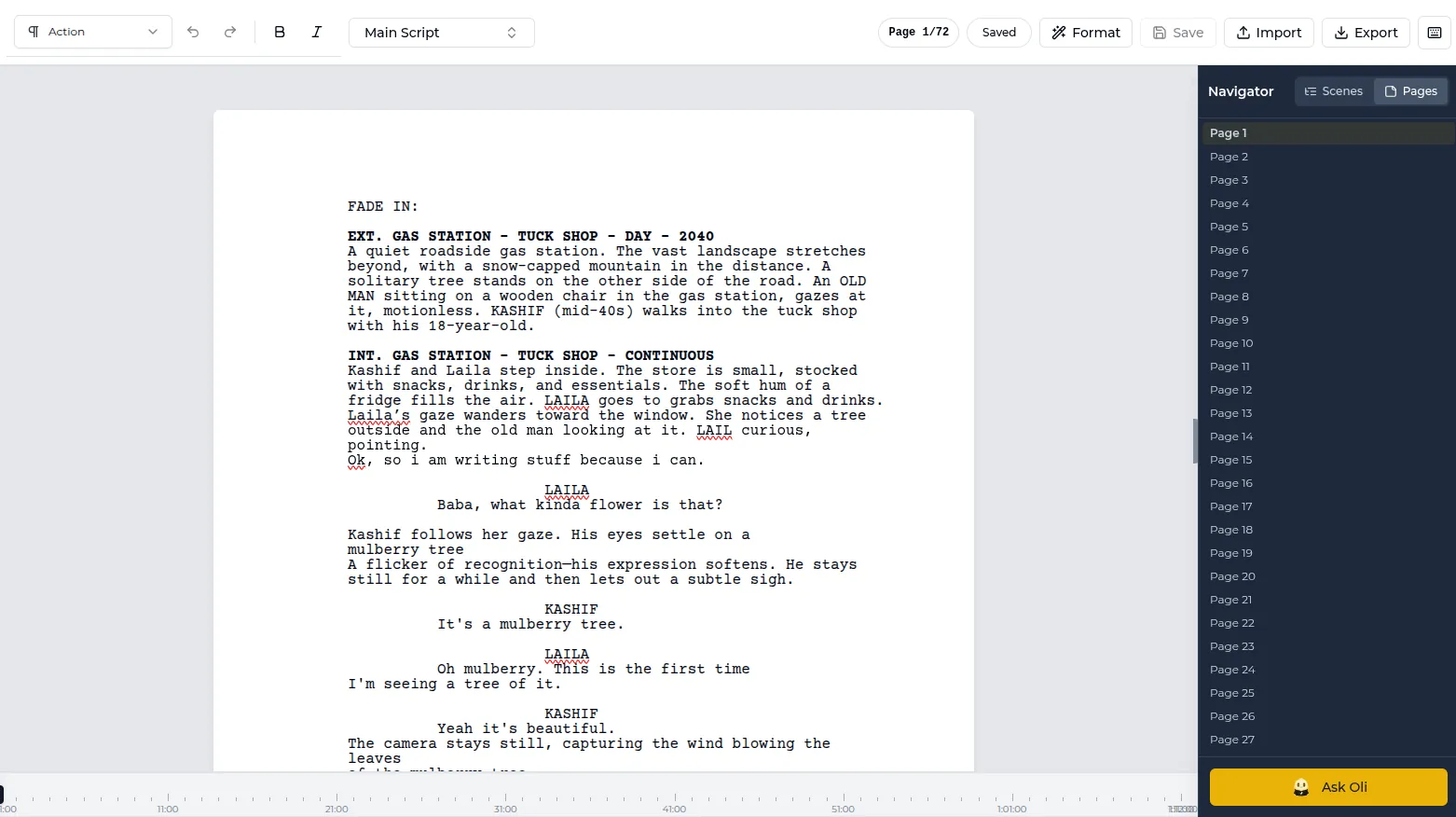
A script breakdown lists everything each scene needs, which makes it the most direct way to see what your screenplay will ask for. In Lowerated, you can tag props, wardrobe, cast and locations right in the script; tag something once and every mention is tagged. The scene breakdown is then built from your screenplay, and you review and adjust it instead of typing it from scratch. Read more about turning a script into a breakdown.
The clip shows a scene breakdown of cast, props, wardrobe and locations built from the screenplay, then reviewed and adjusted.
The recording shows props and cast being tagged directly in the script.
FAQ
How many locations should a low-budget screenplay have?
There is no fixed number. For a short, two or three locations is a practical target. For a feature, aim for a handful of main locations with several scenes in each.
Is a single-location script a good idea?
It can be, if the story has enough pressure to hold one place. Give the location several areas and times of day so it does not feel static.
Should I write the budget into the script?
No. Write the story, and let the choices of place, cast and action keep it affordable. The budget itself is a separate document built later from the breakdown.
Can a low-budget script still have action?
Yes, if you plan it carefully. Keep it short, contained and safe, and show the result of danger rather than the stunt itself.
Key takeaways
- Cost comes from locations, cast, night exteriors, crowds, vehicles, stunts, effects and named music.
- Start from what you can access, and shape the story around it.
- Cap locations and speaking roles before you outline, not after you draft.
- Spend on the one moment that matters and keep everything else simple.
- Run a breakdown on your draft to see exactly what each scene asks for.