How to Write a TV Series: Seasons, Episodes and Show Bible


By Muhammad Wisal and Muhammad Ali / 7 min read
To write a TV series, you design the engine that produces episodes, then write the documents that prove it works: a pilot script, a show bible, and a season arc broken into episode outlines. The pilot shows the show at its best. The bible shows it can run for years. Write them together, because each one exposes problems in the other.
How is writing a TV series different from writing a film?
A film tells one story and ends. A series needs a situation that keeps generating stories, with characters who can stay in conflict for many hours without the show running out of road. Writers call this the engine of the show. A detective series has a new case every week. A family drama has a family that cannot leave each other alone. If you can pitch ten episodes from your premise without strain, you have an engine. If you can only pitch the first and the last, you may have a film.
TV also has its own structure. Episodes usually carry an A story (the main plot of the episode), a B story (a second plot, often personal), and sometimes a C story (a light runner). Each episode closes its own question while moving the season question forward.
What is the difference between episodic and serialized TV?
An episodic show resolves its main story inside each episode, so you can watch them in almost any order. A serialized show tells one long story across the season, so each episode depends on the last. Most current dramas sit in between: a case or problem of the week inside a season-long arc. Decide where your show sits before you outline, because it changes how much each episode must stand alone.
How long is a TV script?
Page counts depend on the format and the outlet, so treat these as typical ranges, not rules. A half-hour comedy script often runs about 25 to 35 pages. A one-hour drama often runs about 50 to 65 pages. Shows made for ad-supported channels are written with act breaks where the ads fall. Shows for streaming may have no ad breaks but still use act structure to shape the episode. Read scripts from shows like yours and match them. See how to write a TV pilot for the pilot itself.
What goes in a show bible?
A show bible is the reference document that explains the series to a producer, a network or a writers' room. Lengths vary widely, from a few pages for a pitch to a long working document on a show in production. These are the usual sections.
| Section | What it contains | Example |
|---|---|---|
| Title and logline | One or two sentences that sell the premise | "Night Ferry": a disgraced ferry captain takes the last night route between two islands and finds every crossing brings a passenger with a secret |
| Format | Half hour or hour, number of episodes, episodic or serialized | Eight one-hour episodes, crossing of the week inside a season arc |
| Engine | Why the show can keep making episodes | A new passenger each night, and the captain's past on the island she cannot avoid |
| World and tone | Setting, rules, visual and emotional tone, comparable shows | Remote island towns, fog, slow-burn mystery with dry humor |
| Main characters | Want, need, flaw, and where each one starts and could go | Captain Odile Varga, deckhand Teo, harbor police chief Ruth Abara |
| Pilot summary | The first episode in a page or less | Odile takes the job no one wants and ferries a man who never gets off |
| Season one arc | The season question and how it is answered | Why was Odile's license pulled, and who on the island arranged it |
| Episode loglines | One or two lines per episode | Ep. 3: a wedding party books the whole ferry and one guest wants off mid-crossing |
| Future seasons | Where the show could go after season one | Season two moves the route to the mainland |
How do you map a season? A worked example
A season map lays out each episode's A story, B story and the beat it adds to the season arc. Here is the first half of season one for "Night Ferry".
| Episode | A story | B story | Season arc beat |
|---|---|---|---|
| 1 (Pilot) | A passenger vanishes mid-crossing | Odile moves into her late father's house | We learn she lost her license after a crash |
| 2 | A teenage runaway hides on board | Teo owes money to the wrong people | Ruth starts watching Odile |
| 3 | The wedding party crossing | Odile's sister arrives uninvited | A guest recognizes Odile from the crash |
| 4 | A storm traps the ferry overnight | Teo and Ruth clash over his debts | Odile finds the crash report was altered |
Read across a row and you get one episode. Read down the last column and you get the season. If a row has no arc beat, that episode is filler. If the arc column moves too fast, you run out of story by episode five.
How do you write a TV series step by step?
- Find the engine. Write the premise as a logline, then list ten episode ideas. If the list comes easily, move on. Read how to write a logline.
- Build the characters for the long run. Give each lead a flaw that causes trouble every week and a need that can take seasons to meet.
- Choose the format. Half hour or hour, episode count, and where you sit between episodic and serialized.
- Map the season. Fill in the A story, B story and arc beat for every episode, as in the table above.
- Outline the pilot. Break it into acts and beats. A beat sheet helps you see where the act breaks land.
- Write the pilot. It has to introduce the world and characters and still tell a complete, entertaining episode.
- Write the bible. Use the sections above. Update it as the pilot changes.
- Get feedback and revise. Hold a table read, rewrite, and keep each revision as a separate draft.
What are common mistakes when writing a TV series?
- Writing a pilot that is all setup, so nothing happens until the last page.
- Spending the best idea for the whole show in episode one.
- An engine that only works once: a mystery solved in the finale with no reason for a season two.
- A bible that is a long backstory document instead of a guide to future episodes.
- Characters who change completely in one episode, leaving nothing to explore.
- Ignoring the format of the outlet you are aiming at, so page counts and act breaks are wrong.
For a close look at how a long-running drama builds its engine, read how to write the next Breaking Bad. On a produced show, the showrunner keeps the bible and the room aligned.
How to write a TV series in Lowerated
In Lowerated, a series project holds its seasons and episodes, so the pilot and later episodes sit in one place instead of a folder of loose files.
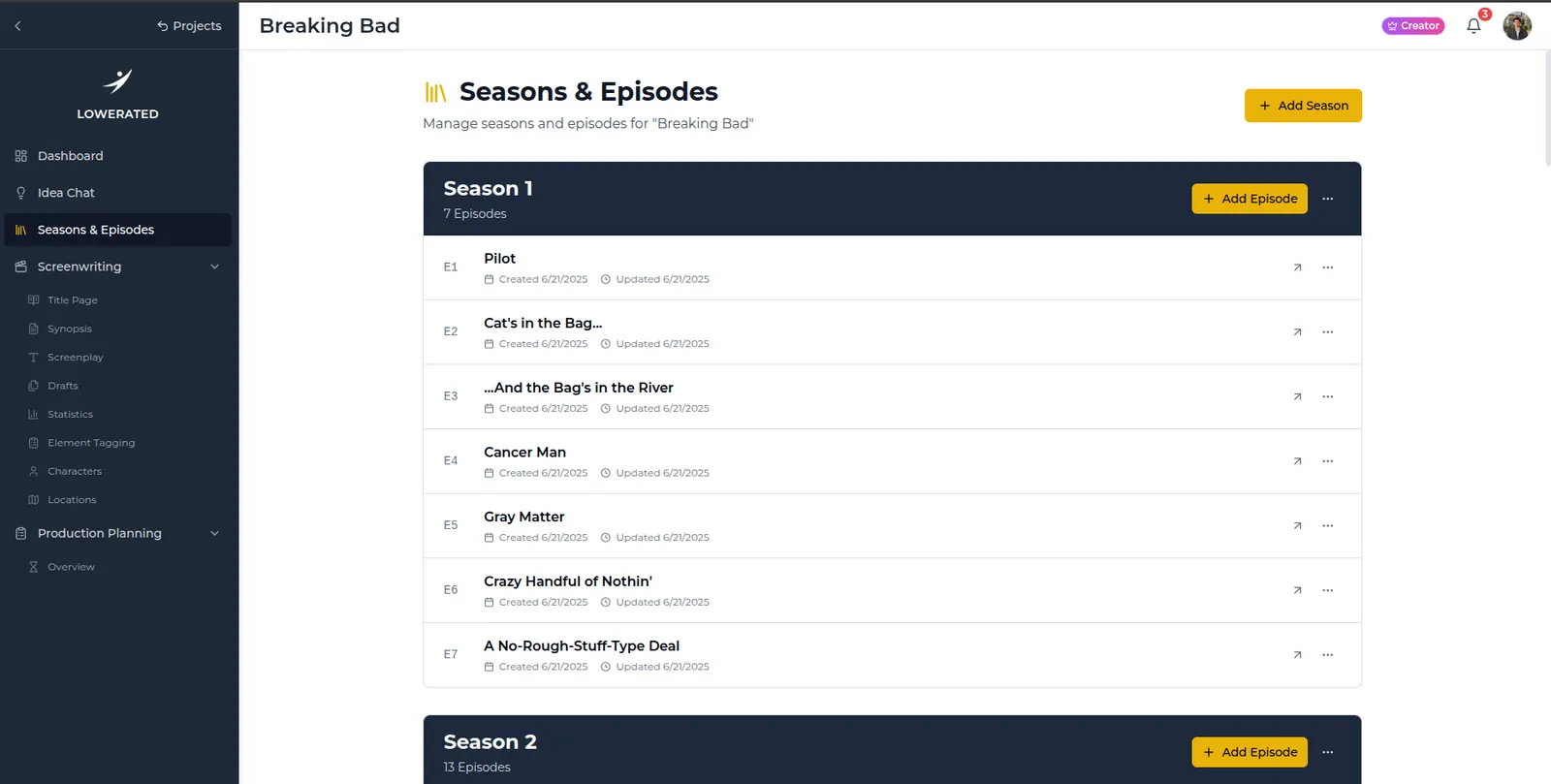
- Set up the series. Create the project and add season one with its episodes.
- Capture ideas as they come. Record voice notes, which are transcribed into Idea Chat, and develop episode ideas there.
- Write each episode in the editor. Formatting is applied as you type. Characters you write appear on the characters page, with AI-drafted profiles you can edit, which helps keep a large cast consistent across episodes.
- Write with your room. Co-writers can work live in the same script and leave comments.
- Keep every revision. Save drafts and track revisions with revision colors, then export a clean PDF to send out.
The clip shows writers working on the same script at the same time in Lowerated.
The clip shows how drafts and revisions of a script are kept in Lowerated.
If you write with a partner, see how screenwriters collaborate on a script.
FAQ
Do I need a show bible to pitch a series?
Often yes, or at least a short version. Producers want to see that the show can last beyond the pilot, and the bible is where you show it.
Should I write the pilot or the bible first?
Many writers draft a short bible first to test the engine, then write the pilot, then expand the bible. Keep updating both.
How many episodes should I plan for season one?
Plan to the format you are aiming at. Shorter seasons of six to ten episodes are common for streaming dramas, but this varies by outlet and country.
Can I write a spec episode of an existing show?
Yes, as a writing sample. Original pilots are now the more common sample, so check what the fellowship, agent or producer asks for.
Key takeaways
- A series needs an engine: a situation that keeps producing episodes.
- Write the pilot, the show bible and the season map together.
- Give each episode an A story, a B story and one beat of the season arc.
- Match page counts and act breaks to the format and outlet you are aiming at.
- Keep every revision, and update the bible as the pilot changes.