How to Write a TV Pilot


By Muhammad Wisal and Muhammad Ali / 7 min read
To write a TV pilot, decide what kind of show it is (half-hour or hour, episodic or serialized), pick whether the pilot shows the world's starting event or a typical episode, outline it act by act to the format's page count, and end it in a way that makes the reader want episode two. The pilot has to work as a good episode and as proof the show can run for years.
What is a TV pilot, and what does it have to do?
A TV pilot is the first episode of a series, written to sell the show. It has two jobs that pull against each other. It must tell a complete, satisfying story on its own, and it must set up the engine that will produce dozens more episodes: the world, the core cast, the central conflict and the kind of story the show tells every week.
In the industry, an original pilot is also the main writing sample for TV writers. Managers, showrunners and staffing programs usually ask for an original pilot rather than a spec episode of an existing show, so even if your series is never made, the pilot can get you work.
What is the difference between a premise pilot and a non-premise pilot?
A premise pilot shows the event that starts the series. A non-premise pilot drops the audience into a typical episode of a world that already exists.
| Type | What it does | Good for | Risk |
|---|---|---|---|
| Premise pilot | Dramatizes the inciting event: the move, the death, the new job, the crime | Serialized dramas and shows whose situation is unusual | Reads like a movie's first act, and the reader may not see what episode five looks like |
| Non-premise pilot | Shows the show as it will run week to week | Procedurals, workplace comedies, hangout shows | Can feel flat if the world is not established quickly |
A useful test: if the show's situation only exists because of something that happens in the pilot, you probably need a premise pilot. If the situation already exists when the show starts (a hospital, a restaurant, a police unit), a non-premise pilot usually reads stronger.
How long is a TV pilot, and how is it structured?
Page count depends on the format, and readers notice when a pilot is far outside the usual range. The figures below are typical industry ranges, not rules. See how long a screenplay is for other formats.
| Format | Typical pages | Common structure |
|---|---|---|
| Half-hour single-camera comedy | About 25 to 35 | Cold open, two or three acts, sometimes a tag |
| Half-hour multi-camera comedy | About 45 to 55 (formatted with extra spacing) | Teaser, two acts with scenes lettered A, B, C, tag |
| Hour-long drama | About 50 to 65 | Teaser or cold open, then four or five acts |
| Streaming drama | Varies widely, often 45 to 65 | No commercial breaks, but writers still build turns where act breaks would fall |
Each act should end on a turn: a reveal, a decision or a complication that changes what the characters want next. On broadcast TV these were placed before commercial breaks, and readers still expect them in spec pilots. Act breaks are written in the script as "END OF ACT ONE" and the next act starts on a new page with "ACT TWO". Format rules for the rest of the page are in how to format a screenplay.
How do you write a TV pilot step by step?
- Define the engine. Write one sentence describing what happens in a typical episode. "Each week, a public defender takes a case nobody else will touch" is an engine. "A woman's life falls apart" is not.
- Write the logline and a short series overview. One sentence for the show, then a page on the world, the main characters and where season one goes. This keeps the pilot honest about what it sets up.
- Choose premise or non-premise. Use the test above.
- Build the core cast. Most pilots introduce somewhere between four and eight regulars. Give each one a want that will create conflict for years, not one that the pilot resolves.
- Outline A, B and C stories. The A story carries the episode. The B and C stories give other regulars something to do and show the range of stories the show can tell.
- Outline act by act. Write each act's opening situation and the turn that ends it. Check the turns escalate.
- Write the cold open last if you are stuck. The opening few pages often become clear only once you know how the episode ends.
- End with a question, not a cliffhanger for its own sake. The last scene should make the reader want to see the series, usually by revealing what the characters are now stuck with.
- Read it for length and balance. Check total pages against the format and see whether one character is eating the episode.
What does a pilot outline look like? A worked example
Here is an outline for "Last Ferry," an hour-long premise pilot. Odette Mariner inherits her late father's failing ferry service to a small island, along with his debts and a crew who think she will sell. Engine: each week, something the island needs has to cross the water, and someone does not want it to.
| Section | Pages | What happens | Turn |
|---|---|---|---|
| Cold open | 1 to 4 | Night crossing in a storm. Odette's father radios the harbor, then the signal cuts out | The ferry arrives with nobody at the wheel |
| Act one | 5 to 17 | Odette, a city accountant, arrives for the funeral. The engineer, Bram, assumes she is there to sell | A buyer offers cash for the boat and the route by Friday |
| Act two | 18 to 30 | Odette rides one crossing to see the business. B story: deckhand Lucinda is hiding a pregnancy from her mother | The ledger shows her father was carrying unregistered cargo |
| Act three | 31 to 43 | Odette tracks the cargo to a harbor official. C story: Bram applies for a job on the mainland | The official tells her the buyer is the person her father owed |
| Act four | 44 to 55 | Odette refuses the sale and has to run Friday's crossing herself with half a crew | Bram stays on board instead of leaving |
| Tag | 56 to 58 | Odette opens her father's locked cabin | Inside: a second ledger with names of island families |
The pilot resolves its episode story (Odette keeps the ferry) and opens the series question (who on the island is in that ledger). Every regular has a want that can run for seasons.
What are common mistakes in TV pilots?
- Too much backstory. Flashbacks and explanation crowd out the present. Trust that later episodes can carry history.
- A pilot that is really a movie. If the central problem is solved by the end, there is no series.
- Introducing too many characters. Readers lose track of a dozen names in 30 pages. Save some regulars for episode two.
- No clear engine. If a reader cannot guess what episode six is about, the show feels thin.
- Soft act breaks. Acts that end on a mood instead of a turn make the script feel long, whatever the page count.
- Ignoring the format. A 70 page half-hour comedy gets put down before page ten.
How to write a TV pilot in Lowerated
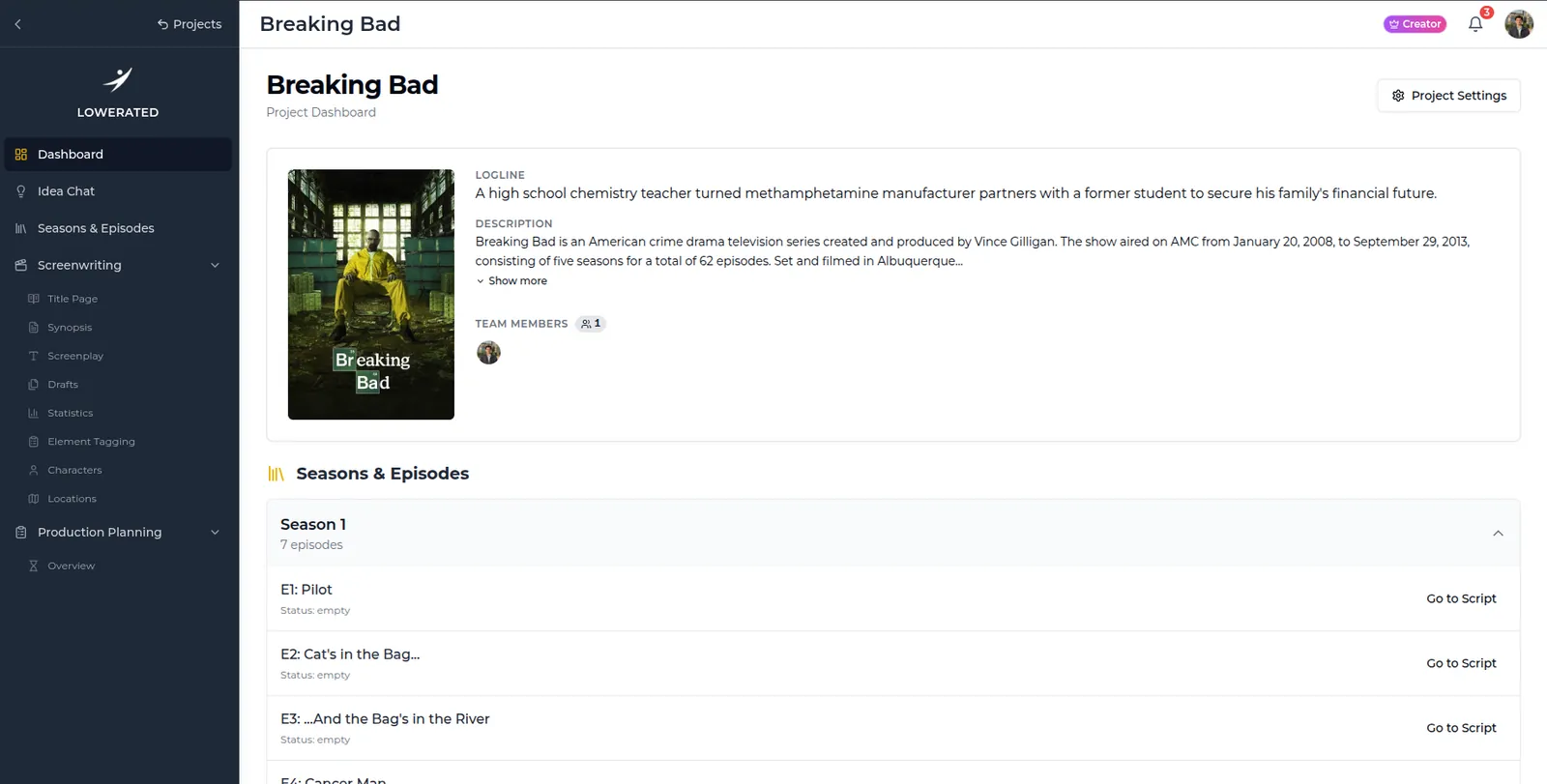
Lowerated keeps a series in one project. You add each season and its episodes, and each episode has its own script, so the pilot, the next episodes and your notes on the show live in one place.
- Create the series project. Add season one and set the pilot as its first episode.
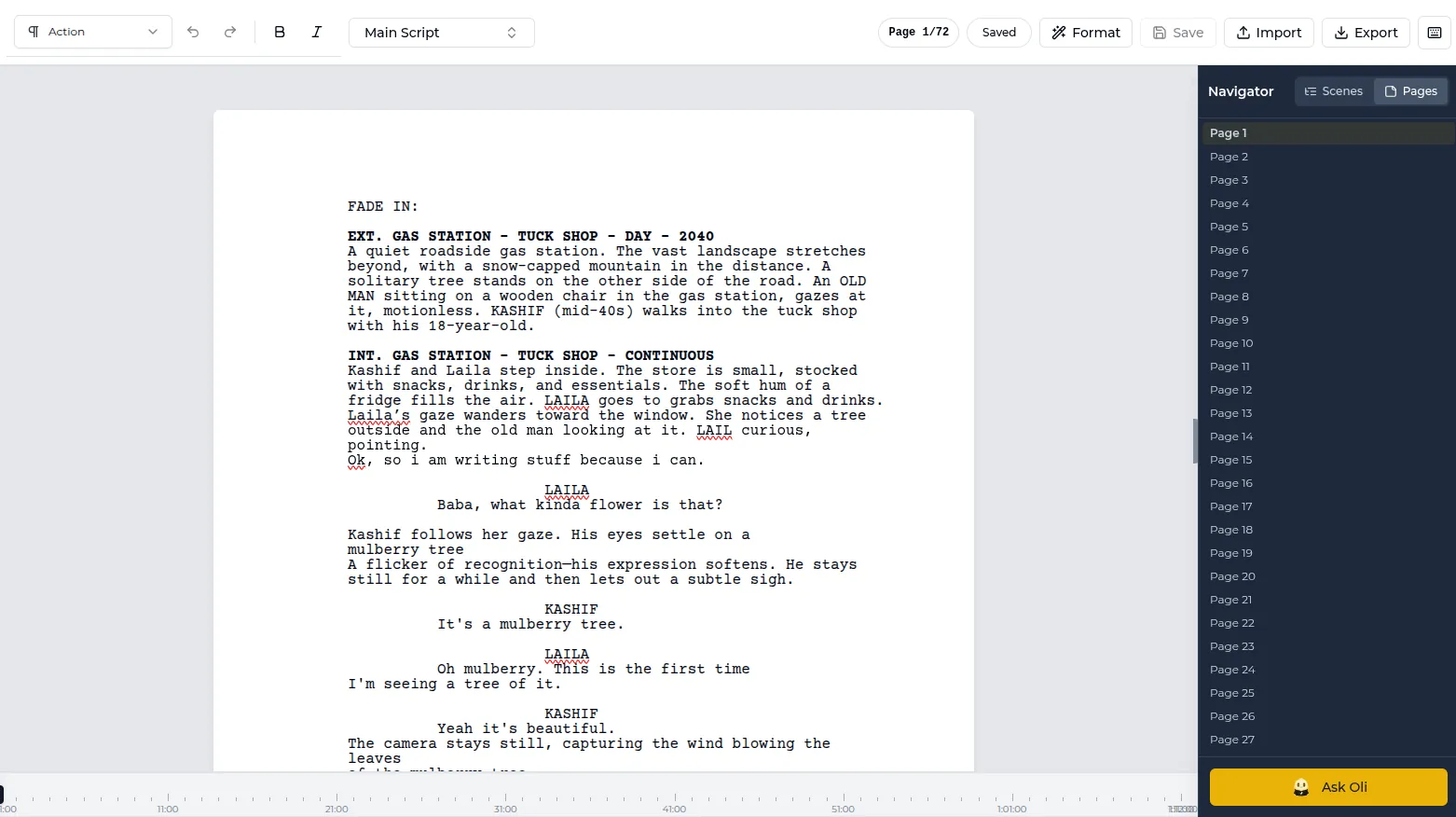
- Write the pilot in the editor. Scene headings, action, character names and dialogue fall into industry-standard format as you type.
- Check length and balance. Script statistics show dialogue share per character, scene lengths, day and night scenes and locations, which helps you spot a regular who barely speaks or a scene that runs long.
- Keep drafts and export. Save drafts as you revise, then export a clean PDF when it is time to send the pilot out.
The recording shows a scene being typed while the formatting is applied automatically.
The clip shows script statistics: how much each character speaks, scene lengths, day and night scenes and locations.
For planning the full season and show bible, see how to write a TV series, and for a long-form example, how to write the next Breaking Bad.
FAQ
Should I write a pilot or a spec episode of an existing show?
For most new TV writers today, an original pilot is the expected sample. Some fellowships and programs still accept or ask for specs of current shows, so check each one's rules.
Do I need a show bible with my pilot?
Not to submit to most contests or managers. A short series overview of a few pages helps when a producer asks where the show goes after the pilot.
Can a pilot be shorter than the usual page count?
A few pages under is fine. Far outside the typical range suggests the writer does not know the format, so trim or expand before sending.
How many characters should a pilot introduce?
Enough to show the ensemble, usually four to eight regulars, each introduced through action that shows what they want.
Key takeaways
- A pilot must work as a complete episode and prove the show can run for years.
- Choose a premise pilot when the situation starts in the pilot, and a non-premise pilot when the world already exists.
- Match the page count and act structure of your format.
- Define the engine in one sentence before you outline.
- End each act on a turn and end the pilot on the question the series will answer.