How to Come Up With Movie Ideas (Plus an Idea Generator Method)


By Muhammad Wisal and Muhammad Ali / 7 min read
The fastest way to come up with movie ideas is to combine a character, a want, an obstacle and a setting you would not normally put together, then test the result against what you can actually shoot. A random idea generator, an AI chat tool or a simple dice table can all give you raw combinations. The work is in picking one and pushing it until it has a clear conflict.
Where do good movie ideas come from?
Good movie ideas usually start with a specific person in a specific problem. "A film about loneliness" is a theme. "A night-shift toll booth worker starts leaving notes for the same driver every night" is an idea, because you can picture a scene.
Most usable ideas come from one of these sources:
- Your own life, slightly changed. A job you had, a family argument, a place you know well. You already know the details that make a scene feel true.
- A "what if" on something ordinary. What if the lost and found office kept everything forever? What if a wedding photographer realized the groom was someone she once reported to the police?
- A location you can access. For low-budget films this is often the best starting point. A laundromat, a farm, an empty office after hours.
- A collision of genres. A heist told as a quiet family drama. A ghost story set in a call center.
- News, history and public records. Use them for situations, then invent your own characters. True stories about real people can raise rights questions, so check before you build on one.
What is a movie idea generator?
A movie idea generator is any tool or method that gives you random or prompted story combinations: a character, a goal, a setting, a twist. Some are websites with a button. Some are AI chat tools you prompt in plain language. The simplest one is a table and a die.
Generators are good at breaking a blank page. They are weak at telling you which idea is worth two years of your life. Treat every result as a starting point and run it through the test further down this page.
The idea generator method: a table you can copy
This is a simple generator you can use with one six-sided die, or a random number from 1 to 6. Roll once per column and write down the combination. Then roll again until you get three combinations that make you curious.
| Roll | Character | Wants | Obstacle | Setting | Complication |
|---|---|---|---|---|---|
| 1 | A retired stunt driver | To win back a lost reputation | A secret they swore to keep | A 24-hour laundromat | The person helping them is lying |
| 2 | A teenage beekeeper | To leave town for good | A family debt | A ferry that runs once a day | A storm closes the only road |
| 3 | A hospital night porter | To prove they are innocent | A rival who wants the same thing | A wedding venue in off-season | Someone they love arrives unannounced |
| 4 | A failing magician | To protect a younger sibling | Their own bad memory | A small-town radio station | The deadline moves up by a day |
| 5 | A court interpreter | To find out what really happened | A rule they cannot break without losing their job | A farm during harvest | They get exactly what they wanted, and it is wrong |
| 6 | A school bus driver | To finish one last job | No money and no time | An apartment building with one working elevator | A stranger knows their secret |
Replace the entries with your own. Fill the Setting column with places you can actually get into, and the Character column with people you know something about. That one change makes the generator far more useful than a generic one.
A worked example: from a roll to a logline
Say you roll 3, 5, 3, 2, 4. That gives you a hospital night porter who wants to find out what really happened, blocked by a rival who wants the same thing, at a small-town radio station, with the deadline moving up by a day.
On its own that is a jumble. Now ask questions until it hangs together:
- Who is the porter? Odile, who works nights and calls into a late-night radio show every week.
- What happened? The host, her only friend, vanished mid-broadcast. The station says he quit.
- Who is the rival? A podcaster who wants the story first.
- Why the deadline? The station is being sold and the building cleared on Friday.
Logline draft: When the late-night radio host she calls every week disappears mid-show, a hospital night porter has three nights to search the station before it is sold, while a podcaster races her for the story. That is specific enough to outline. For more on this step, see how to write a logline.
How do you know if a movie idea is good?
A movie idea is worth developing when it has a clear character, a clear want, something in the way, and stakes you can explain in one sentence. Run each idea through these questions:
- Can you say it in one sentence? If not, the conflict is probably not clear yet.
- Does the main character have to act? Ideas where things happen to a passive person tend to stall in the second act.
- Can you picture three scenes? If you can only picture the premise, there may not be a film yet.
- Can you shoot it? Count locations, cast and night scenes. A short with one location and three actors is far easier to make than one with ten. See writing a low-budget screenplay.
- Do you care about it? You will live with this idea for a long time. Pick the one you keep thinking about.
Movie idea generators compared (as of 2026)
Here is how the common options compare. Features and prices change, so check each tool's own site before you commit.
| Option | What it does | Cost | Best for |
|---|---|---|---|
| Dice table (above) | Random combinations from lists you write | Free | Writers who want ideas built from their own material |
| Reedsy Plot Generator | Web tool that builds a plot from genre, structure (such as 3-act or Save the Cat), protagonist and conflict | Free | Quick prompts and structure practice, mainly aimed at fiction authors |
| General AI chat tools (ChatGPT, Claude, Gemini) | Brainstorm in plain language, ask follow-up questions, test variations | Free tiers and paid plans | Fast back-and-forth when you already have a rough direction |
| Sudowrite | AI writing tool for fiction with brainstorming features | Paid subscription, check current plans | Novelists and prose writers |
| Lowerated Idea Chat with Oli | Idea chat inside a filmmaking platform, with voice notes transcribed into the chat, next to the screenplay editor | Basic plan free; Scriptwriter $10/month | Filmmakers who want the idea, script and planning in one project |
A few honest notes. AI tools tend to suggest familiar combinations, so push them with your own constraints (your locations, your actors, your budget). Free web generators are quick but do not remember your project. Lowerated is built for filmmakers and is more than you need if all you want is one random prompt. It also does not edit video, and it offers no writing services; the ideas and the script stay yours.
How to develop movie ideas in Lowerated
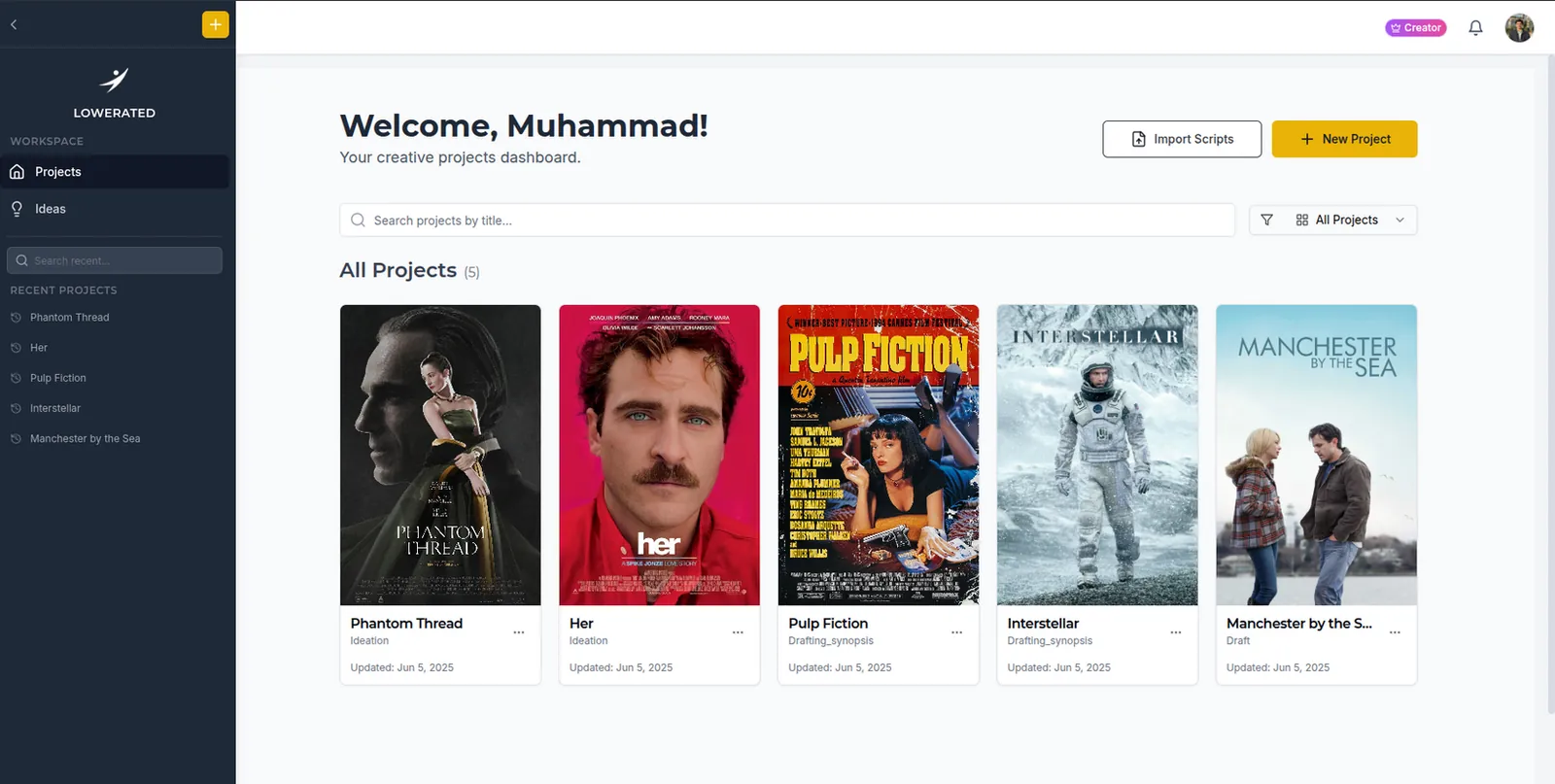
In Lowerated, ideas live in the same project as the screenplay, so nothing gets lost between a voice memo and page one.
- Capture the idea fast. Record a voice note. It is transcribed into Idea Chat.
- Talk it through with Oli. Use Idea Chat to ask questions about the premise, the stakes or the ending, the same way you would with the dice example above.
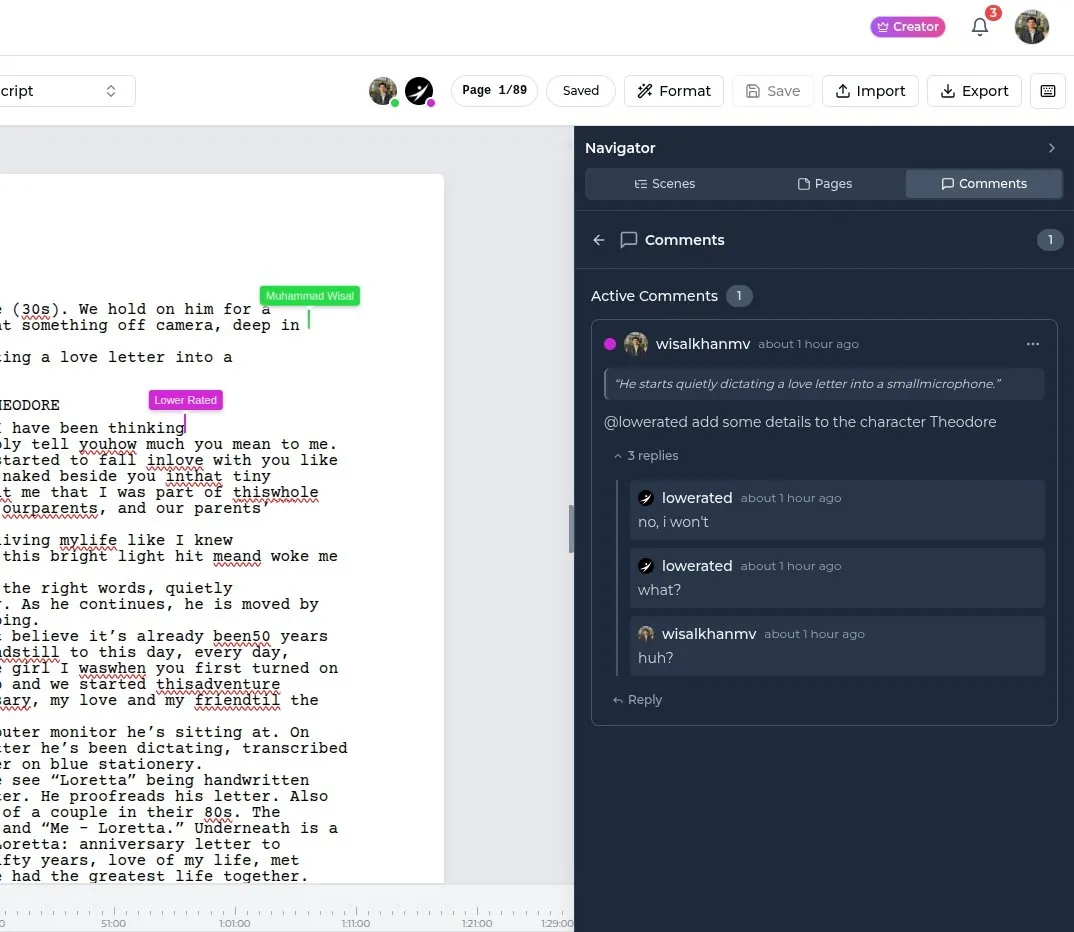
- Move into the script. Start writing in the editor, which formats to industry standard as you type.
- Rewrite line by line. Select a line and ask Oli for options. Nothing changes until you accept.
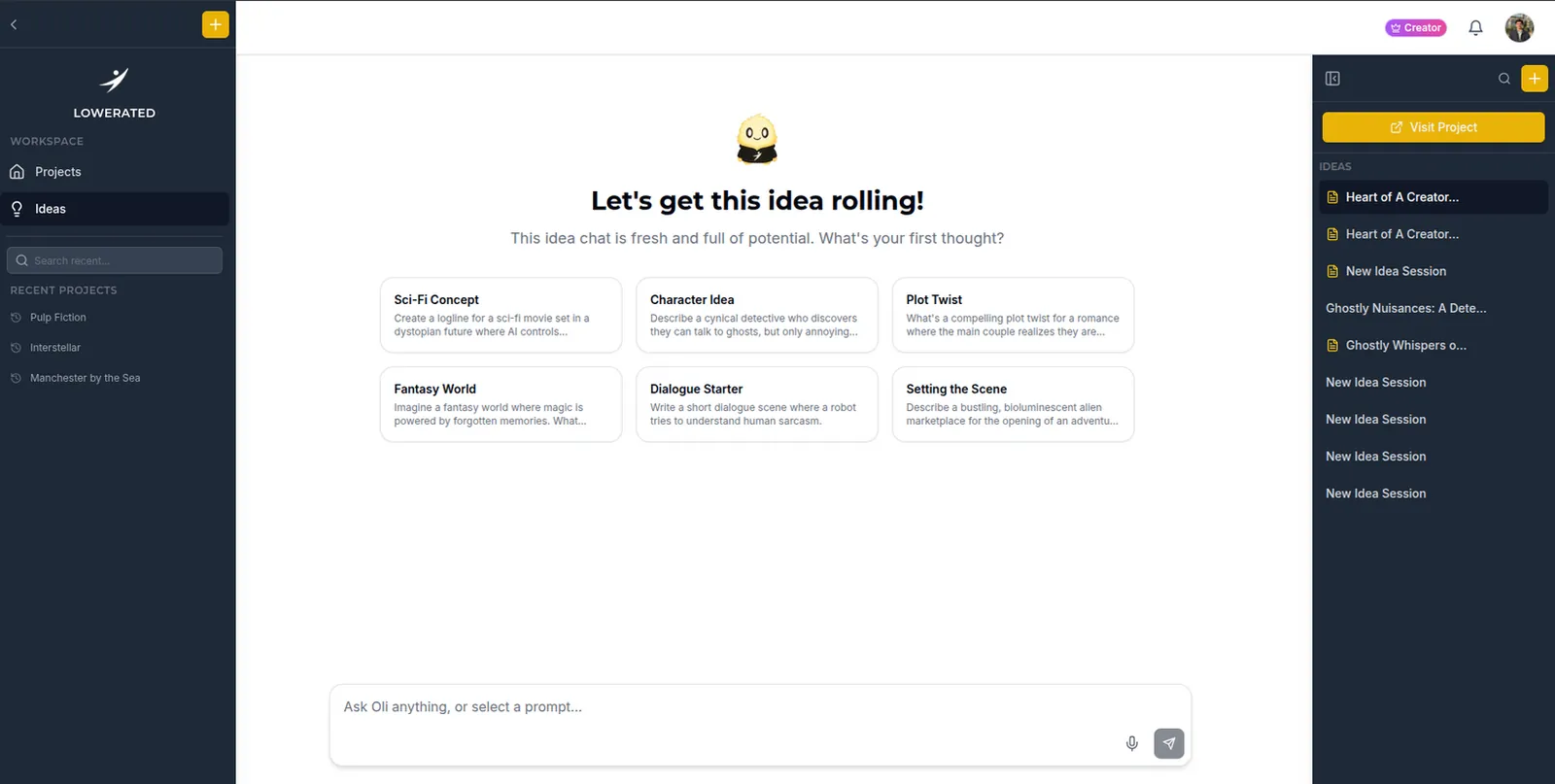
The recording shows a voice note being added to Idea Chat.
The clip shows Oli working inside the script editor.
For a longer walkthrough of AI brainstorming, read how to generate film ideas using AI.
FAQ
Can an AI generator give me a whole movie idea?
It can give you a premise. Turning that into a film still needs your choices about character, stakes and tone, and AI suggestions are often familiar unless you add specific constraints.
How many ideas should I generate before picking one?
Many writers generate ten to twenty, shortlist three, and write a logline for each. Pick the one you can explain clearly and still want to work on next week.
What is the best idea generator for a short film?
A table built from locations and people you can actually get. Short films live or die on what you can shoot, so start there.
Should I keep my movie ideas secret?
Ideas themselves are hard to protect, and execution matters more. Share them with people you trust and keep dated notes of your work.
Key takeaways
- A movie idea is a specific character with a want, an obstacle and stakes, in a setting you can picture.
- Use a generator to break the blank page, then question the result until it has a clear conflict.
- Build your own dice table from places and people you can access.
- Test every idea: one-sentence logline, an active lead, three scenes you can picture, and a plan you can shoot.
- Keep ideas in the same place as your script so the good ones turn into pages.