Beat Sheets: How to Use One Without Writing by Numbers


By Muhammad Wisal and Muhammad Ali / 6 min read
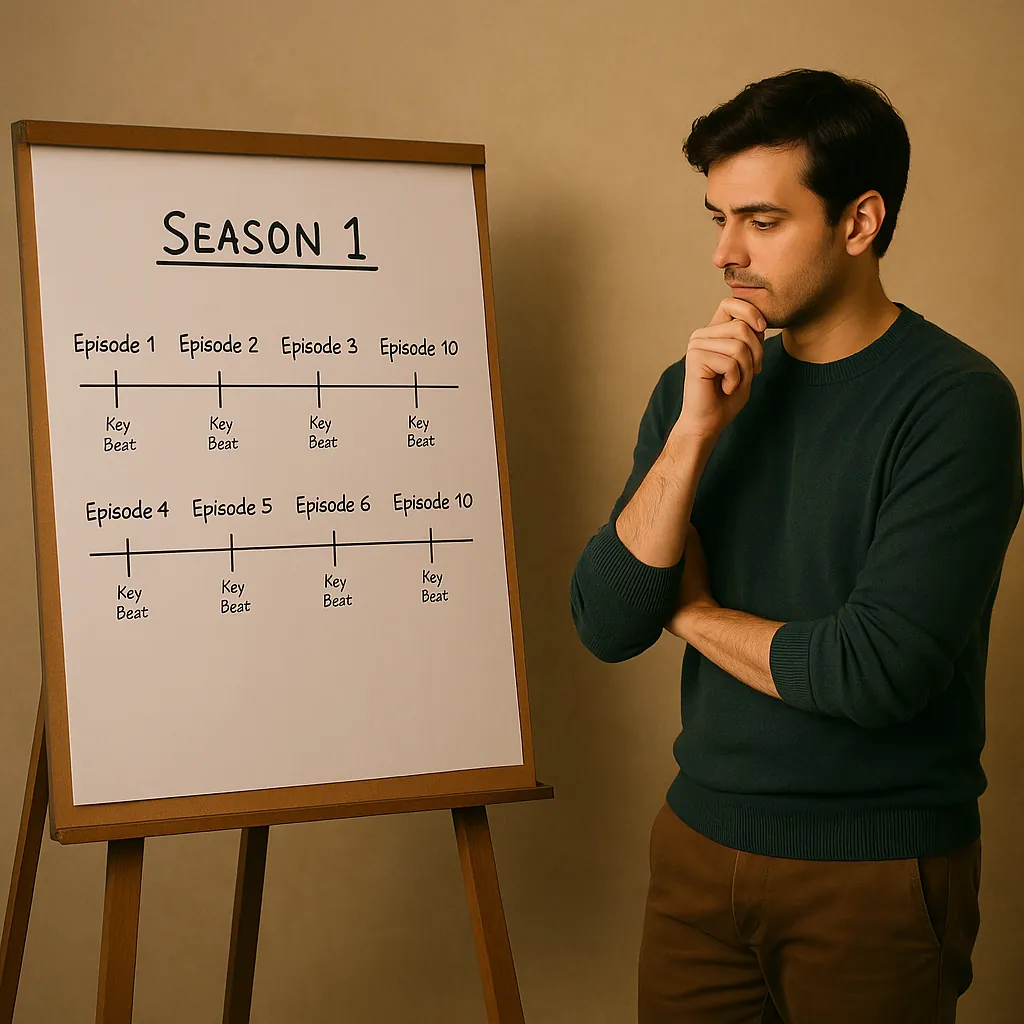
A beat sheet is a one or two page list of the key story moments in a screenplay, in order, usually with a target page for each. The best-known version is Blake Snyder's 15-beat sheet from Save the Cat. Use it to test whether your story has a clear catalyst, midpoint, low point and finale, then let your own story decide the details.
What is a beat sheet in screenwriting?
A beat sheet breaks a story into its major turning points, or beats, so you can see its shape on one page. Each beat is a moment where something changes: the character gets a problem, makes a choice, wins, or loses. A beat sheet sits between the logline and the full outline. It has more detail than three-act structure and far less than a scene-by-scene outline.
The word "beat" means other things in screenwriting too. Inside a scene, a beat is a single exchange of action and reaction. In dialogue, "(beat)" is a parenthetical that marks a short pause. A beat sheet uses the word in the largest sense: the big moments of the whole story.
What are the 15 beats in the Save the Cat beat sheet?
Blake Snyder's book Save the Cat (2005) lists 15 beats, with page targets based on a 110 page script. Here they are as a template you can copy. Fill in the right column for your story in one or two sentences per beat.
| Beat | Target page (of 110) | What it does | Your story |
|---|---|---|---|
| 1. Opening image | 1 | A snapshot of the hero's world and problem before the story starts | |
| 2. Theme stated | 5 | Someone hints at the lesson the hero needs to learn | |
| 3. Set-up | 1 to 10 | The hero's life, flaws, and what is missing | |
| 4. Catalyst | 12 | The event that disrupts everything (the inciting incident) | |
| 5. Debate | 12 to 25 | The hero hesitates: should I go? | |
| 6. Break into Two | 25 | The hero chooses to act and enters a new world | |
| 7. B Story | 30 | A second storyline, often a relationship that carries the theme | |
| 8. Fun and games | 30 to 55 | The premise in action, the scenes the poster promises | |
| 9. Midpoint | 55 | A false victory or false defeat; stakes go up | |
| 10. Bad guys close in | 55 to 75 | Outside pressure grows and the team starts to crack | |
| 11. All is lost | 75 | The lowest point, often with a loss or a symbolic death | |
| 12. Dark night of the soul | 75 to 85 | The hero sits with the loss before finding a way forward | |
| 13. Break into Three | 85 | A new idea, often from the B Story, shows the way | |
| 14. Finale | 85 to 110 | The hero applies what they learned and faces the final test | |
| 15. Final image | 110 | A mirror of the opening image that shows the change |
If your script is shorter or longer, scale the pages. For a 95 page script, multiply each target by about 0.86.
What does a filled-in beat sheet look like?
Here is a beat sheet for an invented comedy, "Last Dance". Lorna is a wedding DJ who never says no to a booking. Then her agency books her for her ex-fiancé's wedding.
- Opening image: Lorna plays a flawless reception, then eats cold canapés alone in her van.
- Theme stated: Her sister: "You make everyone else's best night. When is yours?"
- Set-up: She is broke, overbooked and proud of never turning down a gig.
- Catalyst: The booking sheet arrives. The groom is Callum, who left her two years ago.
- Debate: She tries to pass the gig on, but the fee would clear her van loan.
- Break into Two: She signs the contract and meets the bride, who is lovely.
- B Story: Theo, the wedding photographer, sees through her act from day one.
- Fun and games: Planning meetings, playlist fights, a disastrous dance lesson.
- Midpoint: Callum admits he still has feelings for her. A false victory.
- Bad guys close in: The bride suspects something, her agency threatens to drop her, Theo pulls away.
- All is lost: At the rehearsal dinner, the truth comes out and she is fired from the job.
- Dark night of the soul: She sells her decks to cover the canceled fee.
- Break into Three: Theo reminds her what she told him on day one: the music belongs to the couple.
- Finale: She returns, apologizes to the bride, and plays the wedding the couple wanted. Then she leaves before the last song.
- Final image: Lorna dances at her own small party, with no one to perform for.
How do you use a beat sheet without writing by numbers?
Use the beats as questions about your story, and treat the page numbers as a loose check. A beat sheet becomes formula when you write toward the template instead of toward your characters. These habits help:
- Write a messy version first. Draft your beats in your own words before you look at any template. Then compare and see what is missing.
- Ask what each beat is for. The catalyst exists to force a choice. If your story forces that choice another way, it still works.
- Let beats move. A catalyst on page 3 or a midpoint on page 50 is fine if the story earns it. Readers notice weak beats, not page numbers.
- Merge or skip beats that do not fit. A tragedy may not need a hopeful Break into Three. A quiet drama may have no "bad guys".
- Use it again after the first draft. Beat out what you actually wrote. The gaps between the plan and the draft show you where to rewrite.
- Keep the character arc in view. The beats describe plot, but they work best when each one also changes the hero. See character arcs and theme in screenwriting.
What are common beat sheet mistakes?
- Beats that are topics. "Midpoint: things get serious" says nothing. Write the event.
- A passive Break into Two. The hero should choose to enter Act Two, not drift into it.
- A thin B Story. If the second storyline has no arc of its own, the theme has nowhere to live.
- A finale that ignores the theme. The hero should win, or lose, because of what they learned.
- Stopping at the beat sheet. Fifteen beats are not a script. Turn them into a scene list next. The guide to outlining a screenplay covers that step.
Are there other beat sheet models?
Yes. Some writers use the hero's journey from Joseph Campbell and Christopher Vogler, others use an eight-sequence model, and many use a simple list of five turning points: inciting incident, first act break, midpoint, second act break and climax. They describe similar shapes with different labels. Pick the one that helps you see your story, or mix them.
Capturing beats in Lowerated
Beats often arrive as half-ideas away from the desk. In Lowerated you can record a voice note and it is transcribed into Idea Chat, so a midpoint idea you had on the bus sits in the same project as your script.
The recording shows a voice note sent to Idea Chat and transcribed into the project.
FAQ
Is a beat sheet the same as an outline?
No. A beat sheet lists the 10 to 15 major story moments. An outline lists every scene. Most writers do the beat sheet first.
Does the Save the Cat beat sheet work for every genre?
It fits many commercial genres well. Art-house dramas, ensemble films and experimental work often bend it, so use the beats that help and drop the rest.
Can I use a beat sheet for a TV pilot?
Yes, scaled down. Many writers beat out a pilot by act, with a teaser or cold open at the start.
Should I send my beat sheet to producers?
Usually not unless asked. Producers more often ask for a logline, a synopsis or a treatment.
Key takeaways
- A beat sheet lists the major turning points of a story on one or two pages.
- Save the Cat's 15 beats are the most common template, with page targets for 110 pages.
- Treat beats as questions and page numbers as a loose check.
- Write each beat as a specific event that changes the hero.
- Turn the beat sheet into a scene-by-scene outline before drafting.