Contingency in a Film Budget


By Muhammad Wisal and Muhammad Ali / 6 min read
Contingency in a film budget is a reserve line, usually added after all other costs, that pays for problems you cannot predict: bad weather, an extra shoot day, broken gear, a location that falls through. Many productions set it at around 10 percent of the budget subtotal, then raise or lower it depending on how risky the shoot is. It is money you plan for and hope not to spend.
What is contingency in a film budget?
Contingency is a single line near the bottom of the top sheet, after above the line, below the line, post-production and other costs. It is calculated as a percentage, not built from line items, because it covers things you do not know about yet. If you could name a cost, it would belong in its own line.
Contingency is different from these related ideas:
| Term | What it means | Example |
|---|---|---|
| Contingency | A reserve for unknown problems, set as a percentage | 10% of a 40,000 subtotal: 4,000 |
| Padding | Extra money hidden inside individual lines | Budgeting a 300 lens rental at 450 "just in case" |
| Allowance | A known cost whose exact price is not settled yet | "Music: 1,500 allowance" before the composer is chosen |
| Overage | The amount a line ends up over its estimate | Catering estimated at 2,000, actual 2,400: 400 overage |
Keep contingency visible as its own line. Padding hidden across the budget makes the real costs hard to read, and financiers usually spot it.
How much contingency should a film budget have?
Around 10 percent is the common starting point for independent films. Treat it as a default to adjust, not a rule. Things that argue for more:
- Many exterior days, especially in a season with unreliable weather.
- Night shoots, water, stunts, animals, children, or effects on set.
- Locations you do not control, or a lot of company moves.
- A first-time team, or a schedule with no slack.
- Foreign currency costs, or a shoot far from rental houses.
Things that argue for less: a short shoot in one controlled location, mostly owned gear, and an experienced crew who have worked together.
If you have a completion bond or outside financiers, they usually have their own requirements for contingency, including the percentage and what it is calculated on. Ask them early, because it changes your grand total.
What is contingency calculated on?
Practice varies. The most common approaches are:
- The full subtotal. Contingency is a percentage of everything above it. Simple and common on small films.
- The subtotal minus some items. Some budgets leave out above the line deals that are already fixed, or items such as insurance and fees whose price is locked, since those are unlikely to go over.
Whichever you use, write it in the budget notes: "Contingency: 10% of total below the line" or "10% of subtotal excluding insurance." Anyone reading the top sheet should be able to check the math. For more on the two halves of a budget, see above the line vs below the line costs.
Worked example: sizing and spending a contingency
"The Ferry at Six" is a short about a deckhand, Ruairi, and a passenger, Mireille, stuck together on a delayed crossing. Five shoot days, three of them on a working ferry. The subtotal is 40,000 USD. Because of the water and the weather, the producer, Anneliese, sets contingency at 12 percent: 4,800.
During the shoot she keeps a log of every draw:
| Date | Problem | Cost | Approved by | Remaining |
|---|---|---|---|---|
| Start | Contingency set at 12% of 40,000 | Producer | 4,800 | |
| Day 2 | Wind stopped the ferry; half day added on Day 6 | 1,900 | Producer | 2,900 |
| Day 3 | Damaged lens, insurance deductible | 500 | Producer | 2,400 |
| Day 4 | Dock parking fee higher than quoted | 250 | Line producer | 2,150 |
| Post | Extra day in the sound mix for wind noise | 600 | Producer | 1,550 |
Without the extra 2 percent for the water, the reserve would have been 4,000, and the same problems would have left 750. That is still positive, but thin going into post. Read more about what drives the total in how much a short film costs.
What should contingency be used for?
Contingency is for real surprises that threaten getting the film finished. Good uses:
- An added shoot day or half day because of weather, illness or lost time.
- Replacing or repairing broken equipment, or paying an insurance deductible.
- A location that falls through and has to be replaced at short notice.
- Overtime when a day runs long for reasons you could not control.
- Post-production fixes you did not plan for, such as extra sound work.
Poor uses: a new creative idea halfway through the shoot, a nicer camera, a wrap party upgrade, or covering a line you knew was underestimated when you wrote it. If a cost was foreseeable, fix the budget line instead.
How do you manage contingency during production?
- Decide who can approve a draw. Usually the producer. On larger shows, financiers or the bond company may need to sign off above a set amount.
- Log every draw. Date, reason, amount, who approved it, what is left. A simple table like the one above is enough.
- Compare estimates and actuals weekly. Overages show up as they happen, not at wrap.
- Move savings back. If a line comes in under estimate, you can note that saving against overages elsewhere before touching contingency.
- Protect some for post. Many producers keep part of the contingency untouched until picture lock, because post problems arrive last and money is tightest then.
What are common contingency mistakes?
- Leaving contingency out because the budget already "feels" tight. That is when you need it most.
- Hiding contingency in padded lines, so nobody knows how much reserve there is.
- Spending it on the first day on avoidable costs, leaving nothing for real problems later.
- Not writing down what the percentage is calculated on, so the math cannot be checked.
- Treating unspent contingency as a bonus. It usually goes back to investors or into finishing and distribution.
Tracking contingency in Lowerated
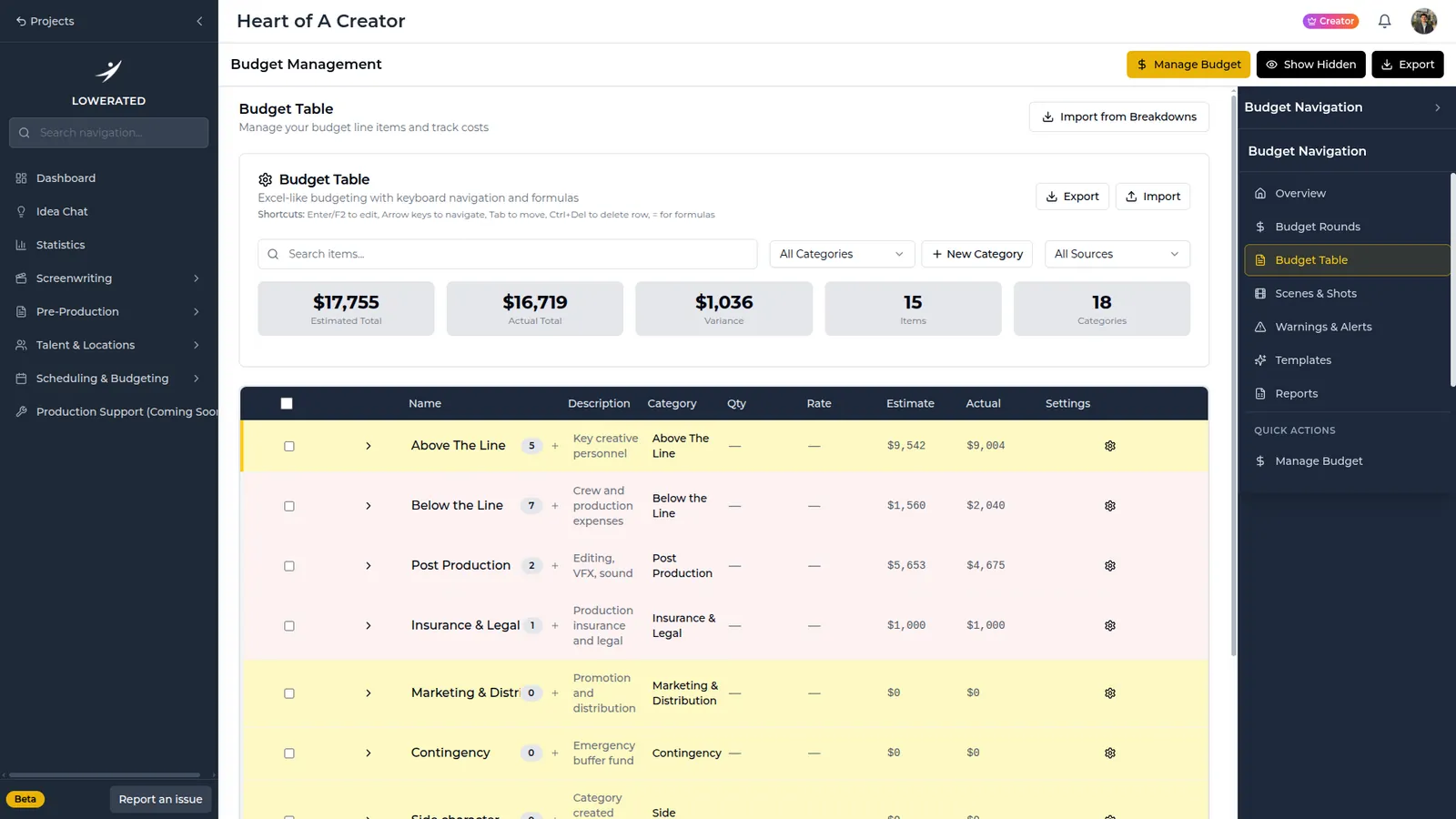
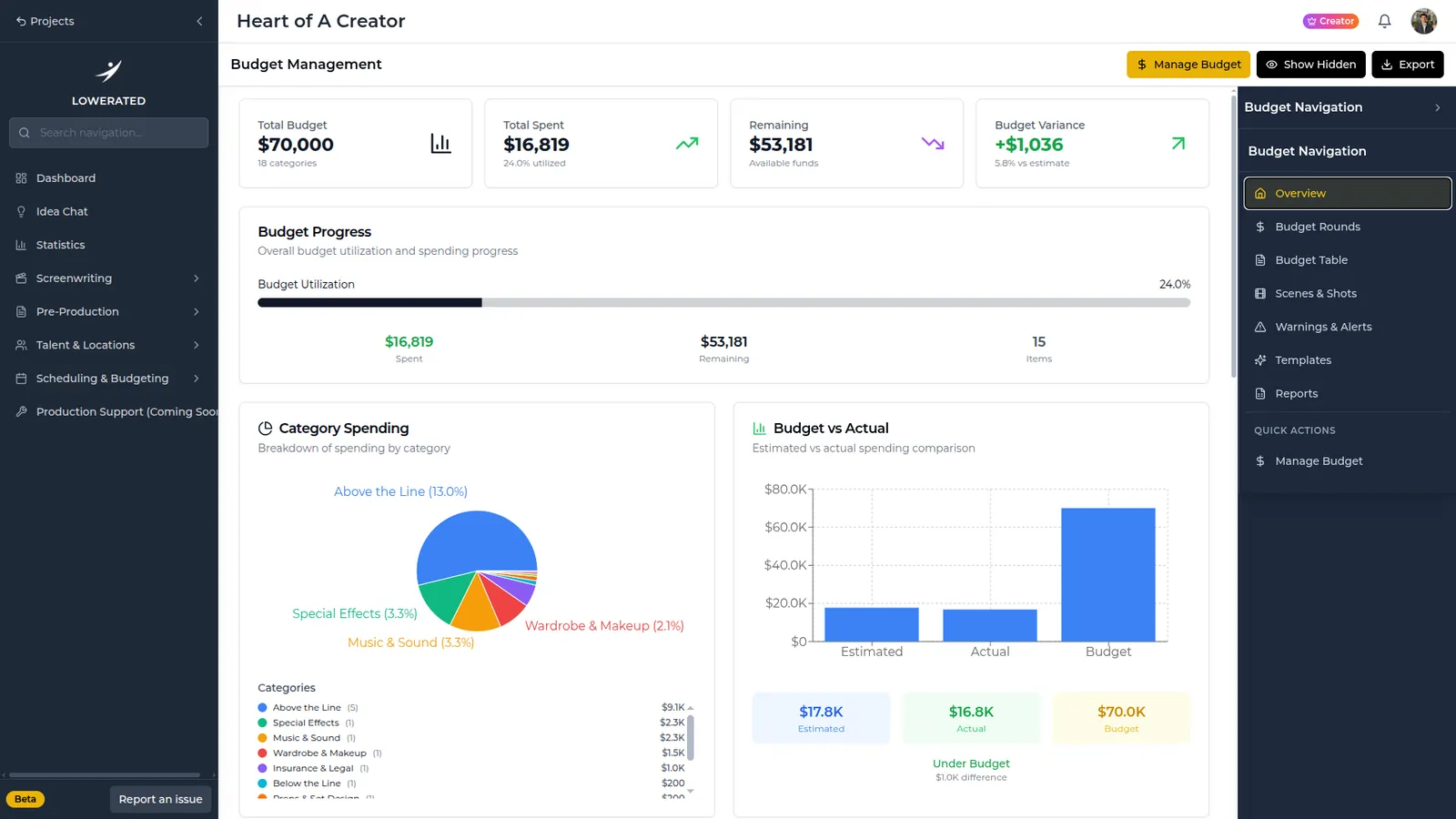
In Lowerated you plan the budget next to your schedule: add line items, including a contingency line, and track estimates against what you actually spend. Seeing actuals beside estimates as the shoot goes on shows you early when a line is drifting and whether you are likely to draw on the reserve. You can start from a budget template, or build on the sample in our film budget template guide.
The clip shows budget line items added next to the schedule, with estimates tracked against actual spending.
FAQ
Is 10 percent contingency enough?
For many small shoots it is a sensible start. Raise it for weather-heavy, technical or remote shoots, and check what any financier or bond company requires.
Does contingency go above or below the line?
Neither. It usually sits on its own after both, near the bottom of the top sheet, before the grand total.
What happens to unused contingency?
It depends on your agreements. Often it returns to investors or covers finishing, festivals and distribution. Agree this before the shoot.
Should a no-budget short have contingency?
Yes. Even a few hundred dollars set aside covers a replacement location, a taxi for a stranded actor or one more lunch.
Key takeaways
- Contingency is a visible reserve line for unknown problems, usually around 10 percent of the subtotal.
- Adjust the percentage for risk: weather, water, stunts, night work and unfamiliar locations.
- Write down what it is calculated on and who can approve spending it.
- Log every draw and compare estimates with actuals throughout the shoot.
- Keep part of it for post-production, where surprises arrive last.