Breakdown Sheet Template and Color Codes


By Muhammad Wisal and Muhammad Ali / 6 min read
A breakdown sheet is a one page form that lists everything a single scene needs to be shot: cast, extras, props, wardrobe, makeup, vehicles, effects, special equipment and notes. You fill in one sheet per scene from the tagged script, and the sheet's color shows whether the scene is interior or exterior, day or night. Below is a template you can copy, the standard color codes, and a filled-in example.
What is a breakdown sheet?
The breakdown sheet is the record of the script breakdown for one scene. Where the tagged script shows elements highlighted on the page, the sheet lists them in boxes by department, with the scene's key facts in a header at the top. Each sheet later becomes a strip on the stripboard, so it is the bridge between the script and the schedule.
The 1st AD or unit production manager usually prepares breakdown sheets once the script is locked and scenes are numbered. On small films the producer or director often does it. Department heads then read the sheets for their own category and add what they know: the wardrobe designer adds costume changes, the props master adds doubles.
What goes on a breakdown sheet?
Every breakdown sheet has a header with the scene's facts and a set of element boxes. These are the usual fields.
| Field | What to write | Example |
|---|---|---|
| Production title | Working title of the film | "Vacancy" |
| Sheet number | Running number of the sheet | 14 |
| Scene number | From the locked script | 22 |
| INT / EXT | Interior or exterior | INT |
| Set | The place as written in the scene heading | COPPERHEAD MOTEL, OFFICE |
| Location | The real place you will shoot | Desert Rose Inn, Route 9 |
| Day / Night | Time of day the scene plays | NIGHT |
| Page count | Length in eighths of a page | 1 5/8 |
| Script day | Which day in the story this is | Story day 2 |
| Synopsis | One line on what happens | Lyle finds Bettina going through the guest ledger |
Page counts use eighths: a scene that fills one full page and five eighths of the next is 1 5/8. These are the numbers the stripboard adds up to plan each shoot day.
What do the breakdown sheet colors mean?
The sheet itself is color coded by scene type. The same colors are used for strips on a traditional stripboard, so you can see the shape of a schedule at a glance. A common convention is:
| Scene type | Sheet and strip color |
|---|---|
| Interior, day | White |
| Exterior, day | Yellow |
| Interior, night | Blue |
| Exterior, night | Green |
Some productions add their own colors, for example for dawn or dusk scenes, and software may use different defaults. What matters is that the whole team uses one key.
What are the color codes for breakdown elements?
Inside the sheet, each element box matches the color or mark used when the script was tagged. There is no single official standard, but this convention is widely used:
| Element box | Tagging color or mark |
|---|---|
| Cast | Red |
| Stunts | Orange |
| Extras (silent bits) | Yellow |
| Extras (atmosphere) | Green |
| Special effects | Blue |
| Props | Purple |
| Vehicles and animals | Pink |
| Sound effects and music | Brown |
| Wardrobe | Circle |
| Makeup and hair | Asterisk |
| Special equipment | Box |
| Production notes | Underline |
Our guide to script tagging explains what belongs in each category and how to mark the page.
Breakdown sheet template
Copy this into a spreadsheet or document, one copy per scene. Add boxes for set dressing, greenery, weapons, VFX or anything else your film needs.
| Box | Entry |
|---|---|
| Production title | |
| Sheet no. / Scene no. | |
| INT or EXT / Day or Night | |
| Set | |
| Location | |
| Page count / Script day | |
| Synopsis | |
| Cast (by cast number) | |
| Stunts | |
| Extras: silent bits | |
| Extras: atmosphere | |
| Props | |
| Wardrobe | |
| Makeup and hair | |
| Vehicles and animals | |
| Special effects | |
| Sound effects and music | |
| Special equipment | |
| Production notes |
What does a filled-in breakdown sheet look like?
Here is scene 22 of "Vacancy", a thriller short about a motel night manager, Lyle, and a guest, Bettina, who is not who she says she is. The sheet would be printed on blue paper, since it is an interior night scene.
| Box | Entry |
|---|---|
| Header | "Vacancy". Sheet 14. Sc. 22. INT. COPPERHEAD MOTEL, OFFICE. NIGHT. 1 5/8 pages. Story day 2 |
| Location | Desert Rose Inn, Route 9 |
| Synopsis | Lyle finds Bettina going through the guest ledger and locks the office door |
| Cast | 1. Lyle. 2. Bettina |
| Stunts | None |
| Extras: silent bits | Trucker seen through window, collecting a key (1) |
| Extras: atmosphere | None |
| Props | Guest ledger (hero), desk bell, key rack with 12 keys, Lyle's flashlight, Bettina's lighter |
| Wardrobe | Lyle: night manager vest, change 2. Bettina: wet raincoat, change 3 |
| Makeup and hair | Bettina: wet hair, smudged mascara |
| Vehicles and animals | Semi truck lights pass outside window |
| Special effects | Rain on window (rain bar outside) |
| Sound effects and music | Radio playing low, ice machine hum |
| Special equipment | None |
| Production notes | Ledger needs 3 pages of fake guest entries. Confirm we can black out office windows. Is rain practical or VFX? |
Notice the elements the dialogue only implies: the rain on Bettina's coat means wet wardrobe, wet hair and a rain bar outside the window. Catching those is the point of a breakdown.
How do you fill in a breakdown sheet step by step?
- Lock and number the script. Scene numbers must not change after breakdown starts.
- Tag the script. Mark every element on the page using one color key.
- Measure page counts. Divide each page into eighths and record each scene's length.
- Fill in the header. Scene number, INT or EXT, set, location, day or night, script day and a one line synopsis.
- Copy elements into the boxes. List each tagged item under its category. Give cast their numbers and use the same name for an element every time.
- Add what the page does not say. Doubles of props that get damaged, costume changes by story day, continuity of injuries.
- Write production notes. Open questions and decisions to make at the production meeting.
- Send to departments. Let each head check their box and add details.
What are common breakdown sheet mistakes?
- Only listing what is named in the action, and missing what the scene implies.
- Calling the same prop by two names on different sheets, so it gets bought twice.
- Forgetting the script day, which wardrobe and makeup need for continuity.
- Guessing page counts instead of measuring them, which throws off the schedule.
- Not updating sheets when revised pages come out.
Building breakdown sheets in Lowerated
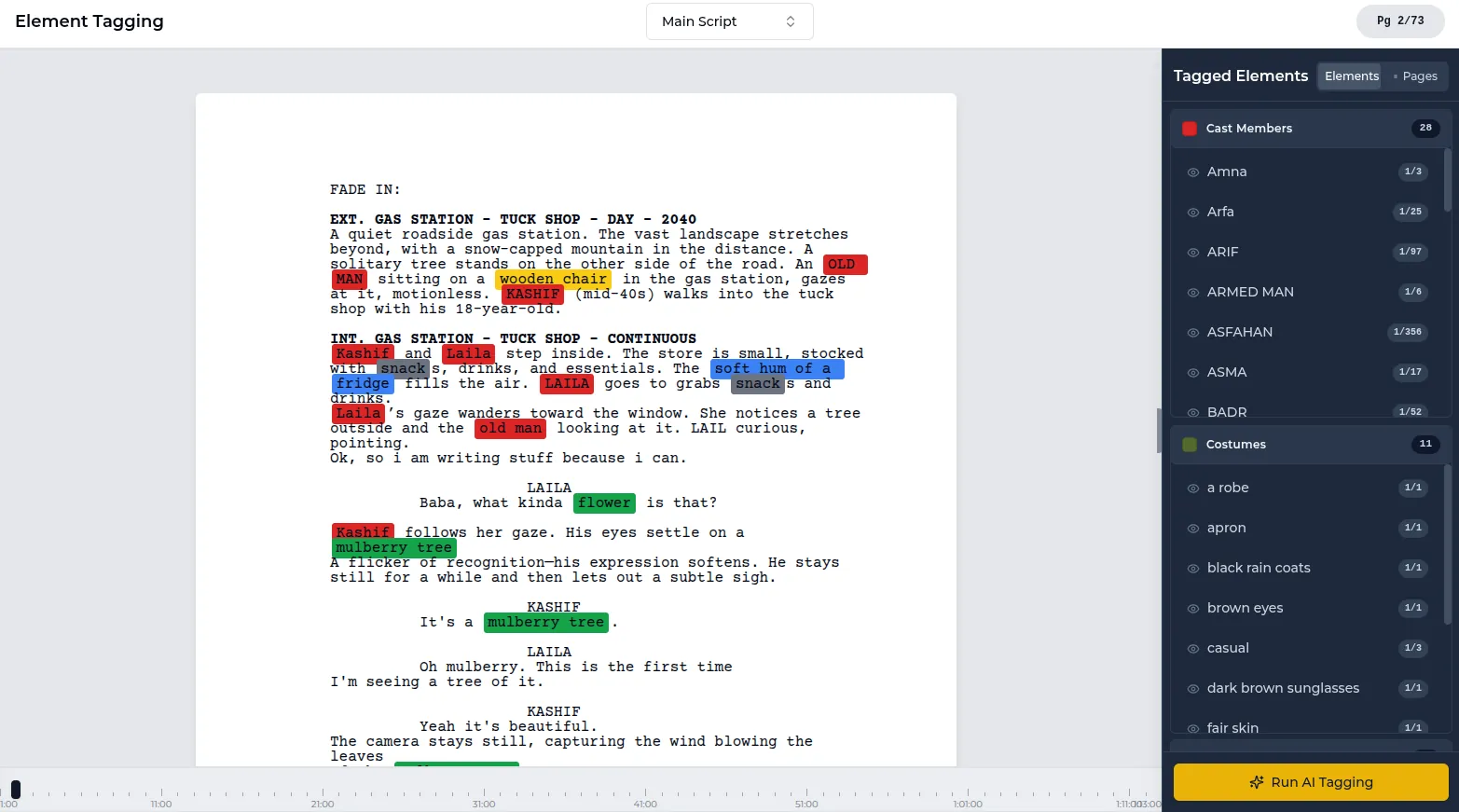
In Lowerated, breakdown starts in the script. You tag props, wardrobe, cast and locations right on the page, and when you tag something once, every mention lights up. Every tag flows into your breakdown, your schedule and your budget.
The clip shows elements tagged in the script, with every mention of a tagged item highlighted.
From the screenplay, Lowerated then builds a scene breakdown listing cast, props, wardrobe and locations. You review and adjust it instead of typing each sheet from scratch.
The clip shows a scene breakdown built from the screenplay, then reviewed and adjusted.
For a wider view of the process, read script breakdowns: turning a script into a plan.
FAQ
Is a breakdown sheet the same as a script breakdown?
The script breakdown is the whole process of identifying every element. Breakdown sheets are its output, one form per scene.
Do I need one breakdown sheet per scene?
Yes, usually. Very short scenes in the same set and time can share a sheet, but separate sheets are easier to schedule.
What color is a breakdown sheet for an exterior night scene?
Green, under the common convention. Interior day is white, exterior day yellow and interior night blue.
What comes after the breakdown sheets?
Each sheet becomes a strip, the strips are arranged into a shooting schedule, and the schedule feeds the day out of days and the budget.
Key takeaways
- A breakdown sheet lists everything one scene needs, under a header with the scene's key facts.
- Sheet colors show scene type: white INT day, yellow EXT day, blue INT night, green EXT night.
- Element boxes follow the same color key used to tag the script.
- Include what the scene implies, not only what it names.
- Each sheet becomes a strip, so accurate sheets make an accurate schedule.