What Is a Day Out of Days Report (and How to Read One)


By Muhammad Wisal and Muhammad Ali / 8 min read

A day out of days report (DOOD) is a chart that shows, for every cast member, which shoot days they work, travel, rehearse or sit on hold, with totals at the end of each row. It is built from the shooting schedule, and the production uses it to book actors, write deal memos and work out what the cast will cost. To read one, follow an actor's row from left to right: the first code tells you when they start, the last tells you when they finish, and the totals tell you how many days you are paying for.
What is a day out of days used for?
The DOOD turns the schedule into a per-person view of time and money. The stripboard answers "what are we shooting on Tuesday?" The DOOD answers "which days do we need Joe, and how many of them do we pay for?"
Several people rely on it:
- Production manager or line producer: uses the totals to budget cast and to spot expensive holds.
- Producer: checks that the schedule fits the money before anyone is booked.
- Casting: uses the start date, finish date and day count when making offers and checking actor availability.
- Accounting and payroll: pays from it and compares it against time cards.
- 1st AD: builds it from the stripboard and updates it every time the schedule changes.
Many productions also track key extras, stunt performers or animals the same way.
What do the codes on a DOOD mean?
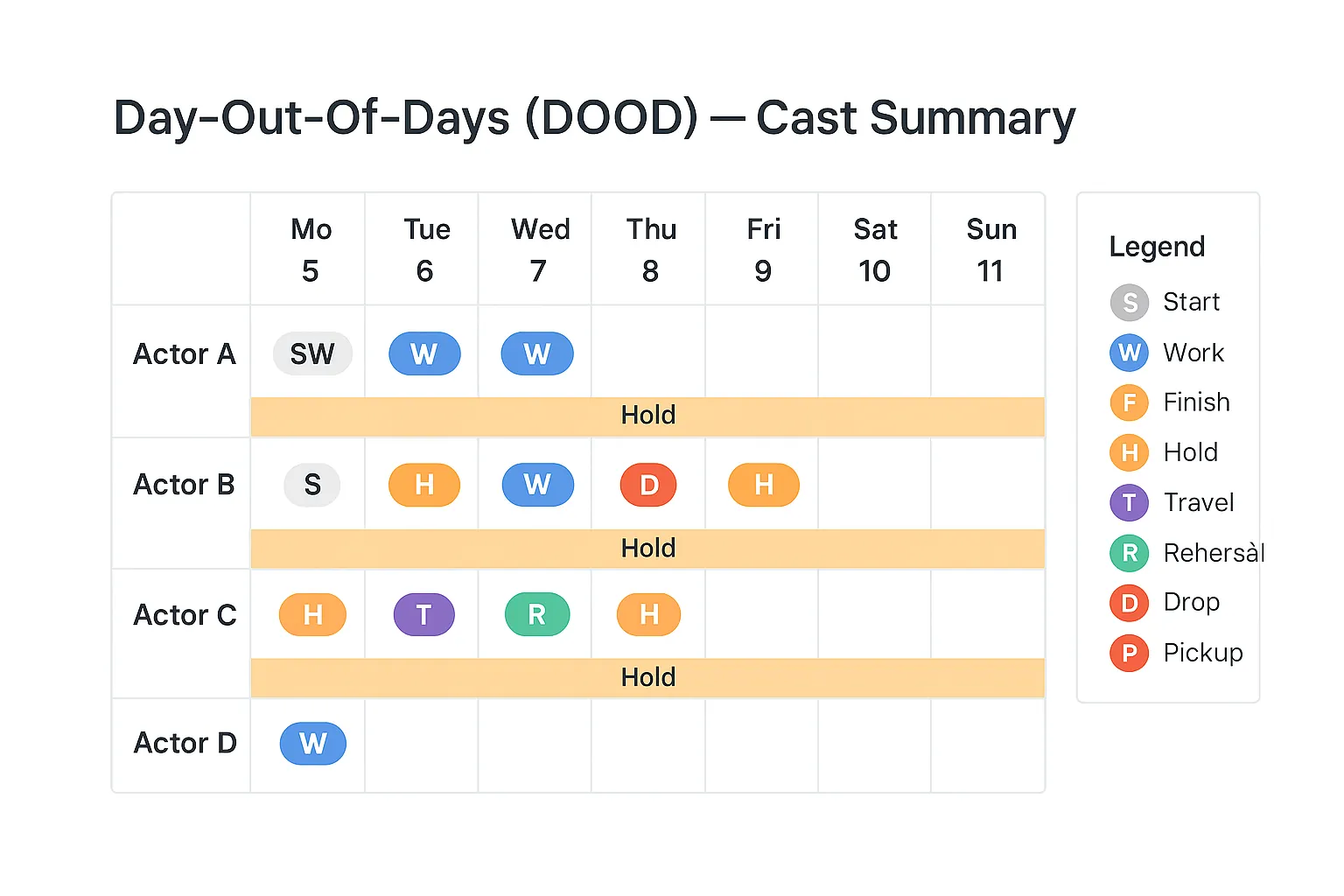
Each cell holds a short code that describes that person's status on that day. The core codes are close to universal, though software and productions vary slightly.
| Code | Meaning | When you use it |
|---|---|---|
| SW | Start work | The actor's first day on the job |
| W | Work | A working day between start and finish |
| H | Hold | Not working but kept on the payroll and available |
| WF | Work finish | The actor's last day |
| SWF | Start, work and finish | A one-day role, often a day player |
| T | Travel | Traveling to or from a distant location |
| R | Rehearsal | A rehearsal or fitting day before or during the shoot |
| WD / PW | Work drop / Pick up work | WD on the last day before the actor is released, PW on the first day back |
| Holiday or Off | Non-shooting day | Weekends, public holidays or idle days, shown as a column note |
Holiday and idle days matter because an actor on hold across a weekend may still be owed something, depending on the deal. Marking those columns keeps that visible.
How do you read a row on a day out of days?
Read a row from the first code to the last, then check the totals. Ask four questions of every row:
- When do they start? Find SW, SWF, or the first T or R.
- When do they finish? Find WF, or the last T if they fly home.
- What is in between? Every H is a paid day with no work. A gap that starts after a WD (work drop) and ends at a PW (pick up work) means the actor was dropped. Any other gap needs checking.
- Do the totals match the cells? Work, hold, travel and rehearsal days should add up to the total paid days.
What does a worked DOOD example look like?
Here is a DOOD for a short shoot with four actors over six days. Cast numbers come from the breakdown, where the lead is usually #1.
| # | Cast | Day 1 | Day 2 | Day 3 | Day 4 | Day 5 | Day 6 | Work | Hold | Travel | Rehearsal | Total |
|---|---|---|---|---|---|---|---|---|---|---|---|---|
| 1 | Maya | SW | W | W | W | W | WF | 6 | 0 | 0 | 0 | 6 |
| 2 | Joe | SW | W | H | H | W | WF | 4 | 2 | 0 | 0 | 6 |
| 3 | Ana | T | R | SW | WF | T | 2 | 0 | 2 | 1 | 5 | |
| 4 | Ray | SWD | PW | WF | 3 | 0 | 0 | 0 | 3 | |||
| Totals | 15 | 2 | 2 | 1 | 20 |
Reading it row by row:
- Maya works every day. Six paid days, no waste.
- Joe works days 1, 2, 5 and 6 but is held on days 3 and 4. You pay six days for four days of work.
- Ana flies in on day 1, rehearses on day 2, shoots two days and flies home on day 5. Five paid days for two days on camera.
- Ray works day 1, is dropped for days 2 to 4, and is picked up on day 5. If his deal allows the drop, you pay three days. If it does not, those three gaps become holds and he costs six. (A three-day gap like this would not qualify for a drop under SAG-AFTRA terms, so this saving only applies to non-union deals that allow it.)
How does the DOOD drive cast costs and deal memos?
The DOOD is the source for the cast line of the budget. Multiply each actor's paid days by their rate, add travel and rehearsal days at whatever rate the deal sets, and you have the cast cost for that schedule. As an example, if Joe's rate is $250 a day, his two hold days add $500 for no footage.
Deal memos are written from the same numbers. A deal memo usually states the start date, the guaranteed number of days, the rate, and how holds, travel and rehearsal are paid. If the DOOD changes after the memos go out, the start date or the day count in the memo may no longer be true, so the two need to be checked together.
For the wider money picture, see budgeting in pre-production.
How do drop and pick up rules affect scheduling?
A drop releases an actor between work periods so you stop paying them, and a pick up brings them back. Under SAG-AFTRA terms, a performer can generally be dropped and picked up only once per production, and only with a minimum gap between the drop and the pick up (commonly cited as at least 10 days; check the current agreement). If the gap is too short, the days in between are treated as holds and paid.
Non-union shoots set their own terms in the deal memo, so read it before you plan a drop:
- Check whether the actor's agreement allows a drop at all.
- Check the minimum gap the agreement requires, if any.
- Avoid planning more than one drop per actor unless the deal clearly allows it.
How do you reduce hold days?
You reduce hold days by reordering the stripboard so each actor's scenes sit on consecutive days. The DOOD shows the problem; the stripboard is where you fix it.
In the example above, if Joe's day 5 and day 6 scenes can move to days 3 and 4, his row becomes SW, W, W, WF: four paid days instead of six, with no holds. If Ray's day 1 scene can move to day 4, he works days 4, 5 and 6 in a row, which removes the drop entirely. Each change can cost something elsewhere, such as an extra location move, so compare before committing.
Useful moves when reordering:
- Sort the DOOD by total hold days and start with the most expensive actor.
- Find the scene that creates the gap and see whether it can share a day with their other scenes.
- Group short roles so day players are SWF where possible.
- Put traveling actors' scenes back to back so travel days do not stretch out.
- Check availability before moving anything, then regenerate the DOOD and compare totals.
The stripboard itself comes from the script breakdown, so a clean breakdown makes this much easier.
What are common DOOD mistakes?
- Building the DOOD by hand and forgetting to update it after the schedule changes.
- Leaving gaps unmarked, so nobody knows whether the actor is on hold or dropped.
- Counting a drop that the actor's agreement does not allow.
- Sending deal memos with start dates from an old version of the schedule.
How to make a day out of days report in Lowerated
In Lowerated, the day out of days report is generated from your schedule, with each actor's work days and costs worked out for you. The steps:
- Break down the script. The breakdown is built from your screenplay and lists cast per scene. Review and adjust it.
- Schedule on the stripboard. Each scene is a strip. Drag scenes between shoot days and filter, for example to night scenes. Lowerated warns you if a scene lands on a day an actor is marked out.
- Open the day out of days. It shows who is needed on which day and what it costs.
- Reorder and compare. If an actor has holds, move their scenes on the stripboard and check the day out of days again.
The clip shows the day out of days report generated from the schedule, with each actor's work days and costs.
The clip shows scenes as strips being filtered to night scenes and dragged onto day one.
Scheduling and the day out of days are part of the Producer plan; see pricing. You can sign up free to look around first.
FAQ
What does DOOD stand for?
DOOD stands for day out of days. It is a report that shows each cast member's status on every shoot day, with totals.
Who makes the day out of days?
The 1st AD usually builds it from the stripboard. The production manager and producer then use it to budget cast and plan deals.
Is a hold day paid?
Usually yes. A hold day keeps the actor available and on the payroll, so it is normally paid at the daily rate unless the deal says otherwise.
What is the difference between SWF and SW?
SW marks the first day of a run that continues. SWF means the actor starts and finishes on the same day, which is typical for a one-day role.
Do I need a DOOD for a short film?
If you have more than a couple of actors or more than two shoot days, yes. It takes little time and shows holds you would otherwise pay for without noticing. See the pre-production checklist for where it fits.
Key takeaways
- A day out of days shows each actor's start, work, hold, travel, rehearsal and finish days, with totals.
- Read each row from first code to last and check that the totals match the cells.
- Paid days times rate gives cast cost, and deal memos are written from the same numbers.
- Drops can save money, but only where the actor's agreement allows them.
- Reduce holds by reordering the stripboard, then regenerate the DOOD and compare.