Three-Act Structure Explained With Examples


By Muhammad Wisal and Muhammad Ali / 7 min read
Three-act structure splits a story into a setup, a confrontation and a resolution. Act One introduces the main character and the problem, Act Two puts obstacles in the way of the goal, and Act Three forces a final choice and shows the result. In a feature script, Act One usually runs about a quarter of the pages, Act Two about half, and Act Three the last quarter.
What is three-act structure?
Three-act structure is a way of dividing a story into beginning, middle and end, with clear turning points between them. The idea goes back to Aristotle's note that a whole story has a beginning, middle and end, and screenwriting teachers such as Syd Field turned it into the page-based model most screenwriters learn today. It describes how most mainstream films already work. Use it to check a story, not as a formula you fill in.
The acts are separated by turning points: moments where something happens that changes the direction of the story and cannot be undone. The turning points matter more than the act lengths. If your act breaks are strong, the proportions usually take care of themselves.
What happens in each act?
Each act has its own job. Act One asks a question, Act Two makes the question harder to answer, and Act Three answers it.
| Part | Job in the story | Rough pages in a 100 to 110 page feature |
|---|---|---|
| Act One: setup | Show the character's ordinary world, what they want and what is wrong | Pages 1 to 25 |
| Inciting incident | The event that disrupts the ordinary world and starts the story | Around pages 10 to 15 |
| First act break | The character commits to a goal and enters a new situation | Around pages 25 to 30 |
| Act Two: confrontation | Obstacles, escalating stakes, new allies and enemies, subplots | Pages 25 to 85 |
| Midpoint | A reversal or revelation that raises the stakes or changes the goal | Around page 55 |
| Second act break | The lowest point, or a discovery that sets up the final push | Around pages 75 to 85 |
| Act Three: resolution | The climax, where the character makes a final choice, and the aftermath | Pages 85 to the end |
Page targets are rough guides. One script page is often treated as about one minute of screen time, so a 100 page script lands near 100 minutes, but that varies with genre and style. For page counts by format, see how long a screenplay is.
What are some three-act structure examples?
Well-known films show the turning points clearly. Here are two classics and one original example.
The Wizard of Oz (1939)
- Act One: Dorothy is unhappy on the farm and wants to save Toto from Miss Gulch. She runs away, then a tornado carries the house to Oz.
- Act Two: She wants to get home, sets off for the Emerald City, gathers companions, and is sent to bring back the Wicked Witch's broomstick.
- Act Three: The witch is defeated, the Wizard is exposed, and Dorothy learns she could always go home. She wakes up in Kansas.
Star Wars (1977)
- Act One: Luke is stuck on a farm. He finds Leia's message in R2-D2, refuses Obi-Wan's call, then returns home to find his aunt and uncle killed and decides to go.
- Act Two: They reach the Death Star, rescue Leia and escape, and Obi-Wan is killed.
- Act Three: The rebels attack the Death Star and Luke makes the final run, choosing to trust the Force.
An original example: "The Salt Road"
Here is how you might plan a small drama about Teodor, a retired truck driver, and his estranged granddaughter Wren.
- Setup: Teodor lives alone and avoids his family. Wren, 17, has a music school audition 900 miles away and no way to get there.
- Inciting incident: Wren's mother is hospitalized and calls the one person with a truck.
- First act break: Teodor agrees to drive her, on the condition that they leave tonight and she never asks about her grandmother.
- Midpoint: Wren finds old letters in the cab and learns Teodor walked out on the family. She stops speaking to him.
- Second act break: The truck breaks down two states short, the audition is in 30 hours, and Wren tries to leave on her own.
- Climax: Teodor calls the son he has not spoken to in 20 years to ask for help, and tells Wren the truth.
- Resolution: She makes the audition. He waits outside. The last image is the two of them sharing a meal at a roadside diner.
Notice that every turning point is a decision or a discovery that changes what the characters do next. That is the test of a real act break.
How do you use three-act structure when writing?
Use structure early, when the story is still cheap to change, and again during rewrites.
- Name the goal and the question. Write one sentence: what does the character want, and what stands in the way? The story question is whether they get it.
- Find the ending first. Decide how the question is answered. It is easier to plant setups when you know the payoff.
- Place the two act breaks. The first is the point of no return. The second is the moment the character has the least hope, or learns the thing they need for the climax.
- Find the midpoint. Act Two is where most drafts sag. A midpoint reversal splits it into two halves with different energy.
- List escalating obstacles. Each problem in Act Two should be harder than the last, or cost the character more.
- Check the character arc. The external plot and the internal change should meet at the climax. See character arcs for how they line up.
- Outline, then draft. Turn the turning points into a scene list before you write pages. The guide on outlining a screenplay covers this step, and a beat sheet breaks the acts into smaller story beats.
Does three-act structure work for short films?
Yes, but compressed. A 10 page short still has a setup, a turn and an ending, but the setup may be one scene and the inciting incident may land on page one. Many shorts work best with a single turning point and a final image. For more on short-form shape, read how to write a short film script.
What are common three-act structure mistakes?
- Treating page numbers as rules. A first act break on page 32 is fine if the setup earns it. Readers notice weak turns, not page numbers.
- A passive act break. Things happen to the character but they never choose. The first act break works best when the character makes a decision.
- A sagging second act. Obstacles repeat at the same level. Raise the cost each time and use the midpoint to change the game.
- A climax decided by luck. If rescue comes from outside, the ending feels unearned. The main character should act.
- Too long a setup. If nothing disrupts the ordinary world by page 15 to 20, readers drift.
- Forcing every story into one shape. Some films use four or five act models, or loose ensemble structures. Three acts is a tool, so use it where it helps.
Writing a three-act screenplay in Lowerated
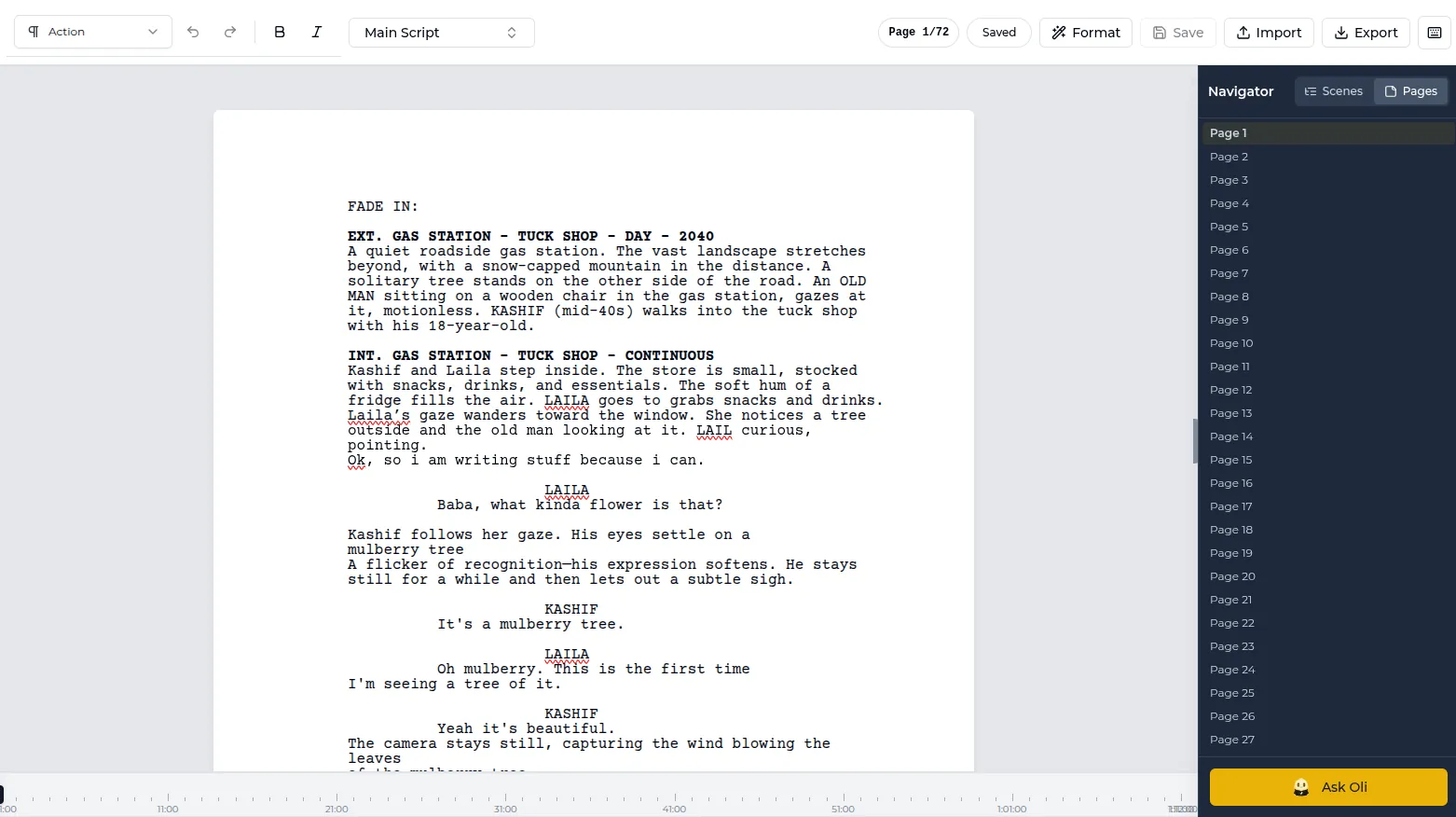
Once your act breaks are planned, you write the script in Lowerated's Scriptwriter, which formats scene headings, action and dialogue to industry standard as you type. That leaves your attention on the turning points instead of margins. Drafts and revisions let you keep track of each version as you rework the structure.
The recording shows a scene being written in the editor, with formatting applied as you type.
FAQ
Who invented three-act structure?
No one person. Aristotle described the beginning, middle and end of a story, and Syd Field's book Screenplay popularized the modern page-based model for film.
Is Act Two really half the script?
Usually about half in a feature. That is why the midpoint matters: it splits a long act into two manageable halves.
What is the difference between three-act structure and a beat sheet?
Three-act structure is the big shape. A beat sheet breaks that shape into 10 to 15 smaller story moments, such as the catalyst, midpoint and all is lost moment.
Do TV episodes use three acts?
Many TV scripts use more acts, often shaped around commercial breaks, with a cold open or teaser at the start. Streaming scripts are looser. The setup, escalation and payoff still apply.
Key takeaways
- Act One sets up the character and problem, Act Two escalates, Act Three resolves.
- Turning points drive the structure: each should be a choice or discovery that cannot be undone.
- In a feature, aim for roughly 25 percent, 50 percent and 25 percent, and treat that as a guide.
- Use a midpoint reversal to keep Act Two from sagging.
- Plan the ending and act breaks before drafting pages.