
How to Find an AI Script Writer With a Free Trial


By Muhammad Wisal and Muhammad Ali / 10 min read

Finding an AI Script Writer with a free trial sounds simple until you start comparing platforms.
One tool may advertise free access but limit you to a few generations. Another may provide a trial but hide screenplay formatting, exports, collaboration, or useful production features behind a paid plan. Some tools may be excellent at general writing but feel poorly suited to the way filmmakers actually work.
For filmmakers, the real question is not simply, “Is there a free trial?”
It is:
“Can I test the parts of the writing workflow that actually matter before I pay?”
That means testing how an AI tool handles your story, characters, scenes, dialogue, screenplay formatting, revisions, and the transition from writing into production.
This guide explains what to look for, how to evaluate a trial properly, and how an AI scriptwriting tool can fit into a larger filmmaking workflow.
Why Filmmakers Look for an AI Script Writer Free Trial
Writing software is a long-term workflow decision. Once a filmmaker starts developing a screenplay inside a platform, changing tools halfway through a project can create unnecessary work.

A free trial or free starting option can reduce that risk.
It allows you to answer practical questions before committing:
- Does the interface feel natural?
- Does the AI understand my story?
- Can I control the direction of the writing?
- Is screenplay formatting handled correctly?
- Can I revise scenes easily?
- Can I keep multiple drafts organized?
- Does the tool support collaboration?
- Does it help beyond the first draft?
These questions matter more than simply generating a paragraph and deciding that the AI "sounds good."
Google's current Search Essentials guidance also emphasizes useful, people-first information rather than content created primarily to manipulate rankings. That means a useful guide should help the reader make a real decision rather than simply listing features or repeating marketing claims.
What Makes a Good AI Script Writer Free Trial?
Not every free trial is equally useful.
A good trial should give you enough access to judge the actual workflow.
1. Test a Real Film Idea
Do not test the platform with a random one-line prompt.
Use an idea you might genuinely turn into a short film, feature, documentary, or series.
Give the AI enough context to understand:
- Genre
- Premise
- Main characters
- Conflict
- Setting
- Tone
- Intended audience
Then see whether the results move your story forward.
The objective is not to determine whether the tool can produce words. Almost any modern AI system can do that.
You want to know whether it can help you think more clearly about your film.
2. Test a Complete Scene
A strong evaluation starts with a real scene rather than a generic paragraph.
Ask the tool to help you explore a scene with a specific dramatic purpose.
Then examine the result.
Does the dialogue sound different from the description?
Do the characters have distinct motivations?
Does the scene actually create tension?
Does the AI understand what should remain unsaid?
Most importantly, does the output give you something worth revising?
That final question is often more useful than asking whether the AI can produce a "perfect" scene.
AI Script Writer for Filmmakers: Look Beyond Story Generation
An AI Script Writer for Filmmakers should solve more than the blank-page problem.

A screenplay is a working document that continues to evolve throughout development and pre-production.
You should therefore evaluate whether the platform supports the wider writing process.
Look for capabilities such as:
- Industry-style screenplay formatting
- Character development
- Scene development
- Dialogue assistance
- Revisions
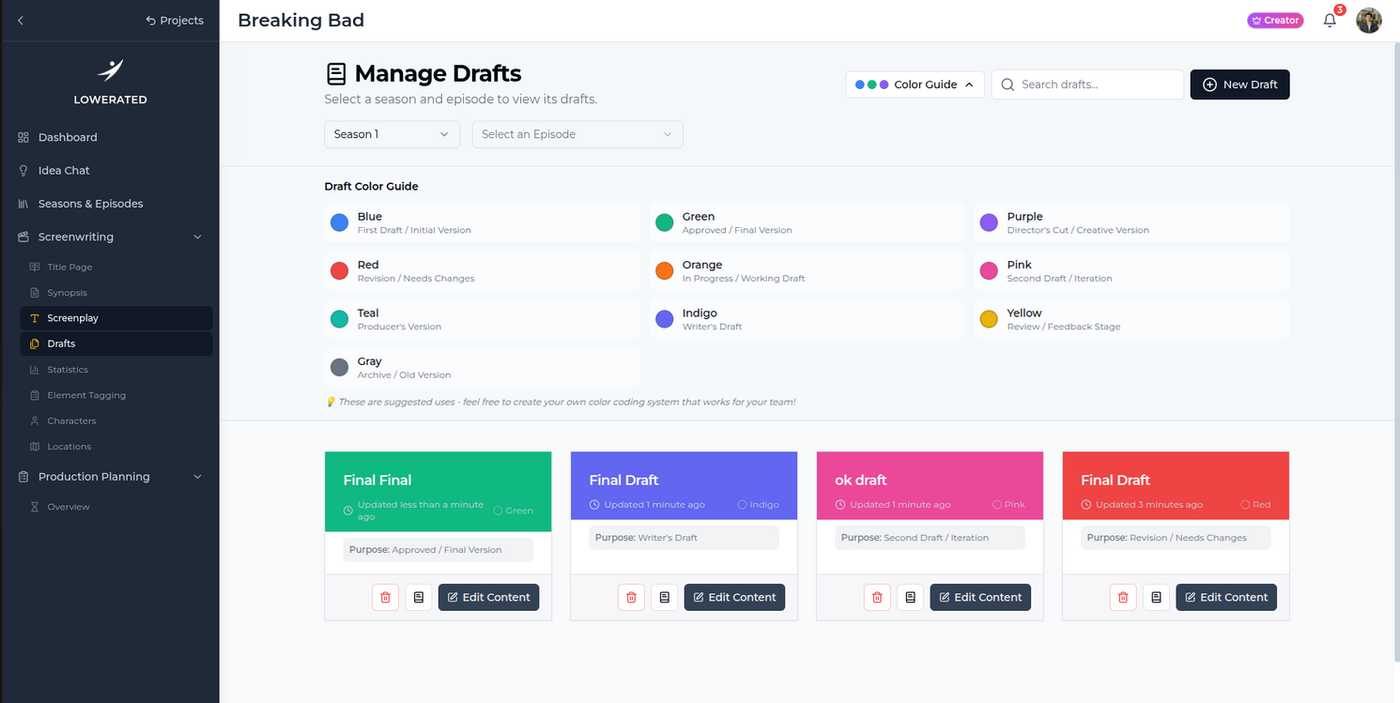
- Draft management
- Collaboration
- Production-related organization
Lowerated's current Script Writer page highlights screenplay formatting, character profiling, element tagging, collaboration across drafts and revisions, script analytics, and AI assistance.
That matters because filmmakers eventually need to move beyond writing.
A screenplay becomes a production document.
Don't Choose a Trial Based on AI Generation Alone
One of the biggest mistakes filmmakers make is comparing tools by asking which one writes the longest script.
Longer is not necessarily better.
A useful AI scriptwriting platform should help you make better decisions.
During a trial, ask:
Can I easily change the character's motivation?
Can I rewrite a scene without losing the previous version?
Can I keep track of recurring characters and locations?
Can the tool help me identify weaknesses in my script?
Can my writing partner or producer review the work?
These questions take you closer to the actual job of screenwriting.
The U.S. Copyright Office has also emphasized that AI-assisted work can remain protectable where sufficient expressive elements are determined by a human author, while merely providing prompts does not by itself establish human authorship.
For filmmakers, that reinforces an important working principle: use AI as assistance, while keeping meaningful creative decisions in human hands.
How to Test an AI Script Writer Properly
Instead of opening a free trial and clicking around randomly, use the same test project across every platform you compare.

Step 1: Start With Your Own Concept Write a short description of your actual movie idea.
Do not let the AI invent the entire project before you understand what you are trying to make.
Step 2: Build One Main Character Give the character a goal, fear, contradiction, and personal history.
Then ask the AI to help you develop the character.
Look at whether its suggestions strengthen your concept or flatten it into something generic.
Step 3: Develop One Scene
Choose a scene with an identifiable purpose.
Ask for different approaches.
You might want:
- A quieter version
- A more tense version
- A version with less dialogue
- A version with an unexpected ending
This is a better test of creative usefulness than simply asking for "a screenplay."
Step 4: Rewrite It Yourself
Now make changes.
Remove lines.
Add your own dialogue.
Change the scene order.
Rewrite the ending.
This tells you whether the software supports your writing process rather than forcing you into its workflow.
Step 5: Test Collaboration and Revisions
A script rarely exists in one final version.
Directors, producers, writers, and other collaborators may all provide feedback.
Lowerated's Script Writer currently describes real-time co-writing, inline comments, and version control as part of its collaboration workflow.
Those features are worth testing because a tool that works well for one writer may behave very differently once a team gets involved.
Free Trial vs Free Plan: Know the Difference
This is where many searches for a "free AI Script Writer" become confusing.
A free trial usually means temporary access to paid functionality.
A free plan means some functionality remains available without payment, but premium features may be restricted.
The distinction matters.
Lowerated's current pricing page lists a $0 Basic plan that includes a manual script editor, basic idea chat, unlimited free viewers, and unlimited projects. The current pricing page separately lists the Script Writer module at $15/month, with an annual option shown at $144/year.
Meanwhile, Lowerated's Script Writer page currently invites users to "Start for free."
Because access and pricing can change, filmmakers should check the current plan details before assuming that every AI Script Writer feature is included in the free tier.
That is a good rule for evaluating any software.
Read the actual feature limits, not just the word "free."
What Should You Test Before Paying?
A serious evaluation should go beyond writing quality.
Writing Quality
Does the AI help develop scenes, dialogue, and story structure without making everything sound generic?
Creative Control
Can you reject suggestions and steer the story in your own direction?
Formatting
Does the platform handle screenplay structure and formatting without making you manually fix every page?
Character Consistency
Do characters retain their distinct personalities and motivations as the script grows?
Revision Workflow
Can you compare, revise, and recover earlier drafts?
Collaboration
Can other members of your team contribute without creating a mess of duplicate versions?
Production Readiness
Can screenplay information eventually support planning rather than becoming a dead-end document?
These areas provide a much better basis for choosing an AI writing platform.
Why Screenwriting Should Connect to Pre-production Filmmaking
A script does not exist in isolation.
Once the screenplay is ready, filmmakers need to figure out how to shoot it.

That is where Pre-production Filmmaking begins to connect directly with the writing process.
Characters become casting requirements.
Locations become scouting requirements.
Scenes become scheduling requirements.
Props and wardrobe become production elements.
Shots become part of the visual plan.
A useful platform should help filmmakers carry those decisions forward instead of making them start again from scratch.
Lowerated's Script Writer includes automatic tagging for characters, props, wardrobe, locations, and other screenplay elements, with the stated purpose of supporting scene breakdowns, shoot planning, and production reports.
That connection is particularly useful for independent productions where one person may be handling several jobs.
A Filmmaking Planner Tool Should Continue the Workflow
The next question is what happens after the screenplay is written.
A Filmmaking Planner tool can help translate the script into practical production decisions.
For example, a filmmaker might need to organize:
- Scenes by location
- Cast availability
- Shooting days
- Shot lists
- Storyboards
- Budgets
- Production tasks
The value of connecting the writing and planning stages is simple: your production plan still reflects the script you actually developed.
This is where an All-in-one filmmaking platform can make sense.
Instead of using one application to write, another to plan, another to communicate, and another to track the project, the workflow can remain connected.
Film Casting and Film Audition and Casting Calls Are Part of the Same Problem
Casting is another stage where information from the screenplay becomes practical.
Film Casting should begin with a clear understanding of the characters, their relationships, and what the roles demand.

When casting information is disconnected from the screenplay, filmmakers may end up recreating character details manually.
The same applies to Film audition and casting calls.
A useful workflow should make it easier to move from:
Character → Casting requirement → Casting call → Audition → Selection → Production schedule
For independent filmmakers, this connection can prevent unnecessary duplication and reduce the amount of information that gets lost between departments.
Filmmaker Collaboration Platform: Test It Before You Commit

A script can become much more complicated once multiple people start working on it.
A writer may make a change that affects the director's idea.
A producer may request a shorter shooting plan.
An actor may offer a performance suggestion.
A production change may require another script revision.
This is why a Filmmaker Collaboration Platform should be evaluated during a trial, especially for team projects.
Do not just ask whether collaboration exists.
Ask whether collaboration is actually easy.
Can someone understand what changed?
Can you find comments later?
Can you tell which draft is current?
Can you recover an older version?
Those details become important as the project grows.
Filmmakers Community Platform: The Tool Is Only Part of the Equation
Filmmaking is also about finding people.
A strong Filmmakers Community Platform can help writers discover directors, directors find producers, actors find opportunities, and independent creators meet potential collaborators.
This is especially valuable for filmmakers who do not already have an established production network.
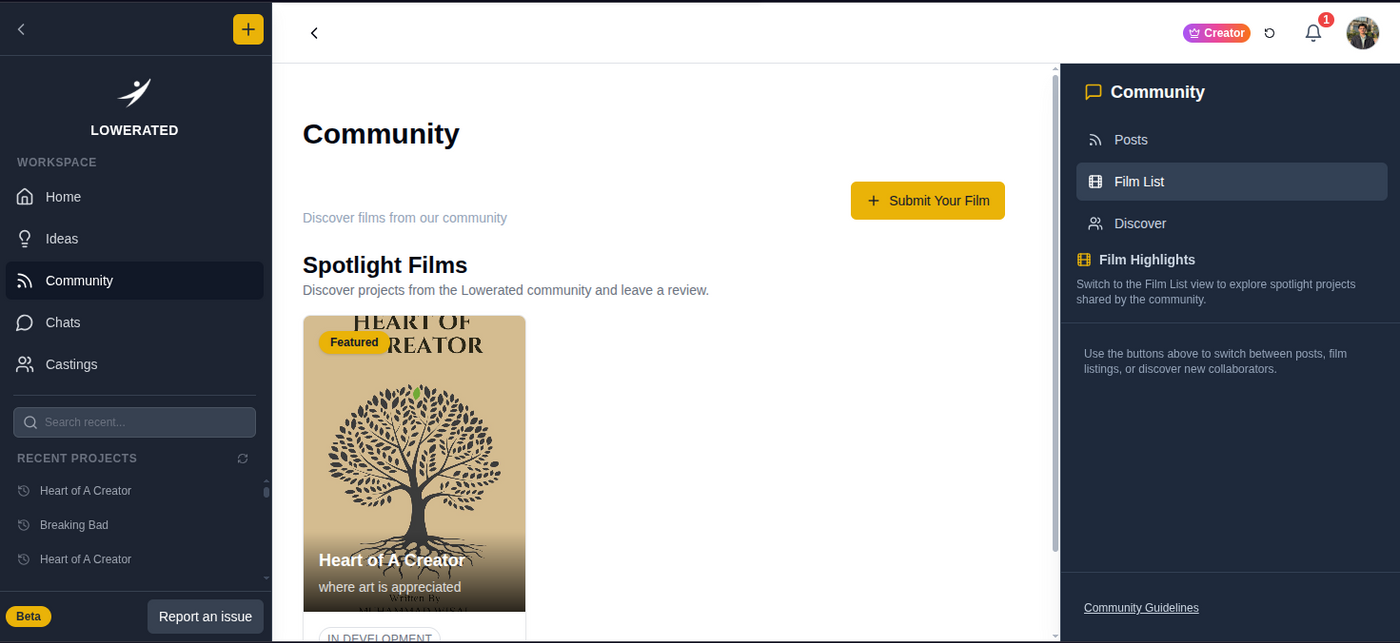
But community quality matters more than the number of registered users.
Look for meaningful interaction, relevant creators, useful opportunities, and conversations that help you move a project forward.
The best filmmaking workflow combines good software with good people.
What Makes the Best Filmmaking Platform for Independent Creators?
There is no single Best filmmaking platform for everyone.
A professional studio may have completely different needs from a student making a five-minute short film.
For an independent filmmaker, however, a good platform should ideally reduce the amount of repeated administrative work surrounding the creative process.
A practical checklist looks like this:
- Can I start developing ideas quickly?
- Can I write and revise a screenplay comfortably?
- Can I keep creative decisions organized?
- Can I move from script to pre-production?
- Can I manage casting and production information?
- Can collaborators work with me?
- Can I avoid unnecessary tool switching?
- Can I understand what I am paying for?
If the answer is yes, the platform is worth considering.
What About Post-production Filmmaking?
Choosing an AI Script Writer may seem unrelated to Post-production Filmmaking, but the connection is stronger than it first appears.

Good production documentation can make later work easier.
The more clearly the project's creative decisions are documented during development and production, the easier it can be to maintain consistency during editing.
This does not mean an AI Script Writer replaces editing software.
It means the screenplay should remain part of the project's larger creative record.
A connected workflow can therefore carry useful information from:
Writing → Pre-production → Production → Post-production
rather than treating every stage as a completely separate project.
How Lowerated Fits Into the Search for a Free AI Script Writer
Lowerated approaches AI scriptwriting as part of a broader filmmaking environment rather than as a standalone text generator.
Its current Script Writer page promotes AI assistance alongside industry formatting, character profiling, element tagging, script analytics, and collaboration.
Its broader platform positions itself as an All-in-one filmmaking platform designed to connect filmmaking stages from idea generation toward distribution, with AI assistance throughout the workflow.
That distinction is useful when evaluating software.
You may begin by searching for an AI Script Writer with a free trial because you need help writing.
But your actual problem may be larger.
You may need:
An idea → a screenplay → a production plan → a cast → a team → a finished film
The right platform should fit that complete journey.
A Simple Free-Trial Checklist for Filmmakers
Before paying for any AI Script Writer, spend your trial period answering these questions:
Writing
Can it help me develop my actual story rather than produce generic content?
Control
Can I maintain my own voice and make the final creative decisions?
Workflow
Does it make writing and revision easier?
Team
Can collaborators review and contribute without creating version confusion?
Production
Can information from the script support planning, casting, and scheduling?
Value
Will I still benefit from the platform after the novelty of AI generation wears off?
If the answer is yes across these areas, you are evaluating the right things.
Final Thoughts
Searching for an AI Script Writer with a free trial should not be about finding the tool that gives you the most free generations.
It should be about finding the tool that gives you enough access to make an informed decision.
Test it with your own film.
Test a real character.
Test a real scene.
Rewrite the output.
Try revisions.
Bring in a collaborator.
See what happens when the screenplay starts becoming a production.
That is when you discover whether the software actually helps.
For independent filmmakers, the best AI writing tool is not the one that writes the movie for you. It is the one that helps you move from a blank page to a stronger screenplay while keeping your creative decisions in your hands.
And when that writing environment connects naturally with Pre-production Filmmaking, a Filmmaking Planner tool, Film Casting, collaboration, and eventually Post-production Filmmaking, it becomes more than an AI writer.
It becomes part of the filmmaking workflow.
Explore Lowerated and review its current free access and paid modules before choosing the workflow that fits your next project.


