Scheduling Around Actor Availability


By Muhammad Wisal and Muhammad Ali / 6 min read
To schedule around actor availability, collect every actor's free and unavailable dates before you build the schedule, then place the most limited actor's scenes first and group each actor's scenes into as few consecutive days as you can. Recheck availability every time the schedule changes, and confirm the final dates in writing.
Why does actor availability drive the schedule?
Locations and crew can often move, but an actor who is booked elsewhere cannot be in two places. On independent films, cast usually have other jobs, other shoots or stage work, so their dates are the hardest constraint you have. Cast are also paid by the day, so how you arrange their scenes changes the budget.
A good schedule gets every actor's scenes onto days they can work, keeps each actor's run of days short, and avoids paying someone to wait at home between scenes.
What availability details should you collect from actors?
Ask for availability as soon as an actor is offered the role, and collect it in one consistent format. These are the details that matter.
| Detail | What it means | Example |
|---|---|---|
| Dates out | Days the actor cannot work at all | Out 9 and 10 June, theater run |
| Dates on hold | Days they have a tentative booking that may or may not confirm | On hold 14 June for a commercial |
| Earliest start, latest finish | The window they can give the production | Free from 6 June, must finish by 20 June |
| Partial days | Days with limited hours | 12 June, free after 2:00 PM |
| Travel | Days needed to get to and from the location | Flies in 5 June, home 21 June |
| Prep | Fittings, rehearsals, hair tests, table read | Costume fitting 3 June |
| Agent or manager | Who confirms bookings and changes | Name and phone of the agent |
Treat a hold as uncertain. Ask the actor or their agent when it will confirm or release, and plan a fallback.
How do you build a schedule around actor availability?
- Break down the script by cast. List every scene each actor is in. A day out of days draft or a cast column on the breakdown works well.
- Put availability on a grid. Rows are actors, columns are shoot days. Mark each cell free, out or on hold.
- Start with the most limited actor. The actor with the fewest free days, or the highest day rate, goes on the schedule first. Fit their scenes into their window.
- Group each actor's scenes together. Put an actor's scenes on consecutive days so they start, work and finish without gaps. This can mean shooting out of story order, for example every scene at one location with a guest actor on the same day.
- Fill around them. Schedule the lead and the flexible cast around the fixed blocks, keeping location moves sensible.
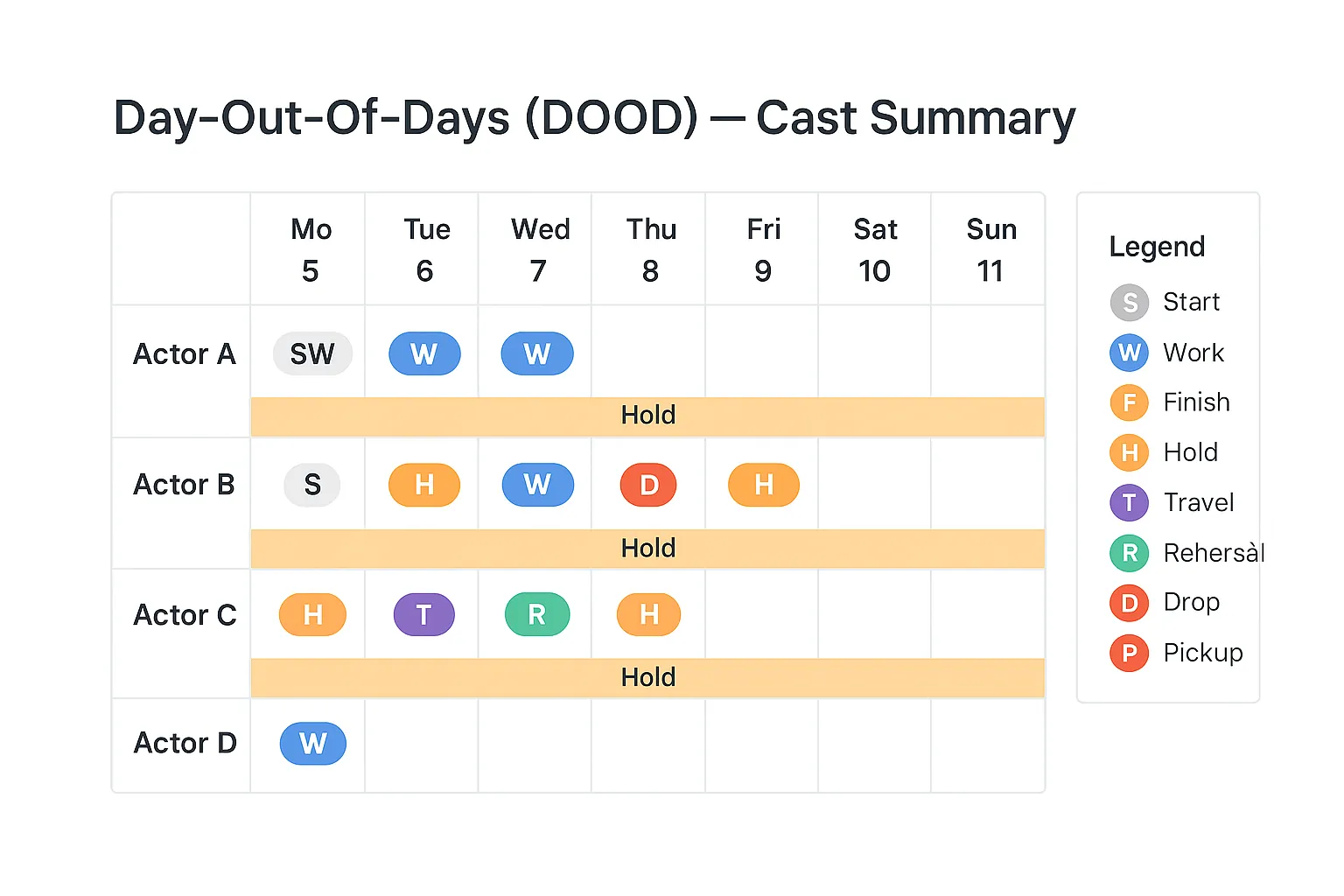
- Check for gaps. If an actor works, then has days off, then works again, you will either pay them for hold days or need a drop and pick up, which union agreements may restrict. See if moving one scene closes the gap.
- Confirm in writing. Send each actor their work days and get them confirmed in their deal memo or booking.
- Recheck after every change. When a scene moves, check the new day against everyone in it.
What does a worked example look like?
A small feature called "The Orchard Lease" has a six day block at a farm. Rosalind, the lead, is free all six days. Teodor, who plays her brother, is out on days 1 and 2. Gus, who plays the land agent, is on hold for another job on every day except day 4.
| Actor | Day 1 | Day 2 | Day 3 | Day 4 | Day 5 | Day 6 |
|---|---|---|---|---|---|---|
| Rosalind | Free | Free | Free | Free | Free | Free |
| Teodor | Out | Out | Free | Free | Free | Free |
| Gus | Hold | Hold | Hold | Free | Hold | Hold |
Gus is the most limited, so both of his scenes go on day 4, including the one where all three characters meet in the farm office. Teodor's scenes go on days 3 to 5 in one run. Rosalind's solo scenes fill days 1, 2 and 6. The resulting day out of days uses the standard codes: SW (start work), W (work), WF (work finish) and SWF (start, work and finish on the same day).
| Actor | Day 1 | Day 2 | Day 3 | Day 4 | Day 5 | Day 6 | Days |
|---|---|---|---|---|---|---|---|
| Rosalind | SW | W | W | W | W | WF | 6 |
| Teodor | SW | W | WF | 3 | |||
| Gus | SWF | 1 |
If one of Teodor's scenes had been put on day 6 instead, he would have had a gap on day 5, and the production would pay a hold day or arrange a drop and pick up. Moving one strip avoids that cost.
What are common availability mistakes?
- Building the schedule first and asking for availability afterward.
- Treating a hold as free, then losing the actor when the other job confirms.
- Collecting dates in texts and emails with no single grid.
- Spreading a guest actor's scenes across the shoot, which adds paid days.
- Forgetting travel, fittings and rehearsals when you count an actor's days.
- Moving scenes late in prep without checking who is in them.
- Not confirming final dates in writing, so nobody can point to what was agreed.
How to schedule around actor availability in Lowerated
In Lowerated, availability sits next to the schedule, so clashes show up while you plan.
- Mark availability. For each actor and crew member, mark the days they are free, out or on hold.
- Build the schedule on the stripboard. Drag scene strips onto shoot days. If a scene lands on a day someone in it is out, Lowerated warns you.
- Fix the clash. Move the strip to a day that works for everyone in the scene.
- Check the day out of days. It is generated from the schedule, with each actor's work days and costs worked out, so you can see what a change costs.
The clip shows days marked as unavailable and the warning when a scene lands on a day an actor or crew member is out.
The clip shows the day out of days report generated from the schedule, with each actor's work days and costs.
FAQ
When should I ask actors for availability?
As early as possible, ideally at audition or offer stage. Ask again before you lock the schedule, since dates change.
What is the difference between out and on hold?
Out means the actor cannot work that day. On hold means they have a tentative booking that may confirm or release, so the day is uncertain.
Should I schedule the lead or the guest actors first?
Start with whoever is most limited. That is often a guest actor with only a few free days, even though the lead has more scenes.
What if two actors in the same scene are never free on the same day?
Look at whether the scene can be shot in parts, with a double or stand-in for over-the-shoulder shots, or rewritten. Talk to the director before you decide.
Key takeaways
- Collect free, out and on hold dates for every actor before you build the schedule.
- Schedule the most limited actor first, then fill around them.
- Group each actor's scenes into consecutive days to avoid paid hold days.
- Recheck availability every time a scene moves.
- Confirm final work days in writing.