How to Plan a Commercial Shoot


By Muhammad Wisal and Muhammad Ali / 6 min read
Commercial shoot planning means turning a client's brief into an approved creative treatment, a bid and budget, a shooting board, a schedule and a call sheet, then confirming every detail at a pre-production meeting before the shoot. The core tools are the same as for a film. What is different is the client: every major decision needs sign-off, and the deliverables are fixed before you roll.
How is planning a commercial different from planning a film?
A commercial is planned backward from a client's approved idea and a fixed list of deliverables, with the client and often an agency approving each stage. A short film answers to its director and producer. A commercial answers to a brand, so approval steps, product accuracy and usage rights shape the whole plan. Schedules are also shorter: many commercials shoot in one or two days, so prep has to be exact.
Who is involved in a commercial shoot?
A typical commercial involves three sides: the client, the agency and the production company. On smaller jobs the agency may not exist, and the production company deals with the brand directly.
| Side | Key people | What they own |
|---|---|---|
| Client (brand) | Brand or marketing manager | The brief, the budget ceiling, final approval, product accuracy |
| Agency | Creative director, copywriter, art director, agency producer | The creative idea and script, client communication, approvals |
| Production company | Director, executive producer, producer or line producer | The treatment, the bid, crew, schedule and the shoot itself |
| Post | Editor, colorist, sound mixer, graphics | The cut, finishing and every deliverable version |
What are the stages of commercial shoot planning?
Commercial planning moves through a fixed set of stages, each ending in an approval. Timings vary a lot by job size, so treat these as an order, not a deadline.
- Brief. The client or agency sends the creative brief and script or storyboard, the target length, the deliverables and a budget range.
- Treatment and bid. The director writes a treatment showing how they will shoot it, with references. The producer builds the bid, a detailed cost estimate. In the US, many production companies use the AICP bid form as their budget layout.
- Award. The client picks a production company and approves the treatment and bid. Contracts and payment terms are agreed.
- Pre-production. Casting, location scouting, wardrobe, props, product sourcing, shot list and shooting board, schedule, crew hiring and paperwork.
- Pre-production meeting (PPM). The production company presents every decision to the agency and client: cast, locations, wardrobe, props, product, the shooting board and the schedule. Approvals here are final.
- Shoot. The client and agency usually watch from video village. Feedback goes through one agreed person.
- Post and delivery. Edit, client review rounds, finishing, then every version on the deliverables list.
The PPM works like a production meeting on a film, with the client in the room and more formal sign-off.
What goes into a commercial production plan?
A commercial plan is a small set of documents, each signed off before the next. This checklist shows what each one covers.
| Document | What it contains | Signed off by |
|---|---|---|
| Treatment | Director's approach, look, casting ideas, reference frames | Agency and client |
| Bid and budget | Crew, equipment, locations, talent, product, post, insurance, markup, contingency | Agency producer and client |
| Shooting board | Every shot as a frame, in order, with notes on product shots | Agency and client at the PPM |
| Schedule | Shot order by setup, product and hero shots, company moves | Producer and 1st AD |
| PPM book | Cast choices, locations, wardrobe, props, product, schedule, deliverables | Everyone at the PPM |
| Call sheet | Call times, location, shot order, cast, client attendees, safety | Producer |
| Deliverables list | Lengths, aspect ratios, versions, captions, file specs | Agency and client |
For the budget layout, start from our film budget template and add commercial lines such as product, food or product stylists, client hospitality and talent usage.
A worked example: planning a one-day 30 second spot
Here is a sample plan for a 30 second spot for a fictional tea brand, Ridgeline Tea. The idea: a cyclist reaches a hilltop at dawn, pours tea from a flask, and the product lands in a close-up. One exterior location, one interior tabletop setup, two actors.
Deliverables agreed at award: 30 seconds and 15 seconds in 16:9; 15 seconds and 6 seconds in 9:16 for social; a 1:1 cut of the 15; captioned versions of each.
| Time | Plan | Note |
|---|---|---|
| 4:30 AM | Crew call at hilltop location | Light for sunrise |
| 5:15 AM | Shots 1 to 4: cyclist arrives, wide and medium | Sunrise window, no second chance |
| 7:30 AM | Shots 5 to 7: pour and sip, close-ups | Hero flask and two spares ready |
| 9:30 AM | Company move to studio | Breakfast on arrival |
| 11:00 AM | Shots 8 to 10: product tabletop, hero pack | Food stylist on steam and liquid |
| 2:00 PM | Vertical and square safety frames of key shots | For the 9:16 and 1:1 cuts |
| 4:00 PM | Client sign-off on product shots, wrap | Agency producer confirms |
Notice two things. The dawn shots go first because the light cannot be rescheduled. And the vertical frames are planned on the day; reframing a 16:9 shot for 9:16 later often loses the product.
What should you check about talent, usage and paperwork?
On a commercial, the actor's fee usually depends on how and where the ad will run and for how long. That is called usage, and it is often paid as a buyout or under a union commercial contract, depending on the country and the talent. Agree usage terms in writing before the shoot. Every on-camera person needs a signed release; see talent release forms. Location agreements, permits, insurance and music licensing also vary by place, so check local rules and have a lawyer review the contracts.
What are common commercial shoot planning mistakes?
- Starting pre-production before the bid is approved in writing.
- Not locking the deliverables list, then finding a vertical version was expected.
- Having only one hero product, so a scratch or dent stops the day.
- Letting several client and agency people give notes on set directly to the director.
- Leaving usage terms vague, which leads to disputes when the ad runs longer.
- Skipping the PPM on small jobs, then debating wardrobe on the shoot day.
Plan the budget and call sheet for a commercial in Lowerated
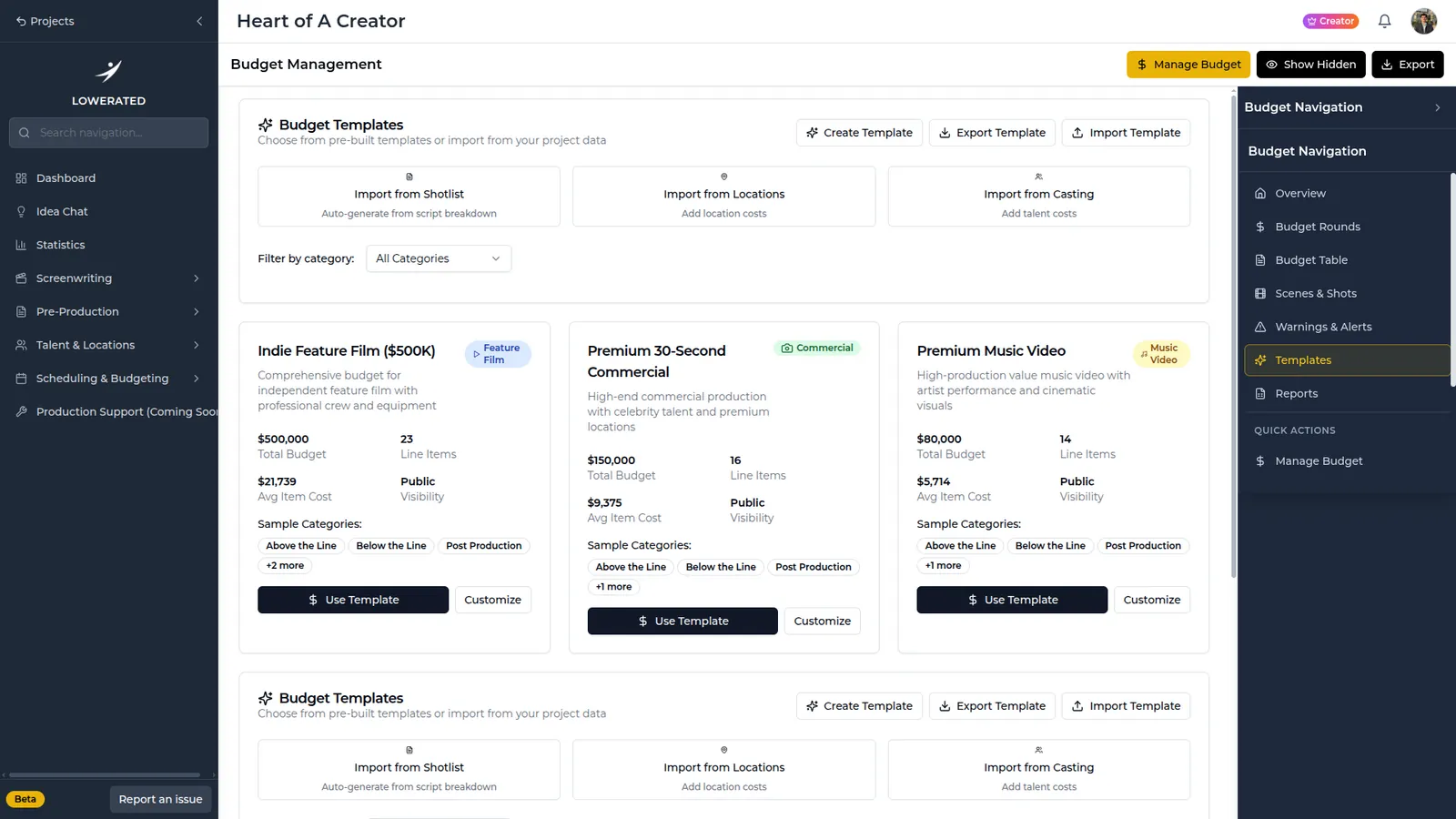
Lowerated has budget templates, including a 30 second commercial, so you can start from a commercial layout. You add line items and track estimates against actual spending next to the schedule. When the schedule is set, call sheets are built from it with call times, locations and crew filled in, ready to review and send the night before.
The clip shows line items added to a budget, with estimates tracked against actual spending next to the plan.
The clip shows a call sheet built from the schedule, with call times, locations and crew filled in, then reviewed and sent the night before.
Our guide on how to make a call sheet covers each section in detail.
FAQ
How long does it take to plan a commercial shoot?
It depends on the job. Small social spots can go from award to shoot in days; larger campaigns take weeks. The PPM is usually held a few days before the shoot.
What is a PPM in commercial production?
The pre-production meeting, where the production company presents cast, locations, wardrobe, props, the shooting board and schedule to the agency and client for final approval.
What is a bid in commercial production?
A detailed cost estimate the production company submits to win the job. Once approved, it becomes the working budget.
Do I need an agency to make a commercial?
No. Many small brands hire a production company directly. The production company then handles the creative and client approvals itself.
Key takeaways
- Plan backward from the approved brief and a locked deliverables list.
- Get the treatment and bid approved before spending on pre-production.
- Use the PPM to get final sign-off on every visible detail.
- Bring spare hero products and plan vertical frames on the day.
- Agree talent usage terms in writing and check local legal requirements.