Transitions, Parentheticals and Other Screenplay Elements


By Muhammad Wisal and Muhammad Ali / 7 min read
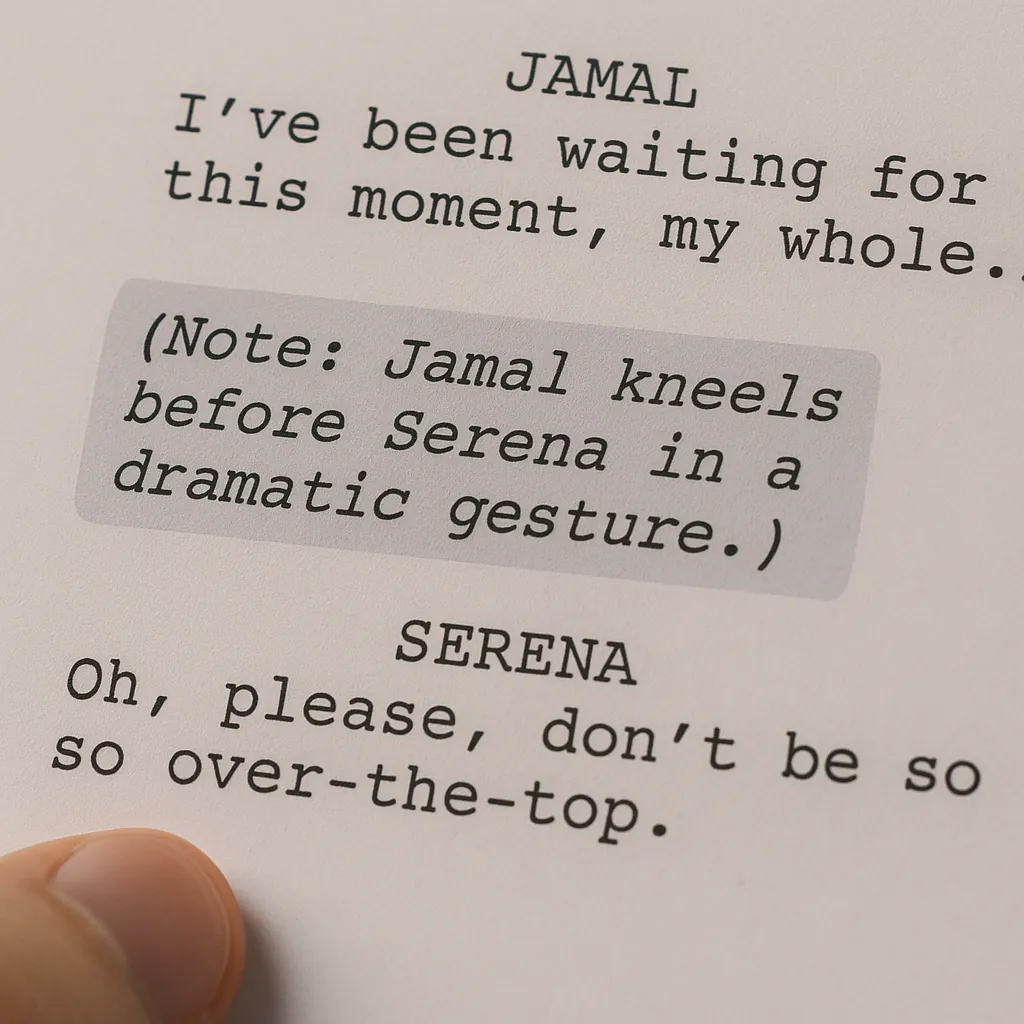
The screenplay elements are the standard building blocks every script is made of: scene heading, action, character name, dialogue, parenthetical, extension, transition and shot. Most pages use only the first four. The others (transitions, parentheticals, extensions like V.O. and O.S., shots, and special formats such as intercuts and on-screen text) do small, specific jobs, and the skill is knowing when to use them and when to leave them out.
What are the elements of a screenplay?
A screenplay has eight core elements, each with its own position on the page and its own purpose. Screenwriting software treats each one as a separate style, which is why a script stays readable and why one page holds roughly a minute of screen time.
| Element | What it does | Example |
|---|---|---|
| Scene heading | Says where and when the scene takes place | INT. RADIO STATION - STUDIO B - NIGHT |
| Action | Describes what we see and hear | KENJI (60s) slides a fader up. The ON AIR light blinks red. |
| Character | Names who speaks, in caps, above the dialogue | WREN |
| Dialogue | What the character says | You're three minutes over. |
| Parenthetical | A short note on how a line is said or who it is said to | (into the mic) |
| Extension | Shows where the voice comes from | KENJI (V.O.), WREN (O.S.) |
| Transition | Marks a notable cut or change between scenes | DISSOLVE TO: |
| Shot | Calls a specific shot when the story depends on it | INSERT - THE CALL LOG |
Scene headings and action have their own guides: scene headings explained and how to write action lines. This guide covers the rest.
What are transitions, and when should you use them?
A transition is an instruction about how one scene moves to the next. It sits on the right side of the page, in caps, ending with a colon. Since every new scene heading already implies a cut, most modern spec scripts use very few transitions and save them for moments where the change itself means something.
| Transition | What it signals | When writers use it |
|---|---|---|
| FADE IN: | The film begins | The first line of the script, at the left margin |
| CUT TO: | A straight cut | Rarely needed; sometimes to stress a contrast |
| SMASH CUT TO: | An abrupt, jarring cut | Calm to chaos, or a punchline |
| MATCH CUT TO: | A visual link between two shots | A spinning record becomes a spinning car wheel |
| DISSOLVE TO: | One image blends into the next | A passage of time |
| INTERCUT WITH: | Two locations shown back and forth | Phone calls and parallel action |
| FADE OUT. / FADE TO BLACK. | The film or a major section ends | The last line of the script |
A good test: if you removed the transition, would the reader miss anything? If not, cut it. For phone calls, INTERCUT saves you from writing a new scene heading for every line.
What is a parenthetical, and how do you use one?
A parenthetical is a short note in brackets, on its own line under the character name or between lines of dialogue, that tells the reader something the words alone would not. It is lowercase, a few words long, and has no full stop.
Parentheticals are useful in four situations:
- Tone that would otherwise be misread. "(meaning it)" before a line that looks sarcastic on the page.
- Who the line is aimed at. "(to the caller)" when several people are in the room.
- A small action during the line. "(pocketing the key)". Anything bigger belongs in an action line.
- Language. "(in Japanese)" or "(in Japanese, subtitled)".
Avoid stacking them or using them to direct the actor on every line. Actors and directors tend to ignore heavy parentheticals, and readers find them cluttered. Never end a dialogue block with a parenthetical; if something happens after the line, write it as action. The parenthetical glossary entry has more examples.
What do V.O., O.S. and CONT'D mean?
These are character extensions: short labels in brackets after the character name that tell the reader where the voice is coming from.
| Extension | Meaning | Example |
|---|---|---|
| (V.O.) | Voice over: the speaker is not physically in the scene, such as narration, a voice on a phone or radio, or a recorded message | CALLER (V.O.) heard through Kenji's headphones |
| (O.S.) | Off screen: the speaker is in the location but out of frame | WREN (O.S.) calling from the corridor |
| (O.C.) | Off camera: an older equivalent of O.S., still seen in some TV scripts | WREN (O.C.) |
| (CONT'D) | The same character keeps speaking after a break, such as an action line or a page break | KENJI (CONT'D) |
| (PRE-LAP) | Dialogue from the next scene is heard before we cut to it | WREN (PRE-LAP) |
The difference between V.O. and O.S. is about presence: O.S. means the character could walk into frame; V.O. means they could not. When a speech breaks across a page, the first part ends with (MORE) and the next page repeats the name with (CONT'D). Screenwriting software adds both for you. Narration has its own guide: writing voiceover and narration.
What are shots, inserts and on-screen text?
Shot elements name a specific shot. In a spec script they should be rare, because choosing shots is the director's job. Use one when the story would not make sense without it.
- INSERT. A close view of an object the audience must read or notice: INSERT - THE CALL LOG, followed by the detail, then BACK TO SCENE.
- POV. What a character sees: KENJI'S POV - THE PARKING LOT. Use it when the story depends on what one person can or cannot see.
- CLOSE ON / ANGLE ON. Common in older scripts and shooting scripts. In a spec, you can usually get the same effect with a short action line about the detail itself.
- SUPER or TITLE CARD. Text that appears on screen: SUPER: "Osaka, 1987." Write the text exactly as it should appear.
- Dual dialogue. Two characters speaking at the same time, set in two columns side by side. Use it for genuine overlap, not for quick back and forth.
What does a page with several elements look like?
Here is a short moment from a late-night radio show, with each line labeled by element.
| Line on the page | Element |
|---|---|
| INT. RADIO STATION - STUDIO B - NIGHT | Scene heading |
| KENJI (60s, cardigan, reading glasses on a cord) slides a fader up. The ON AIR light blinks red. | Action |
| KENJI | Character |
| (into the mic) | Parenthetical |
| Line four. You're on the air. | Dialogue |
| CALLER (V.O.) | Character with extension |
| Is this still the show where you play what we ask for? | Dialogue |
| A knock on the glass. WREN (30s, producer, headset around her neck) holds up three fingers. | Action |
| WREN (O.S.) | Character with extension |
| Three minutes over, Kenji. | Dialogue |
| INSERT - THE CALL LOG | Shot |
| Line four: no number. Duration: 00:00. | Action |
| BACK TO SCENE | Shot |
| DISSOLVE TO: | Transition |
The caller is heard through the board, so it is V.O. Wren is in the corridor behind the glass, so it is O.S. The insert is there because the empty call log is the twist of the scene; without it, the reader would miss the point. The dissolve marks the night passing.
What are common mistakes with screenplay elements?
- CUT TO: after every scene. It adds lines and tells the reader nothing new.
- Parentheticals doing the actor's job. "(angrily)", "(sadly)", "(with a sigh)" on line after line.
- Action hidden in parentheticals. "(she crosses the room, opens the window and looks out)" should be an action line.
- Mixing up V.O. and O.S. A character shouting from the next room is O.S., not V.O.
- Directing the camera in a spec. A run of CLOSE ON, ANGLE ON and PAN TO makes the page read like a shot list.
- Formatting elements by hand. Tabbing dialogue into place in a word processor leads to drifting indents and missing (MORE) and (CONT'D) labels.
Formatting screenplay elements in Lowerated
Lowerated's Scriptwriter places scene headings, action, character names and dialogue in industry standard format as you type, so you can think about which element a moment needs instead of where its indent goes. If you already have a script, you can import it from Final Draft, Fountain, Celtx or PDF and keep writing where you left off.
The recording shows a scene typed into the editor, with each element formatted as it is written.
FAQ
Do I need to write FADE IN: at the start of a screenplay?
It is traditional and most scripts still open with it, but it is optional. Many writers also end with FADE OUT. or FADE TO BLACK.
How many parentheticals is too many?
There is no fixed number. If you see one on most dialogue blocks on a page, cut the ones the line already makes clear.
Is CONT'D still required?
(MORE) and (CONT'D) across a page break are standard. Using (CONT'D) when a character speaks again after an action line is optional; many current writers leave it out.
Can I use camera directions in a spec script?
Sparingly. Use an insert or POV when the story depends on it, and leave other shot choices to the director.
Key takeaways
- Most of a screenplay is scene headings, action, character names and dialogue.
- Use transitions only when the change between scenes carries meaning.
- Keep parentheticals short, lowercase and rare; put physical action in action lines.
- V.O. means the speaker is not in the scene; O.S. means they are there but out of frame.
- Call specific shots only when the story would not work without them.