Parenthetical: What It Means in Filmmaking


By Muhammad Wisal and Muhammad Ali / 2 min read
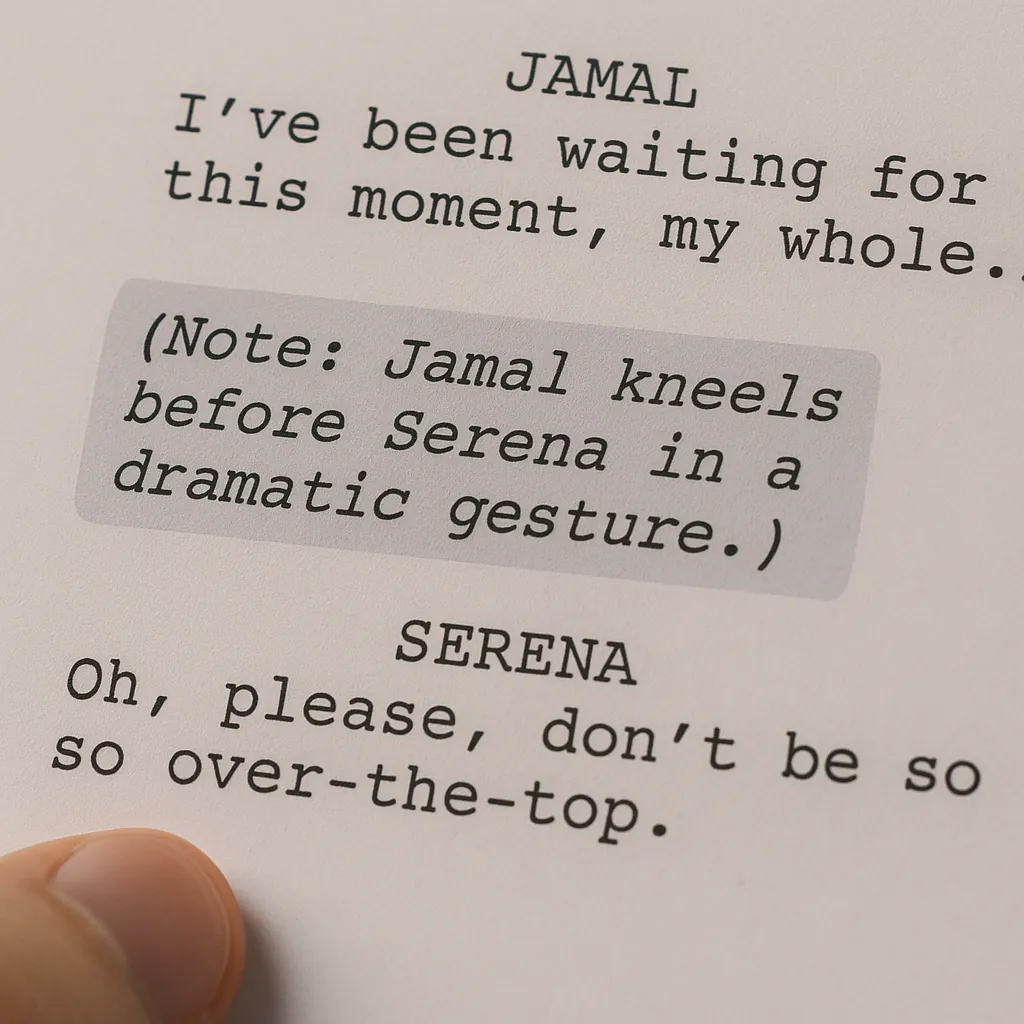
A parenthetical is a short direction in brackets placed under a character's name in a screenplay, telling the reader how a line is said or who it is said to.
What does parenthetical mean?
A parenthetical (sometimes called a "wryly," after an old example) sits between the character cue and the dialogue, or between two pieces of the same speech. It is indented, written in lowercase, and kept to a few words. Its job is to clear up something the reader could otherwise get wrong: a line that reads as sincere but is sarcastic, a line spoken to one person in a group, a line in another language, or a small action that happens mid-speech, such as "(beat)" or "(into phone)."
Use them sparingly. Actors and directors tend to dislike parentheticals that dictate emotion on every line, because the performance should come from the scene. If the dialogue and the action lines already make the tone clear, the parenthetical is extra. A useful test: delete it and see whether the line could be misread. If not, leave it out. Longer actions belong in an action line, not in brackets. For more on where each element goes, see how to format a screenplay.
Example: parentheticals in a scene
In this excerpt from a short film called Night Ferry, Odile and her brother Kasim are driving to catch the last boat.
INT. ODILE'S CAR, MOVING. NIGHT
Rain hammers the windshield. Kasim checks the time on his phone.
KASIM
(not looking up)
Eleven minutes.ODILE
I can count.
(beat)
Is the ticket printed?KASIM
(to the phone)
Come on, load.
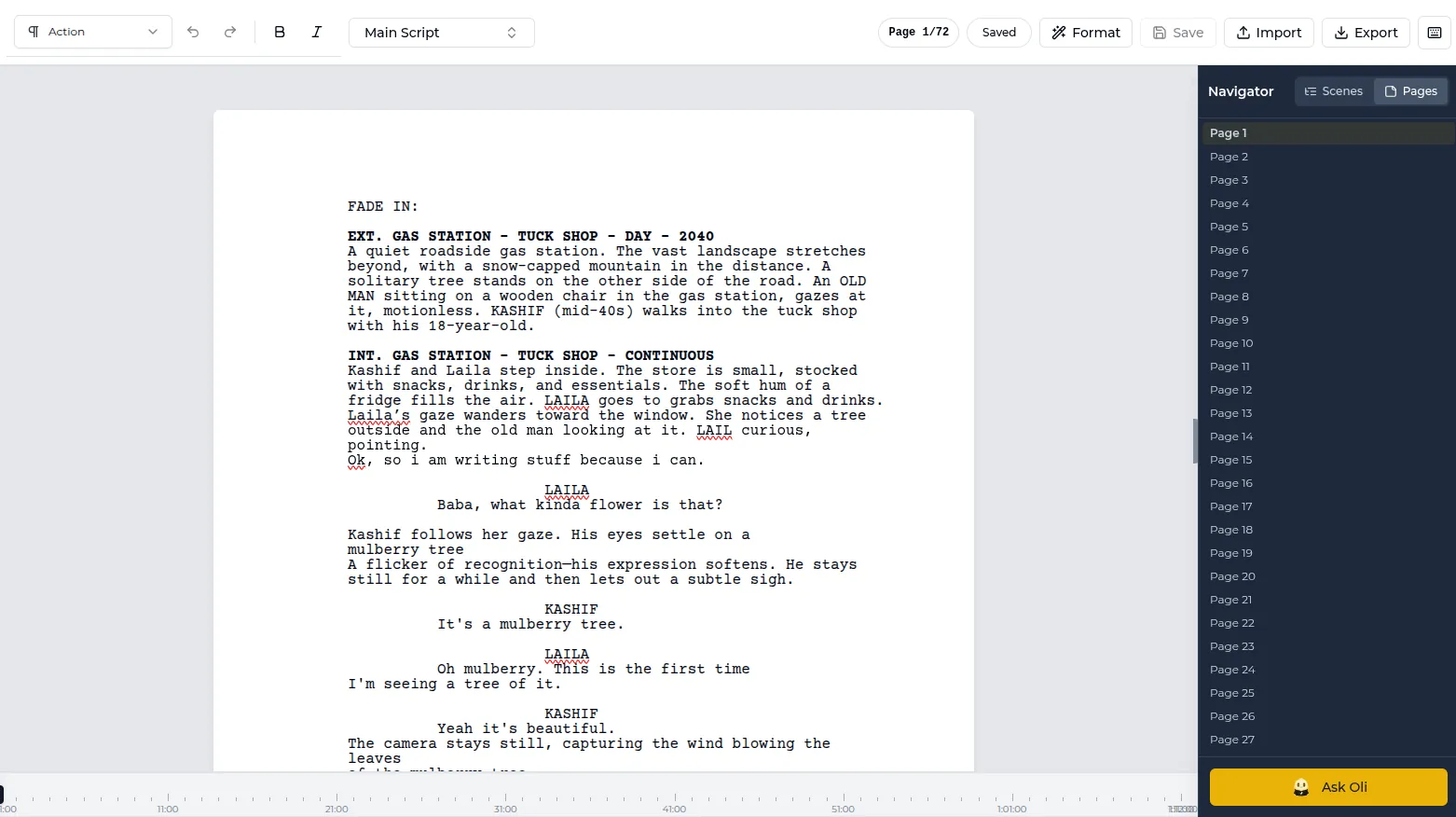
Each one earns its place. "(not looking up)" tells us Kasim is focused on the phone, "(beat)" marks a pause that changes the subject, and "(to the phone)" makes clear he is not talking to Odile. A weak version would add "(angrily)" to "I can count," when the words already carry the tone. A screenwriting app handles the indents for you; in Lowerated's editor, character names, parentheticals and dialogue fall into standard format as you type.
Related terms
- Character cue: the character's name in capitals above their dialogue.
- Extension: a tag beside the name, such as (V.O.) or (O.S.), showing where the voice comes from.
- Action line: the description of what we see and hear.
- Beat: a short pause, often written as a parenthetical.
For the full list of script elements, read screenplay elements, and for making lines work without stage directions, see how to write dialogue.
FAQ
Can a parenthetical end a block of dialogue?
Conventionally, no. A parenthetical comes before a line of dialogue. If something happens after the last line, write it as an action line.
Is "V.O." a parenthetical?
No. (V.O.) and (O.S.) are character extensions and sit on the same line as the character's name, while parentheticals go on their own line underneath.