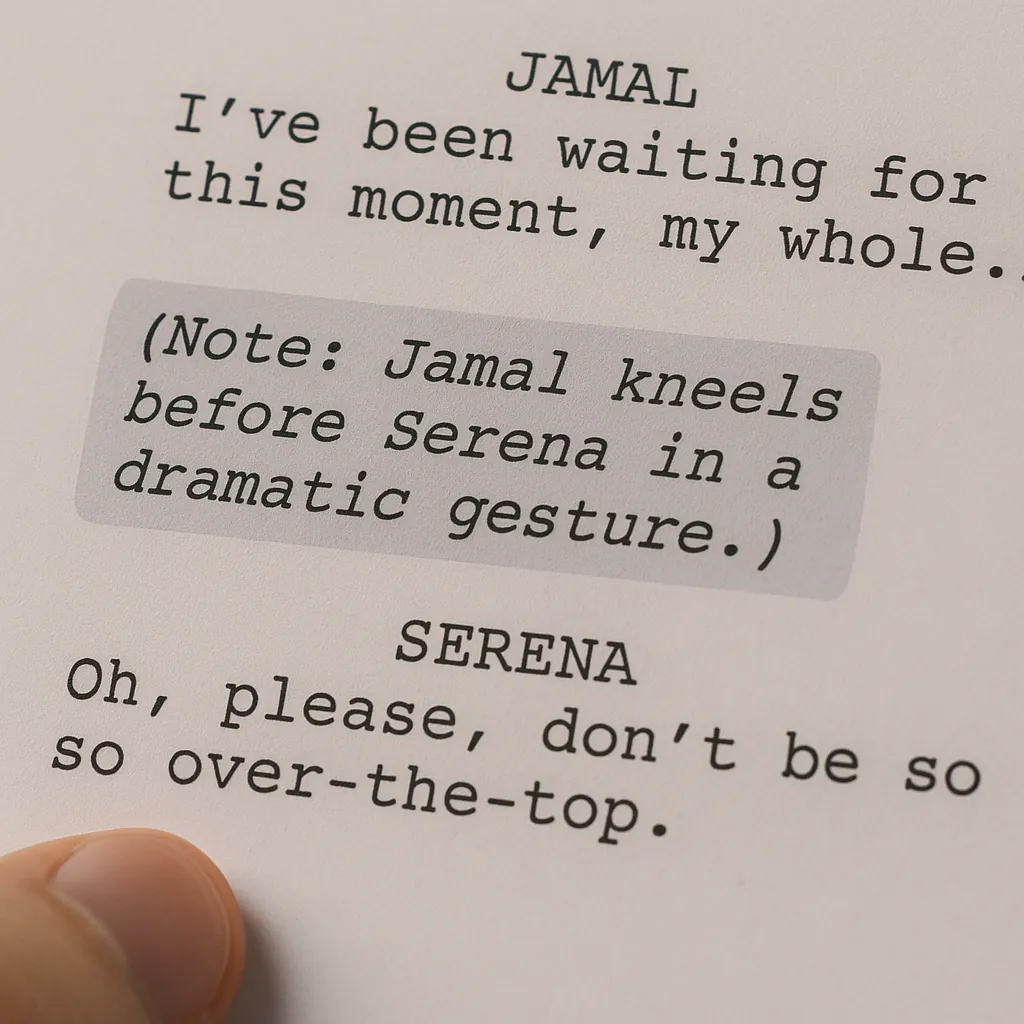
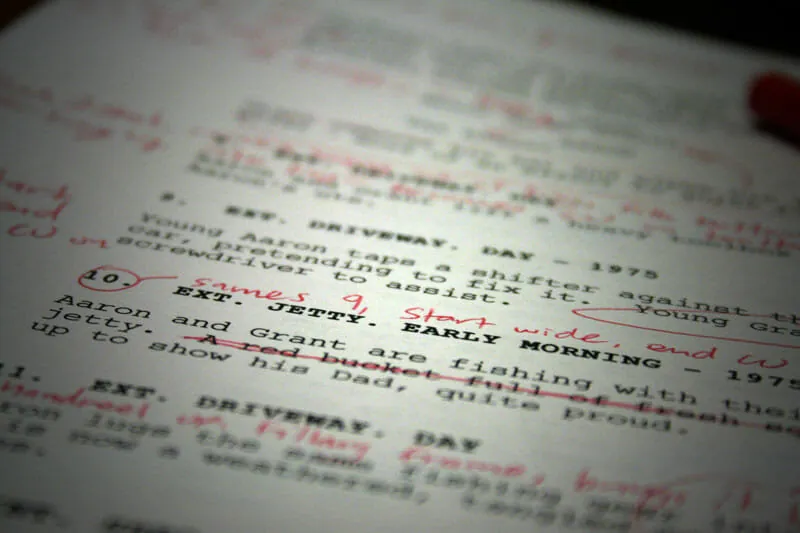
Writing Voiceover and Narration in a Screenplay


By Muhammad Wisal and Muhammad Ali / 7 min read
To write voiceover in a screenplay, put the character extension (V.O.) after the speaker's name in the character cue, then write the line as normal dialogue. Use (V.O.) when the voice comes from somewhere outside the scene, such as a narrator, a recorded message or a character's thoughts, and use (O.S.) when the speaker is physically present in the scene but off camera.
What does V.O. mean in a screenplay?
V.O. stands for voiceover: a voice the audience hears that does not come from anyone physically speaking in the scene's space at that moment. The extension sits in parentheses on the same line as the character name, and the dialogue below it is formatted like any other dialogue. Common uses are narration, inner thoughts, a voice heard over a phone or radio, a letter read aloud, and a voice carried over from the previous scene.
The extension tells three people something different. The reader learns the voice is not part of the action. The director knows not to put the speaker on screen. The sound team knows the line will most likely be recorded separately, often in a booth after the shoot, and mixed in post.
What is the difference between V.O. and O.S.?
The test is location. If the character is in the scene's physical space but we cannot see them, use (O.S.), for off screen. If the voice comes from outside the space or outside time, use (V.O.). Some scripts, mostly in television, use (O.C.) for off camera in place of (O.S.); they mean the same thing.
| Situation | Extension | Why |
|---|---|---|
| A mother shouts from the kitchen while the camera stays on her son in the hall | (O.S.) | She is in the house, only out of frame |
| An older version of the hero narrates over childhood scenes | (V.O.) | The voice comes from a different time |
| We hear what a character is thinking while her lips stay still | (V.O.) | The voice is internal, so no one in the room hears it |
| A voicemail plays on a speaker in the room | (V.O.) | A recording, not a person present |
| A character knocks and talks through a closed door | (O.S.) | The speaker is right there, behind the door |
| A pilot's voice comes over the cabin intercom | (V.O.) | Heard through a device from another space |
Phone calls have their own conventions, including when to intercut both ends of the line. They are covered in how to format phone calls and texts in a script.
How do you format a voiceover in a script?
Format it as regular dialogue with the extension added to the cue. The character name is in caps, the extension follows in parentheses, and the dialogue sits in the dialogue column below. You can still use a parenthetical under the name if the delivery needs a note.
Here is a short example from an invented drama about a lighthouse keeper's daughter. The narrator is the daughter as an adult.
EXT. LIGHTHOUSE GALLERY - NIGHT
Wind. Eleven-year-old ISLA grips the rail as her father, TOMAS (50s), trims the wick of the great lamp.
ISLA (V.O.)
My father believed the light was a promise. Every ship out there was owed one.
Tomas glances down at the black water. He checks his watch twice.
ISLA (V.O.) (CONT'D)
That winter, I learned he was waiting for one ship in particular.
(Indentation is simplified here. In a real script the cue is indented toward the center of the page and the dialogue sits in a narrower column.)
Two details in that example matter. First, the voice is introduced with a name the reader already knows, so there is no confusion about who is speaking. If the narrator has not appeared yet, describe the voice once in action: "A WOMAN'S VOICE, warm and tired, the adult Isla." Second, (CONT'D) appears because the same voice continues after an action line. Many writers and software add it automatically; some drop it entirely. Either way, be consistent.
How do you write a character's thoughts?
Use (V.O.) on the character's own name while they are on screen and silent, and make sure the action makes clear their lips are not moving if there is any chance of confusion. A short line such as "She says nothing. In her head:" works the first time; after that, the reader understands the convention.
Use thought voiceover sparingly. A film shows thoughts best through behavior: what a character looks at, what they almost say, what they do with their hands. If the inner voice only states what the actor's face already shows, cut it. Keep it for moments where the thought contradicts the action, which is where it earns its place. For more on writing what goes unsaid, see subtext in screenwriting.
When does narration work, and when does it hurt a script?
Narration works when it adds something the images cannot carry alone. Well known films that rely on it, such as Goodfellas, The Shawshank Redemption and Sunset Boulevard, use the voice to supply attitude, irony or hindsight. The narrator knows more than the scene shows, or feels differently about it than we expect. The film Adaptation even jokes about the common advice to avoid voiceover, then uses it throughout.
Narration tends to hurt a script in these cases:
- It describes the picture. "I walked into the bar. It was crowded." The audience can see that.
- It patches a story problem. If a scene needs narration to explain why a character acts, the scene itself usually needs work.
- It appears once and vanishes. A narrator who speaks on page 1 and then not until page 85 feels like a fix. Set the pattern early and return to it at steady points.
- It summarizes a scene we then watch. Narration and the scene end up telling the same beat twice.
- It runs long. Big blocks of narration read like prose. Keep lines short, as you would with any dialogue.
Should narration be written as V.O. or as a NARRATOR cue?
If the narrator is a character in the story, use their name with (V.O.). If the voice belongs to no one in the story, such as an unseen storyteller, the cue NARRATOR (V.O.) is the usual choice. Avoid switching between the two for the same voice. A reader who sees ISLA (V.O.) on page 1 and NARRATOR on page 4 will assume a second voice has entered.
If the narrator appears on screen at some point, introduce them in action the first time they appear physically, in caps with an age, the same way you would any new character. After that, their V.O. lines and on-screen lines share one name.
What are common voiceover mistakes?
- Using (V.O.) for a character who is in the next room. That is (O.S.).
- Writing "VOICEOVER:" or "NARRATION:" inside the action line instead of using a character cue.
- Putting the extension on its own line under the name instead of beside it.
- Giving the same voice two different names across the script.
- Letting the narrator explain jokes, twists or feelings the scene already lands.
- Forgetting that every V.O. line usually means a separate recording, which matters on a tight budget.
For the full set of extensions, transitions and other elements, see transitions, parentheticals and other screenplay elements.
How to write voiceover in Lowerated
The Lowerated script editor formats the main screenplay elements as you type: scene headings, action, character names and dialogue fall into industry standard format, so you can stay on the story. Voiceover is dialogue with an extension on the cue, so you write it in the same flow.
When you are unsure whether a narration line earns its place, you can ask Oli without leaving the page. Oli knows your script, so you can ask about a character, a scene or a plot hole and get an answer that fits your story.
The clip shows a writer asking Oli about the script without leaving the editor.
FAQ
Is V.O. the same as narration?
Narration is one use of V.O. The extension also covers thoughts, recordings, letters read aloud and voices heard through devices.
Do I need (CONT'D) on voiceover?
It is common when the same voice continues after an action line, but it is optional. Pick one approach and use it throughout the script.
Can a voiceover line include a parenthetical?
Yes. Put it under the cue as you would for any dialogue, for example (quietly) or (reading). Keep it short.
Should I italicize voiceover dialogue?
Not usually. The extension already tells the reader the line is voiceover. Some writers italicize foreign language or song lyrics, which is a separate convention.
Key takeaways
- Write (V.O.) beside the character name when the voice comes from outside the scene's space or time.
- Use (O.S.) for a speaker who is present in the scene but out of frame.
- Give each voice one name for the whole script, and introduce unknown voices in action.
- Narration should add hindsight, irony or contrast, never repeat what we can see.
- Set a narration pattern early and keep returning to it.