Writing With a Screenwriting Partner: How Co-Writing Works


By Muhammad Wisal and Muhammad Ali / 5 min read
Co-writing a screenplay means two writers share one story, one draft and one credit. Most partnerships work by agreeing on the outline together, then splitting the writing by scenes or by passes, and rewriting each other's pages until the script reads in one voice. The partnerships that last also agree early, in writing, on credit, ownership and what happens if they split.
How does co-writing a screenplay actually work?
Co-writing works best when the story decisions are made together and the typing is divided. Two people trying to write the same sentence at the same time is slow. Two people who agree on what each scene must do, then take turns drafting and rewriting, can move faster than one writer alone, because each partner catches the other's blind spots.
Almost every partnership shares three stages. First, you break the story together: premise, characters, the major turns and an outline scene by scene. Second, you draft. Third, you rewrite each other's pages so the voice evens out.
What are the main ways to split the writing?
There is no single right method. Here are the common ones and when they suit.
| Method | How it works | Suits | Risk |
|---|---|---|---|
| Split by scenes | Each partner drafts alternate sequences from the shared outline, then swaps | Partners in different cities or schedules | Two voices until the rewrite pass |
| Draft and rewrite | One partner writes the whole first draft, the other does the full rewrite | Partners with clearly different strengths | The drafter can feel overwritten |
| Same room | One types while both talk each line through | Dialogue-heavy comedy, tight deadlines | Slow and tiring for long stretches |
| Alternating passes | Each partner takes the whole script for a pass, then hands it back | Later drafts and polishes | Long gaps if one partner is busy |
| Split by strength | One owns structure and action, the other owns dialogue | Partners who know their skills well | Scenes where the two blur |
Many teams combine methods: split by scenes for the first draft, then alternating passes for the rewrite.
How do you choose a screenwriting partner?
Choose someone whose taste you share and whose work ethic matches yours. Skill matters, but most partnerships end over pace, commitment or credit, not talent. Before you commit to a feature, test the partnership on something small.
- Write a short first. A five to ten page short film script shows how you handle disagreement and deadlines.
- Read each other's solo work. You should like it, and you should be able to say clearly what you would change.
- Compare goals. Is this a spec to sell, a script to direct yourselves, or a contest entry? Different goals pull a script apart.
- Compare schedules. A partner who can write two evenings a week and one who writes every morning will both get frustrated.
What should a co-writing agreement cover?
Put your agreement in writing before you start drafting. It does not need to be long, and it is far easier to agree while you are still friends than after a sale or a split. Have a lawyer review it if money is involved, because rules on ownership and copyright vary by country.
- Ownership. Usually an equal split of the script and any income from it.
- Credit and name order. In US guild practice, an ampersand ("Written by Lena Ost & Marcus Hale") signals a team that wrote together, while "and" signals writers who worked separately. Agree on whose name goes first.
- Decision-making. Who has the final say on a disputed scene, or how you break a tie.
- Exit terms. If one partner leaves, can the other keep developing the script, and what does the departing partner keep?
- Expenses. How contest fees, registration and printing are shared.
- Directing or producing rights. If one partner wants to direct, say so now.
What does a co-writing workflow look like week by week?
Here is an example plan for two writers, Lena and Marcus, writing a 100 page thriller called "Glasshouse" around day jobs.
| Week | Lena | Marcus | Together |
|---|---|---|---|
| 1 to 2 | Character notes | Research and logline options | Two calls to break the story |
| 3 | Outline act one | Outline acts two and three | Merge outline, agree on the ending |
| 4 to 7 | Draft Sc. 1 to 20 and 41 to 60 | Draft Sc. 21 to 40 and 61 to 80 | Weekly call on problems found while drafting |
| 8 to 9 | Rewrite Marcus's scenes | Rewrite Lena's scenes | Read the whole draft aloud |
| 10 | Dialogue polish | Format and proofread | Send to readers |
Swapping scenes in weeks 8 and 9 is what turns two voices into one script.
What are common co-writing mistakes?
- Starting a feature without testing the partnership on a short.
- Leaving credit and ownership "for later".
- Emailing versions back and forth until nobody knows which file is current.
- Rewriting a partner's scene silently instead of leaving a note explaining the change.
- Keeping score of who wrote more pages. Shared credit means shared ownership of every page.
- Avoiding hard notes to protect the friendship, so weak scenes survive.
For more on how teams divide the work, read how screenwriters collaborate on a script. When your draft is ready for outside readers, see how to get feedback on your screenplay.
How to co-write a script in Lowerated
In Lowerated, partners work in the same script at the same time, see each other's changes as they happen, and leave notes on scenes, so you stop emailing versions back and forth.
- Create the project and invite your partner to the script.
- Each of you drafts your agreed scenes in the same file.
- Leave notes on scenes instead of rewriting a partner's lines without comment.
- Save a draft at each milestone, so you can return to any earlier version.
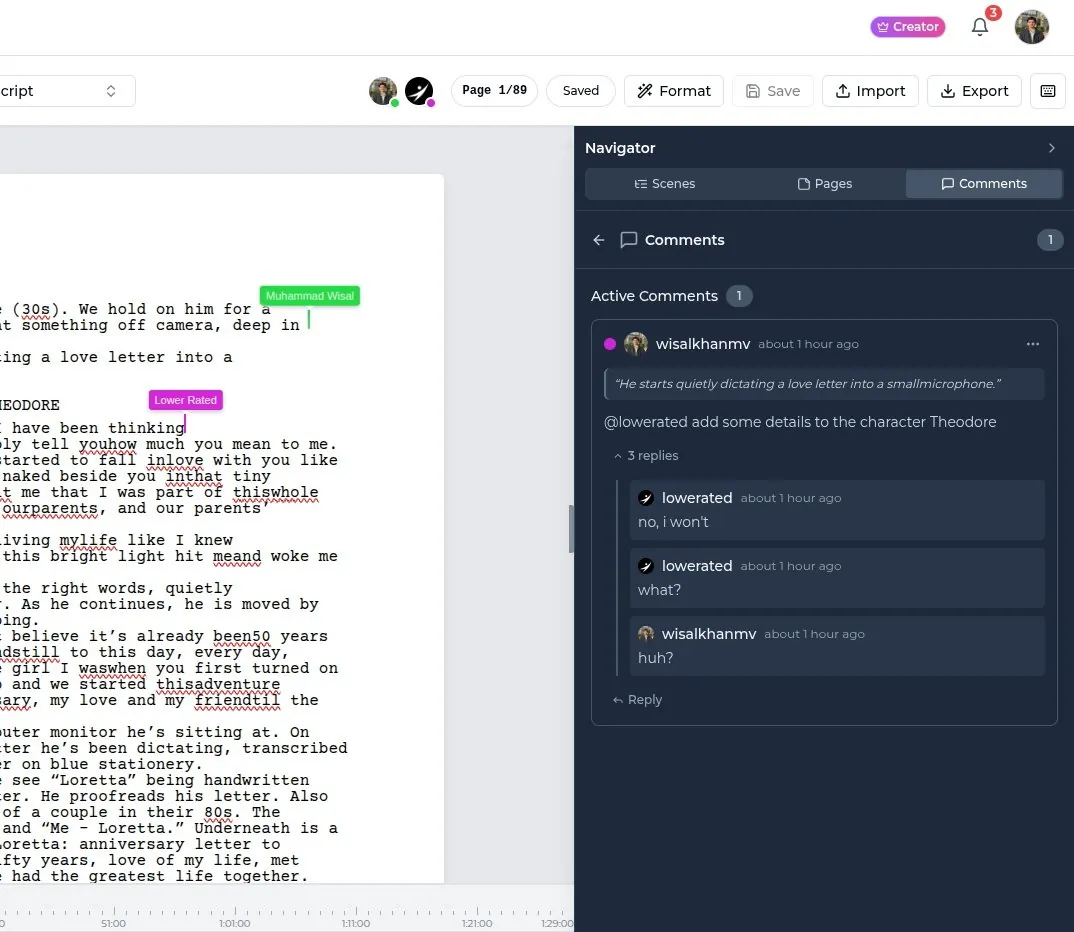
The clip shows two writers working in the same script at once, seeing each other's changes and leaving notes on scenes.
FAQ
How do co-writers split credit?
Teams usually share credit equally and agree on name order in advance. In US guild practice, an ampersand between names marks a writing team.
Can co-writers work remotely?
Yes. Agree on the outline together on a call, split scenes, and work in one shared script so there is only ever one current version.
What if we disagree about a scene?
Try writing both versions and reading them aloud. If you still disagree, use the tie-break rule from your agreement.
Do we need a written agreement for a short film?
It is still wise. A one page note on ownership, credit and exit terms prevents problems if the short does well.
Key takeaways
- Break the story together, divide the drafting, then rewrite each other's pages.
- Test a partnership on a short script before a feature.
- Agree in writing on ownership, credit, decisions and exit terms before you start.
- Keep one shared, current version of the script and leave notes instead of silent rewrites.